
By Halco Trailers Team, Trailer Manufacturing / Safety Specialist
Trailer tie down points work best when they match the load, restraint method and trailer structure. For equipment transport, look for rated anchors, sensible placement, easy access, durable mounting, suitable capacity and a layout that lets you restrain equipment from multiple directions.
A tie-down point can look strong without actually being suitable for the load you are carrying. The important question isn’t simply, “How many points does this trailer have?” It is whether the points, restraints, trailer structure and load work together.
For a landscaper carrying a mower, a builder moving compact machinery, a farmer transporting equipment or an automotive business moving a vehicle, the restraint requirements can be very different.
According to the National Transport Commission’s Load Restraint Guide for Light Vehicles, loads must be properly restrained and the restraint system must suit the particular load. The NTC also explains that the number of lashings required depends on factors such as load weight and shape.
This guide explains the 10 features worth considering when choosing or specifying a trailer for equipment transport in Australia.
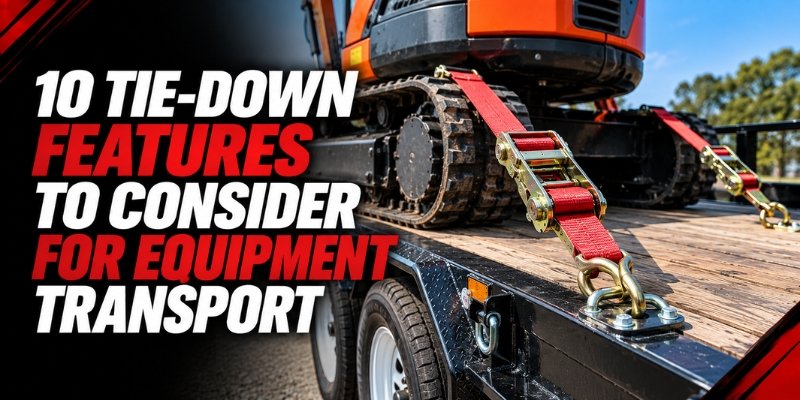
What are the 10 tie-down features to consider for equipment transport?
The best trailer tie-down features combine rated anchor points, strong structural attachment, useful positioning, multiple restraint directions, easy access, suitable hardware, corrosion resistance, load compatibility, inspection access and future flexibility for changing equipment transport requirements.
1. Rated and identifiable anchor points
The first feature to look for is a known load rating. A tie-down ring, rail or anchor should not be treated as suitable simply because it is made from heavy-looking steel.
According to the NTC, rated restraint equipment has been tested by its manufacturer for a stated capacity, and the capacity should be known before it is used. The NTC also notes that the tension in a lashing must not exceed the manufacturer’s stated lashing capacity.
The trailer point itself also needs to be considered as part of the complete restraint system. A strap might have a high rating, but that does not make an inadequately mounted anchor suitable.
What to check:
- Is the point rated or documented?
- Is the rating suitable for the intended restraint equipment?
- Is the rating easy to identify?
- Does the trailer manufacturer specify how the point should be used?
2. Strong structural attachment
The second feature is how the point connects to the trailer.
A D-ring welded or bolted into an appropriate chassis member is fundamentally different from a light-duty hook attached only to a thin panel. The restraint point needs to work with the trailer structure rather than simply being attached somewhere convenient.
Look for sound welds, suitable brackets, backing structure where required and no visible cracking or distortion.
3. Practical positioning
A restraint point should be positioned where it can actually be used with the load.
A point hidden behind a toolbox, directly beneath a machine or too close to a side rail can become difficult to use. The result is often an awkward strap angle or an operator attaching the restraint somewhere that was never intended for it.
Halco’s custom trailer approach considers dimensions, loading access, ramps, storage and tie-down points as part of one complete trailer specification.
4. Restraint from multiple directions
Equipment can move forwards, backwards and sideways during transport. Your restraint layout should therefore give you practical options for controlling movement in the directions that matter for the load.
The NTC distinguishes between tie-down restraint and direct restraint. Direct restraint can be particularly useful for unstable, slippery, offset or wheeled loads because the load is attached directly to the vehicle or trailer.
5. Easy access when loaded
A good anchor point is useful only if you can safely reach it.
Think about the actual loading process. Will the machine be driven onto the deck? Will ramps cover the rear points? Will a pallet or attachment block access? Can the operator attach the chain without reaching underneath the equipment?
For daily commercial use, accessibility can be as important as the number of points.
6. Compatibility with straps and chains
Different loads may require different restraint equipment.
The NTC identifies webbing straps, chains, ropes and other restraint equipment as possible options, with the appropriate method depending on the load. It notes that chains are particularly suited to heavy or unstable loads, while ropes are recommended only for suitable light loads when properly rated.
A trailer intended for machinery should therefore provide points that work with the restraint equipment you actually use.
7. Protection against abrasion and damage
Restraint equipment can be damaged by sharp edges, rough surfaces, exposed steel and moving machinery.
The NTC recommends protecting webbing straps and other restraint equipment from sharp or rough surfaces.
When specifying a trailer, consider whether the point location allows the chain or strap to sit naturally without rubbing against sharp deck edges, machine components or corners.
8. Corrosion resistance
Tie-down points spend their working life underneath equipment, around wet decks and near road grime.
A trailer used for landscaping, farming or construction can see mud, water, fertiliser, soil, gravel and chemicals. A coastal trailer can also experience salt exposure.
Inspect for:
- Rust around welds
- Corrosion around bolts
- Thinning metal
- Cracked coatings
- Distorted rings
- Rust trails around mounting points
A heavily corroded restraint point should not be assumed safe simply because the ring itself still looks intact.
9. Good visibility for inspection
You should be able to see the point and its mounting area.
This matters because damage often starts around the mounting structure rather than the visible ring. A hidden point may make it harder to spot a cracked weld, stretched metal or corrosion.
For work trailers, visible points also make pre-trip inspections easier. If operators can see the condition quickly, they are more likely to notice a problem before loading.
10. Enough flexibility for future loads
A trailer may start by carrying one machine and later be used for another.
If the deck is designed around one exact load, restraint points can become restrictive when the equipment changes. Multiple usable positions or rails can provide greater flexibility, provided they are properly rated and integrated into the design.
Halco’s custom trailer service allows customers to discuss tie-down and load-restraint points alongside the cargo dimensions, loading method, ramps and other equipment requirements.
10-feature comparison table
Feature | What to look for | Why it matters |
Rated anchor | Known capacity | Helps match restraint equipment to the load |
Structural mounting | Strong connection to trailer structure | Restraint forces need to transfer safely |
Positioning | Useful locations around the load | Improves restraint geometry |
Multi-direction control | Front, rear and side options | Helps control different movement directions |
Access | Easy to reach when loaded | Reduces awkward restraint setups |
Compatibility | Works with suitable straps/chains | Supports the correct restraint method |
Abrasion protection | Clear path for restraints | Reduces damage to straps and equipment |
Corrosion resistance | Protected steel and sound hardware | Helps maintain long-term condition |
Visibility | Easy to inspect | Makes damage easier to detect |
Flexibility | Multiple useful positions | Helps with changing equipment |
How do trailer tie-down points support trailer loading safety?
Trailer tie-down points support trailer loading safety by giving suitable restraints a controlled attachment location. They help prevent equipment from shifting during acceleration, braking, cornering and uneven-road travel when correctly matched to the load and restraint system.
Transport Victoria states that loads must be properly restrained and that the responsibility for choosing the appropriate restraint method depends on the load. It recommends suitable equipment such as webbing straps, chains, cargo nets or tarpaulins, with rated equipment used where possible.
This means a restraint point should never be considered separately from:
- The actual load weight
- The load’s shape
- The centre of gravity
- The surface between load and deck
- The direction the load could move
- The restraint equipment
- The trailer’s approved capacity
- The towing vehicle’s capacity
Tie-down versus direct restraint
The NTC explains that tie-down restraint relies on friction created by the load weight and tension in the lashings. Direct restraint attaches, blocks or contains the load and can be particularly useful for difficult loads such as wheeled or slippery equipment.
For example, a compact excavator on a plant trailer is not the same restraint problem as a pallet of boxed products. A wheeled machine can move differently from a static pallet, so the restraint arrangement needs to reflect that.
Lashing angle matters
The NTC states that tie-down lashings are more effective when they are tighter and more vertical, and gives a minimum lashing angle of 35° for effective restraint. It also shows that restraint effectiveness decreases as the lashing angle becomes flatter.
That is why point placement matters.
A trailer with plenty of anchor points can still be poorly configured if every useful point forces the operator to run the strap at an ineffective angle.
What should load restraint points be rated for?
Load restraint points should be suitable for the restraint forces created by the actual load and restraint method, rather than being selected from a generic “heavy-duty” label. The complete system should be checked against manufacturer ratings and applicable Australian requirements.
There is no universal rule that says every trailer needs a particular number of points or that one point can restrain a particular number of kilograms in every application.
According to the NTC, the number of lashings depends on the weight and shape of the load, while rated restraint equipment has a stated capacity.
A practical rating check
Confirm the load mass: use the actual equipment weight, including attachments and items carried with it.
Confirm the restraint method: determine whether you are using tie-down, direct attachment, blocking, containment or a combination.
Check the restraint rating: confirm the manufacturer’s lashing capacity of straps, chains and associated hardware.
Check the anchor rating: the trailer’s restraint point must be suitable for the intended restraint arrangement.
Check the structure: the ring rating alone does not establish the capacity of the surrounding trailer structure.
For unusual machinery, heavy concentrated loads or modified trailers, get the restraint arrangement reviewed by a suitably qualified professional rather than guessing.
For heavy-vehicle operations, the National Heavy Vehicle Regulator’s loading and load-restraint guidance specifically advises that manufacturers should include rated tie-down points for plant and heavy machinery and develop loading plans. Heavy-vehicle requirements can differ from light-trailer applications, so operators should use the rules applicable to their vehicle category.
Where should trailer tie-down points be positioned?
Trailer tie-down points should be positioned so restraints can reach suitable parts of the load without creating excessive angles, sharp bends or interference with ramps, wheels, machinery controls or other trailer components.
Position is one of the biggest differences between a trailer that is easy to load and one that becomes frustrating every day.
A practical layout should consider:
Positioning factor | What to consider |
Front restraint | Can the load be controlled against forward movement? |
Rear restraint | Can rearward movement be controlled? |
Side restraint | Can sideways movement be controlled? |
Load centre | Are restraints positioned around the actual equipment? |
Strap angle | Can restraints achieve an effective angle? |
Access | Can the operator attach them safely? |
Machinery movement | Will suspension, tracks or wheels interfere? |
Ramps | Can ramps be deployed without blocking points? |
Accessories | Do toolboxes or spare wheels obstruct access? |
Future loads | Can different equipment be restrained effectively? |
Example: compact excavator
Imagine a contractor regularly carrying a compact excavator.
The operator needs to position the machine correctly, secure attachments, select suitable restraint equipment and connect the restraints to appropriate trailer points. If the only useful anchor is directly beside a ramp hinge, the strap may rub or sit at a poor angle.
A better design considers the complete loading sequence before fabrication.
Which tie-down features matter for plant, flat-top and car trailers?
The best tie-down arrangement changes with trailer type because machinery, vehicles, pallets and building materials have different shapes, weights and loading methods. Plant trailers need equipment-focused restraint, flat-tops need flexible deck access, and car trailers need vehicle-specific securing options.
Plant trailers
Halco’s plant trailers are designed around machinery transport and can be configured according to machinery dimensions, mass, ramps, axle arrangement and braking requirements.

For a plant trailer, prioritise:
- Multiple suitable restraint positions
- Easy access around machinery
- Strong deck and chassis design
- Ramp compatibility
- Appropriate braking
- Clearance around tracks and wheels
- Attachment points suited to the machine
Flat-top trailers
Halco’s flat top trailers provide an open deck for machinery, pallets, building materials and other cargo that benefits from side or overhead access. Their open layout makes restraint-point positioning particularly important because there are fewer fixed sides to contain cargo.

For a flat-top trailer, consider:
- External restraint access
- Flexible point spacing
- Forklift loading
- Crane or overhead loading
- Long-material restraint
- Removable sides or headboards where applicable
- Protection of straps from deck edges
Car trailers
Halco’s car trailers are designed for vehicle transport and can be configured for different vehicle applications.

Vehicle transport usually requires a restraint system designed around the vehicle’s wheels or approved restraint locations rather than simply wrapping straps around whichever trailer component is closest.
The trailer and vehicle manufacturer’s instructions should take priority.
Equipment transport comparison
Trailer type | Key tie-down priority |
Plant trailer | Machinery-specific restraint and access |
Flat-top trailer | Flexible deck layout and multiple restraint positions |
Car trailer | Vehicle-specific restraint arrangement |
Tandem trailer | Load distribution plus restraint layout |
Lawn mower trailer | Quick access for repeated daily equipment loading |
Tiny-home chassis | Restraint and structural planning around the build stage |
How should you inspect tie-down points before transporting equipment?
Inspect tie-down points before every equipment-transport trip and after rough worksites, impacts or unusual loading. Check the anchor itself, welds, bolts, surrounding chassis, corrosion, deformation and whether the restraint can connect without rubbing or twisting.
A good inspection should take only a few minutes.
- Clean the point before inspection: remove mud, soil, gravel and debris so cracks and corrosion are visible.
- Check the ring or rail for deformation: a bent or stretched point may have already experienced excessive force.
- Inspect welds and brackets: look for cracks, rust lines, broken welds or movement around the mounting.
- Check bolts and fasteners: confirm there are no missing, loose or visibly damaged fasteners.
- Inspect surrounding chassis metal: damage around the point can be more important than damage to the ring itself.
- Check the restraint path: make sure chains and straps will not rub against sharp edges or moving components.
- Check restraint equipment separately: damaged straps, hooks, chains or binders should not be used simply because the trailer point looks sound.
- Recheck after loading: confirm the equipment has not shifted and the restraints remain correctly positioned before departure.
The NTC recommends inspecting restraint equipment before each trip and says damaged or worn restraint equipment should not be used.
Practical inspection frequency
Situation | Recommended check |
Before every equipment trip | Visual and hands-on restraint-point check |
Daily commercial use | Quick operator check before loading |
After rough construction-site travel | Inspect points and surrounding chassis |
After an impact | Stop and inspect before reuse |
After visible corrosion | Detailed inspection |
During scheduled trailer servicing | Include restraint points in the inspection |
After modifying the deck | Confirm restraint layout and structural suitability |
Halco’s trailer inspection guide also includes load-restraint points among the areas that should be checked during a professional trailer inspection.
What mistakes can reduce the effectiveness of tie-down points?
The most common mistakes are using unrated attachment locations, choosing poor strap angles, ignoring load weight, blocking access to points, overloading the trailer, using damaged restraints and assuming more anchor points automatically mean safer equipment transport.
Mistake 1: Using any convenient attachment point
A trailer rail, mudguard bracket or other structural-looking component is not automatically a restraint point.
Use designated or properly engineered points suitable for the load.
Mistake 2: Choosing restraints by appearance
A thick strap or large chain is not enough. Check the manufacturer’s rating and make sure the complete restraint arrangement is appropriate.
Mistake 3: Ignoring strap angle
The NTC’s guidance shows that restraint effectiveness changes substantially as the lashing angle becomes flatter.
Mistake 4: Forgetting attachments
A machine’s bucket, forks, ramps or other attachments can alter the load shape and restraint requirements.
Mistake 5: Treating the trailer’s payload as the machine’s weight
The available payload is affected by the trailer’s tare mass and permanent accessories.
Halco’s trailers for sale in Melbourne guidance notes that permanent additions such as toolboxes, ramps, cages and hydraulic equipment increase tare mass and reduce remaining payload.
Mistake 6: Assuming more points automatically means safer
Ten poorly positioned points are not necessarily better than four well-positioned, appropriately rated points.
The layout must suit the equipment and restraint method.
When should you choose custom load restraint points?
Choose custom load restraint points when standard trailer layouts do not suit the equipment’s dimensions, loading direction, restraint method or daily workflow. Custom positioning is particularly useful for repeat machinery transport, unusual equipment, specialised ramps and changing commercial loads.
Halco’s custom trailer manufacturing process allows restraint points and rails to be considered alongside the cargo, towing vehicle, loading method, ramps, storage and other permanent features.
Custom design makes sense when:
- One machine is transported repeatedly
- Equipment has unusual dimensions
- The machine has limited approved restraint locations
- Ramps interfere with standard points
- The trailer carries different equipment throughout the week
- A business needs consistent loading procedures
- Operators need points accessible from both sides
- The trailer is being designed from scratch
Example: landscaping business
A landscaping company might transport a mower, compact loader, attachments, fuel containers and hand tools.
A generic trailer may technically carry the equipment, but a custom layout can make the daily workflow much better:
- Mower loading ramp positioned correctly
- Tie-down points accessible around the machine
- Toolboxes located away from restraint paths
- Attachment storage separated from the primary machine
- Appropriate deck dimensions
- Space for additional restraint equipment
That is the difference between buying a trailer that can carry something and designing a trailer around how your business actually works.
How much do trailer tie-down points cost in Australia?
The cost of tie-down hardware varies significantly by type, material, rating and installation method. A basic anchor can cost only a few dollars, while heavy-duty rated hardware, rails, structural reinforcement and custom fabrication can add substantially more.
For a current retail reference, Bunnings lists a GRUNT Heavy Duty Anchor Point 2 Pack at $9.20, while its GRUNT Heavy Duty Tie Down Anchor Point is listed at $21.98 each at the time checked. These are hardware examples only, not fitted trailer pricing.
The final cost of adding or changing restraint points can include:
Cost factor | Why it matters |
Anchor hardware | Basic ring, D-ring, rail or specialised point |
Load rating | Higher-capacity hardware can cost more |
Mounting | Bolt-on and weld-on installations differ |
Structural reinforcement | May be required for the intended load |
Number of points | More hardware and installation time |
Trailer floor | Steel, checker plate and other decks affect installation |
Corrosion protection | Galvanising, paint or other finishing |
Custom design | Engineering and fabrication can increase cost |
Accessory relocation | Toolboxes, ramps or lights may need repositioning |
For a new trailer, specifying restraint points during the build is usually more practical than adding them later. Halco’s current trailer-sales guidance recommends identifying permanent features such as racks, cages, toolboxes, lighting and tie-down points during quotation so layout, payload and pricing can be considered together.
Conclusion
Trailer tie down points should be treated as part of the trailer’s overall load-restraint system, not as isolated pieces of hardware. The right combination of rating, positioning, structural attachment, access and restraint equipment makes equipment transport safer and easier to manage.
For plant, flat-top, tandem or car transport applications, start with the actual load and how it will be loaded and restrained. If a standard layout does not suit the job, discuss a custom configuration before the trailer is built.
Halco Trailers manufactures trailers in Warragul for customers across Melbourne, Gippsland and regional Victoria. If you need a trailer designed around machinery, vehicles or repeat commercial equipment transport, speak with Halco about the required deck layout, ramps, restraint points and overall trailer specification.