
By Halco Trailers Team, Trailer Manufacturing / Safety Specialist
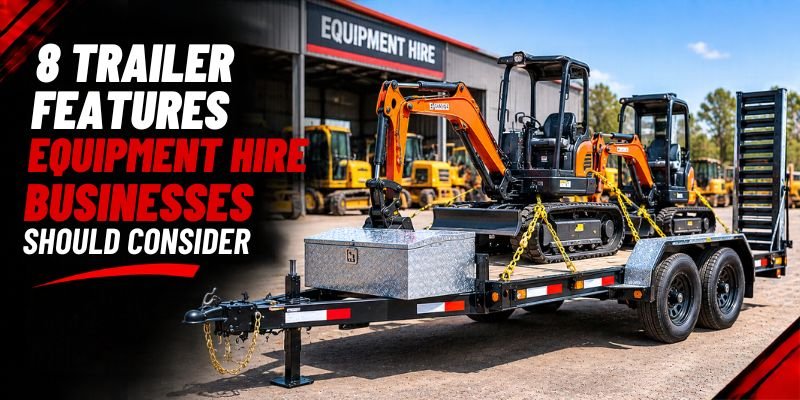
The most important equipment hire trailer features include suitable payload capacity, properly rated loading ramps, secure tie-down points, durable construction, reliable braking systems and easy maintenance access. For equipment hire businesses operating across Warragul, Gippsland and regional Victoria, choosing the right trailer also means considering repeated customer use, equipment compatibility and ongoing fleet maintenance.
Unlike an earthmoving contractor who may transport the same machine regularly, a machinery hire business can supply different equipment to multiple customers. Each booking may involve a different towing vehicle, operator and loading environment.
A trailer that works well for one piece of machinery may not be suitable for another, even when both machines have similar transport weights.
For rental businesses, selecting the right equipment trailer is therefore about more than capacity or purchase price. It involves choosing a configuration that supports safe equipment transport, straightforward inspections, practical customer handovers and manageable long-term operating costs.
Whether your business hires out mini excavators, skid steer loaders, trenchers or landscaping machinery, these eight features are worth considering before expanding or replacing your trailer fleet.
1. Payload Capacity That Matches Your Hire Equipment
Payload capacity is one of the first considerations when choosing trailers for an equipment rental business.
A hire fleet may include several machines with different transport weights, dimensions and attachments. Even equipment from the same category can have different loading requirements.
For example, two mini excavators may look similar but have different operating weights depending on their models, specifications and fitted attachments.
Before selecting trailers, review:
- Documented transport weight of each machine.
- Weight of buckets and additional attachments.
- Trailer tare mass.
- Aggregate Trailer Mass (ATM).
- Available payload.
- Axle, tyre, brake and coupling ratings.
- Customer towing vehicle compatibility.
A trailer’s ATM is the maximum permitted total loaded trailer mass specified by the manufacturer. It does not represent the weight of machinery the trailer can carry.
The trailer’s own weight and any accessories not already included in its tare mass reduce the available payload.
For example, a hire company supplying a compact excavator with an additional bucket must account for both the machine and the attachment.

When comparing plant trailers, businesses should review the approved trailer specifications against the actual machinery supplied.
Hire fleet consideration: Create an equipment-to-trailer compatibility register. Record which machines may be transported by each trailer, subject to confirmed loading, restraint and towing requirements.
This can help staff identify suitable configurations before accepting a booking.
2. Loading Ramps Suitable for Different Machinery
Loading ramps are among the most important features of a machinery hire trailer.
Rental customers may use compact excavators, wheeled loaders, tracked machines or landscaping equipment with different loading characteristics.
A ramp that suits one machine may be unsuitable for another.
Important considerations include:
- Rated capacity of the complete ramp system.
- Ramp length and loading angle.
- Width and spacing for machinery tracks or tyres.
- Surface traction.
- Ground clearance of the equipment.
- Secure ramp attachment.
- Condition of hinges, pins and locking mechanisms.
- Ease of inspection between hires.
For example, a mini excavator with limited ground clearance may have difficulty moving between a steep ramp and the trailer deck.
A skid steer loader may require different ramp spacing or traction arrangements.
Even when a ramp has sufficient rated capacity, its angle, width or surface may make it unsuitable for the intended machine.
Why Ramp Inspection Matters for Hire Businesses
Unlike a trailer used by one contractor, a rental trailer may be loaded by different operators.
Ramps, hinges and locking components can experience repeated use and should be checked during pre-hire and return inspections.
A useful inspection should look for visible damage, deformation, missing retaining components and other defects that could affect safe operation.
Hire businesses should also provide relevant machinery loading instructions and identify any restrictions.
Practical tip: Maintain clear equipment compatibility information rather than expecting customers to determine ramp suitability themselves.
3. Secure and Accessible Equipment Tie-Down Points
Appropriate equipment restraint is essential for machinery transportation.
Hire businesses must consider that customers may have different levels of experience using trailer restraint systems.
A suitable trailer should provide correctly positioned and rated attachment points for the intended machinery.
Important features include:
- Rated tie-down points.
- Accessible attachment locations.
- Suitable restraint angles.
- Secure storage for chains and straps.
- Protection against movement during transport.
- Attachment points that can be inspected for damage.
For example, a customer transporting a mini excavator must secure the machine and its attachments according to the manufacturer’s transport instructions and applicable load-restraint requirements.
The machine’s parking brake or hydraulic system must not be relied upon as the only method of restraint.
Making Customer Handover More Practical
Equipment hire businesses should consider documenting the restraint arrangements relevant to each machine and trailer combination.
A handover may include:
- Identifying designated machinery restraint points.
- Explaining the supplied restraint equipment.
- Checking the condition of chains or straps.
- Providing relevant transport instructions.
- Confirming the customer understands the loading and restraint requirements.
The appropriate system depends on the actual machine and loading configuration.
The National Transport Commission’s Load Restraint Guide provides useful information for light-vehicle transport operations.
For rental businesses, suitable restraint equipment and clear instructions are important parts of the handover process.
4. Durable Chassis and Deck Construction
An equipment hire trailer may be loaded and unloaded repeatedly by different customers.
It may also be used on construction sites, landscaping projects, rural properties and other demanding working environments.
The chassis and deck should be designed for the intended equipment loads and operating conditions.
Important considerations include:
- Structural load capacity.
- Suitable cross-member support.
- Deck support beneath tracks or tyres.
- Appropriate drawbar construction.
- Durable surface finishes.
- Corrosion protection.
- Accessible areas for cleaning and inspection.
For example, a compact track loader transfers weight through its tracks, while a wheeled skid steer creates different concentrated loads through its tyres.
A trailer deck must accommodate the relevant loading conditions.
A heavy-looking steel deck does not automatically mean a trailer has sufficient approved capacity.
The complete chassis, deck, axle and component design must suit the equipment.
Why Easy Cleaning Matters
Rental equipment may be returned with mud, dirt or debris.
A trailer that is practical to clean and inspect can simplify turnaround procedures.
For example, an accessible deck allows staff to check for visible damage, loose components and excessive wear before preparing the trailer for another booking.
Hire fleet consideration: When comparing trailer designs, assess both durability and how easily the trailer can be inspected after customer use.
Planning to Expand Your Equipment Hire Fleet?
Choosing trailers for a rental business involves more than selecting a deck size.
Halco Trailers in Warragul can discuss suitable configurations based on your equipment range, expected loads, loading arrangements and intended use.
Discuss Your Hire Fleet Trailer Requirements
5. Suitable Braking, Axle and Suspension Systems
Braking and running gear are important plant trailer features, particularly for equipment hire businesses managing multiple trailers.
The braking system, axles, tyres and suspension must be suitable for the trailer’s approved mass and intended application.
Important considerations include:
- Correct braking system for the trailer specification.
- Axle load ratings.
- Tyre load and speed ratings.
- Suitable suspension design.
- Wheel and bearing specifications.
- Coupling compatibility.
- Required towing vehicle equipment.
For example, a trailer used for transporting a compact excavator may have different braking and axle requirements from a lighter trailer intended for small landscaping equipment.
A tandem-axle configuration may be appropriate for some machinery trailers, but having two axles does not automatically establish a particular payload capacity.
The complete trailer must remain within its approved ratings.
Why Customer Towing Compatibility Matters
A trailer may be suitable for the hired machine but unsuitable for the customer’s towing vehicle.
Before confirming a booking, hire operators should assess the relevant vehicle and trailer combination.
Important checks include:
- Rated towing capacity.
- Gross Combination Mass limits.
- Towbar and towball download ratings.
- Coupling compatibility.
- Braking system requirements.
- Applicable licence and operating conditions.
For example, an equipment hire trailer fitted with a braking system requiring a compatible controller cannot simply be assumed suitable for every customer vehicle.
Hire businesses should identify these requirements before releasing the trailer.
A suitable trailer-and-machine combination does not automatically mean every customer can tow it.
6. Practical Trailer Dimensions and Equipment Compatibility
Different machines require different amounts of deck space and loading clearance.
For hire businesses, trailer dimensions should be planned around the equipment available in the fleet.
Important measurements include:
- Machine transport length.
- Overall width.
- Transport height.
- Track or wheel spacing.
- Ground clearance.
- Attachment dimensions.
- Required restraint clearance.
For example, a compact excavator may require additional deck length to accommodate its blade, boom or bucket in the specified transport position.
A skid steer loader may have different ramp spacing and deck support requirements.
Should Hire Businesses Standardise Trailer Sizes?
Standardising suitable trailer configurations may simplify certain fleet operations.
Potential benefits include:
- More consistent staff familiarisation.
- Similar inspection procedures.
- Easier identification of compatible equipment.
- More predictable parts and maintenance planning.
- Simplified trailer allocation processes.
However, one standard trailer will not necessarily suit every machine.
A business may benefit from grouping equipment by transport requirements rather than expecting every trailer to handle every load.
For example, smaller landscaping machinery may require one configuration, while heavier compact earthmoving equipment may need another.
The priority should always be verified equipment compatibility.
7. Easy Maintenance and Inspection Access
Trailer maintenance is particularly important for equipment hire businesses.
Rental trailers may be used by different customers, travel over varying road conditions and experience repeated loading cycles.
A fault that goes unnoticed after one hire may affect the next booking.
Routine inspections should therefore form part of the fleet’s operating process.
Important areas to inspect include:
- Tyres and wheels.
- Bearings and hubs.
- Brake systems.
- Couplings and safety chains.
- Suspension components.
- Lighting and electrical connections.
- Loading ramps and locking mechanisms.
- Tie-down points and restraint equipment.
- Chassis and deck condition.
For example, a trailer returned from a muddy construction site may require cleaning and inspection before it is released to another customer.
Pre-Hire and Return Inspections
A useful rental fleet process includes separate inspections before customer collection and after return.
Before collection, staff should confirm that the trailer is serviceable, the intended load is suitable and the relevant equipment is available.
After return, staff should check for damage, wear, missing accessories and maintenance requirements.
Keeping inspection records and photographs can also help identify changes in trailer condition between bookings.
Maintenance frequency should follow manufacturer recommendations and reflect trailer usage, load, road conditions and inspection findings.
Halco Trailers offers trailer servicing and repairs from its Warragul workshop.
Equipment hire businesses can contact Halco to discuss relevant inspections, repair requirements and fleet maintenance needs.
Practical tip: Remove trailers with safety-critical faults from service until they have been appropriately assessed and repaired.
8. Custom Features Designed for Rental Fleet Operations
Equipment hire businesses may require trailer features that differ from those needed by individual contractors.
A rental fleet must balance equipment compatibility, practical customer use, durability and ongoing maintenance requirements.
Depending on the intended application, useful customisation options may include:
- Specific deck dimensions.
- Suitable loading ramp arrangements.
- Rated restraint point locations.
- Storage for chains and straps.
- Secure spare wheel mounting.
- Practical toolbox locations.
- Suitable lighting and electrical fittings.
- Durable finishes.
- Clearly positioned identification and operating information.
For example, a hire company supplying several similar mini excavators may benefit from consistent trailer layouts that match those machines.
A business offering multiple types of equipment may instead need different trailer configurations.

When discussing custom trailers, provide the manufacturer with the intended equipment types, transport weights, dimensions, towing requirements and operating conditions.
Any custom feature must be compatible with the completed trailer design and applicable standards.
Hire fleet consideration: Focus on features that make trailers practical to load, inspect and maintain rather than adding accessories that offer little value to the fleet.
How Should Hire Businesses Match Machinery to Trailers?
A machinery-to-trailer compatibility system can help equipment hire businesses assess trailer suitability before accepting bookings.
Different machines may have similar transport weights but require different loading or restraint arrangements.
Hire equipment | Trailer features to assess | Customer handover priority |
Mini excavator | Payload, ramp rating, deck length and restraint points | Loading method, machine positioning and attachment restraint |
Skid steer loader | Ramp traction, loading angle and deck support | Correct loading procedure and restraint arrangement |
Compact track loader | Track contact loads, deck capacity and ramps | Compatible loading system and machine securement |
Trencher | Ground clearance, ramp dimensions and load positioning | Safe loading orientation and restraint points |
Landscaping machinery | Payload, deck access and equipment dimensions | Suitable securing of tools and accessories |
This table provides general selection guidance rather than confirmation that a particular machine is suitable for a specific trailer.
Before assigning a trailer, compare the machine’s documented specifications with the approved trailer design.
What Information Should a Compatibility Register Include?
A practical equipment compatibility record may contain:
- Machine make and model.
- Documented transport mass.
- Overall transport dimensions.
- Relevant attachment weights.
- Compatible trailer identification.
- Required loading arrangement.
- Restraint instructions.
- Towing vehicle requirements.
Maintaining this information can help staff make more consistent decisions during equipment allocation.
How Much Weight Can an Equipment Hire Trailer Carry?
Understanding payload is essential when selecting trailers for rental fleets.
A trailer’s ATM represents its maximum permitted loaded mass. The trailer’s own weight must be deducted to estimate the amount available for machinery and other equipment.
Example: Equipment Hire Trailer Payload Calculation
Consider a hypothetical trailer with the following figures:
Item | Weight |
Trailer ATM | 3,500 kg |
Trailer tare mass | 950 kg |
Theoretical available payload | 2,550 kg |
Hire machine transport mass | 2,200 kg |
Additional attachment | 150 kg |
Theoretical remaining allowance | 200 kg |
Step 1: Calculate theoretical available payload
3,500 kg − 950 kg = 2,550 kg
Step 2: Calculate the equipment load
2,200 kg + 150 kg = 2,350 kg
Step 3: Calculate the remaining allowance
2,550 kg − 2,350 kg = 200 kg
In this example, the theoretical remaining load allowance is 200 kg.
However, this does not automatically confirm that the combination can be transported safely.
Any equipment, accessories or permanent fittings not already included in tare mass must be accounted for.
The loaded trailer must also comply with its axle, tyre, brake and coupling ratings.
The customer’s towing vehicle must remain within its applicable towing, towbar, axle and combination limits.
Machine placement and weight distribution can also affect axle loading and towball download.
These figures are illustrative only and do not represent a specific Halco trailer.
Important for hire businesses: Trailer payload suitability and customer towing compatibility are two separate checks. Both must be completed before confirming the transport arrangement.
Equipment Hire Trailer Pre-Hire and Return Checklist
A consistent inspection process is useful when trailers are regularly used by different customers.
The following checklist separates the checks needed before a trailer leaves the business from those required after its return.
Before customer collection | After trailer return |
Confirm trailer and machinery compatibility | Check for visible trailer damage |
Verify customer towing vehicle suitability | Inspect tyres and wheels |
Check coupling and safety chains | Check coupling and safety chains |
Inspect brakes and lighting | Identify brake or electrical faults |
Check loading ramps and locking components | Inspect ramp hinges, pins and locks |
Check restraint equipment | Inspect chains, straps and attachment points |
Confirm accessories are present | Check for missing accessories |
Provide relevant loading instructions | Record reported loading or towing issues |
Record trailer condition | Photograph damage where appropriate |
Complete handover documentation | Record maintenance or repair requirements |
Inspection results should be recorded according to the business’s operating procedures.
Any safety-critical defect should be resolved before the trailer is returned to service.
A checklist supports consistent inspections but does not replace qualified technical assessments or applicable safety obligations.
Why Trailer Maintenance Costs Matter for Equipment Hire Businesses
The purchase price is only one part of the cost of operating a rental trailer fleet.
Hire businesses should also consider long-term maintenance, repairs, replacement parts and the effect of trailer downtime.
Common Trailer Ownership Costs
Cost factor | Why it matters |
Initial purchase | Trailer design, approved capacity and selected features |
Routine servicing | Brakes, bearings, tyres and other components require maintenance |
Repairs | Damage or defects can require workshop attention |
Replacement parts | Component availability may affect repair planning |
Inspections | Staff time and suitable technical assessments |
Downtime | A trailer unavailable for hire may affect bookings |
Insurance and registration | Ongoing costs depend on the operation and trailer |
Fleet replacement | Heavily used trailers may eventually require replacement |
For example, a trailer with damaged ramp hinges may need to be removed from the hire fleet until it has been repaired.
The direct cost of repair is only one consideration. The business may also need to rearrange bookings or allocate another compatible trailer.
How Can Hire Businesses Manage Trailer Downtime?
Practical steps include:
- Establishing routine inspection procedures.
- Following manufacturer-recommended maintenance schedules.
- Recording faults promptly.
- Keeping accurate service histories.
- Planning inspections around booking schedules where practical.
- Ensuring the availability of suitable restraint equipment and accessories.
- Discussing servicing requirements with a local workshop.
A trailer that is easy to inspect and maintain may simplify fleet operations.
However, actual maintenance costs and downtime will depend on the trailer’s specifications, usage, operating environment and condition.
5 Common Equipment Hire Trailer Mistakes to Avoid
1. Choosing One Trailer Configuration for Every Machine
Not every machine has the same loading, clearance and restraint requirements.
Group equipment according to compatible transport needs rather than assuming one trailer will suit everything.
2. Overlooking Customer Towing Compatibility
A trailer may be suitable for the machine but unsuitable for the customer’s vehicle.
Verify relevant towing and braking requirements before releasing the equipment.
3. Providing Insufficient Customer Handover Information
Customers need relevant loading, towing and restraint instructions for the actual equipment and trailer combination.
Provide clear information and confirm that the intended operator is competent to undertake the task.
4. Skipping Inspections Between Bookings
Frequent use can result in wear, damage or missing accessories.
Conduct suitable checks before release and after return, and address defects before further use.
5. Focusing Only on Purchase Price
A lower purchase price does not a
utomatically mean a lower long-term operating cost.
Consider durability, inspection access, servicing requirements, component availability and expected usage when comparing options.
Practical Machinery Loading Tips for Equipment Hire Businesses
Equipment hire businesses should consider how customers will load and secure machinery, not just which trailer they will use.
Loading procedures must suit the machinery, trailer and operating conditions.
Before loading, the operator should:
- Confirm that the machine and trailer are compatible.
- Select a suitable loading area with stable ground conditions.
- Inspect the ramps and loading equipment.
- Follow the machinery manufacturer’s loading instructions.
- Keep unnecessary personnel clear of the loading area.
- Position the machine as required by the approved loading arrangement.
- Secure the machine and attachments using appropriate restraints.
- Confirm trailer and towing vehicle limits before departure.
Hire businesses should provide relevant instructions and consider documented customer handover procedures.
Heavy machinery must be loaded by competent operators using appropriate safe work practices.
Do not assume that a trailer’s loading ramps or tie-down points are suitable for every machine simply because the machine appears to fit.
Equipment Hire Trailer Safety Requirements in Victoria
Equipment hire businesses operating around Warragul, Drouin, Moe, Traralgon and wider Gippsland should consider the relevant Australian towing, vehicle and load-restraint requirements.
Trailer Construction and Approved Mass
Trailers with an ATM of 4.5 tonnes or less fall within the Australian light-trailer framework and must meet applicable vehicle standards.
The approved trailer mass, braking system and other components must suit the intended application.
Customer Towing Suitability
Before a trailer is released, relevant tow vehicle ratings and equipment compatibility must be checked.
These may include towing capacity, Gross Combination Mass, towbar rating, coupling requirements and braking compatibility.
Machinery Loading and Restraint
Machinery must be appropriately restrained during transport.
The applicable requirements depend on the vehicle combination and load.
Light-vehicle operators can refer to the National Transport Commission’s guidance, while heavy-vehicle operations may fall under the National Heavy Vehicle Law and related requirements.
For Victorian guidance, see Transport Victoria’s information on securing loads.
Inspection and Maintenance
Trailers must remain serviceable and suitable for road use.
Hire businesses should address faults affecting brakes, tyres, couplings, ramps, chassis components and other safety-related systems before releasing a trailer.
A documented inspection process can support these responsibilities but does not replace the relevant legal and technical requirements.
Buying Trailers for a Hire Fleet vs Hiring a Trailer
These are two different business requirements.
A machinery hire company purchasing trailers for its fleet needs to consider long-term use, customer handover, maintenance and equipment compatibility.
A customer hiring a trailer for a particular task is usually more focused on short-term availability, load suitability and rental conditions.
Buying for an equipment hire fleet | Hiring a trailer for temporary use |
Multiple customers may use the trailer | Usually a specific transport requirement |
Durability and maintenance planning matter | Immediate trailer suitability matters |
Fleet standardisation may be useful | Availability and hire duration matter |
Ongoing inspections and repairs are required | Customer receives hire and return instructions |
Purchase and ownership costs apply | Rental terms and fees apply |
Halco Trailers offers manufacturing and customisation options for businesses considering trailer ownership.
For customers who need a trailer temporarily, Halco also has a separate Trailer Hire page listing available hire configurations and rental information.
These services address different needs, so businesses should choose the option that matches their intended use.
Why Consider Halco Trailers for Your Equipment Hire Business?
Halco Trailers and Fabrication manufactures standard and customised trailer configurations at its workshop in Warragul, Victoria.
The company supplies trailers for tradespeople, contractors, farmers, businesses and equipment owners across Gippsland, Melbourne and surrounding areas.
For equipment hire businesses, Halco can discuss appropriate trailer configurations based on machinery types, actual transport weights, dimensions, loading arrangements and towing requirements.
What Should You Provide When Requesting a Fleet Trailer Quote?
To help assess your requirements, prepare:
- Machinery makes and models.
- Documented transport weights.
- Equipment dimensions.
- Details of buckets and attachments.
- Expected number of trailers.
- Intended customer and towing applications.
- Preferred loading ramp arrangements.
- Equipment restraint requirements.
- Storage and accessory requirements.
- Typical operating conditions.
- Maintenance and servicing considerations.
If your business operates several similar machines, it may also be useful to discuss whether compatible trailer configurations can be standardised.
The suitability of each proposed trailer must still be assessed against the intended equipment and approved specifications.
Whether you manage a machinery hire business in Warragul, supply equipment across Gippsland or operate a rental fleet elsewhere in Victoria, selecting the right trailers begins with accurate equipment information and a clear understanding of your operational requirements.
Discuss Your Equipment Hire Trailer Requirements with Halco Trailers
Choosing trailers for an equipment hire business involves more than selecting a deck size or loading ramps.
The right configuration must suit your machinery, support practical customer use and allow suitable inspections and maintenance throughout its operating life.
From payload capacity and secure restraint points to loading access and customised storage, the best trailer features depend on your fleet’s actual requirements.
Halco Trailers manufactures standard and customised trailer configurations in Warragul, Victoria, serving businesses across Gippsland, Melbourne and regional areas.
If you are starting an equipment hire business, expanding your existing fleet or replacing older trailers, speak with Halco about the options available for your machinery.
Discuss Your Hire Fleet Requirements and Request a Quote
Share your machinery models, transport weights, equipment dimensions, expected trailer quantities and intended operating requirements so the Halco team can discuss suitable trailer configurations.