

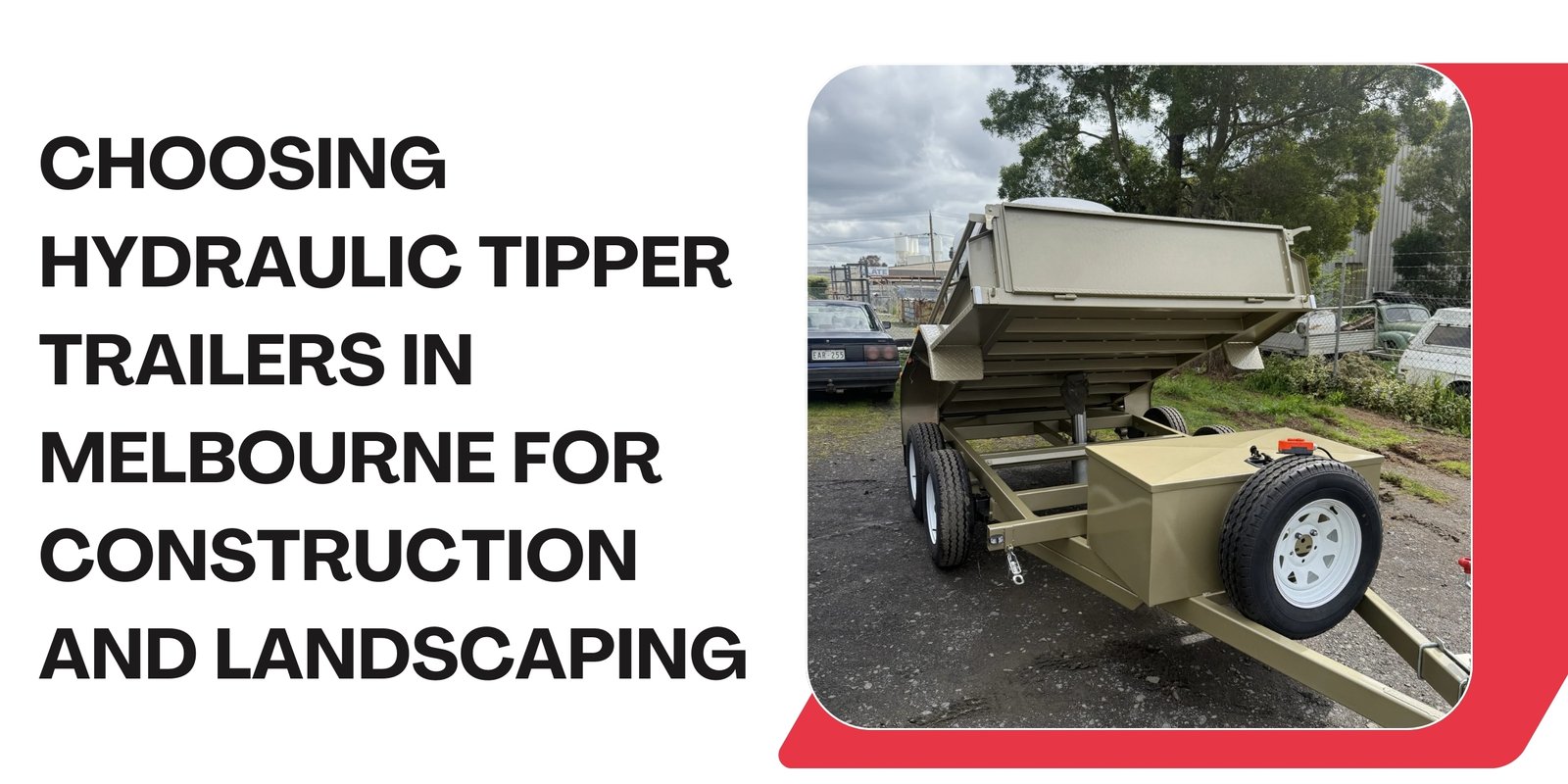
Hydraulic tipper trailers are used in construction and landscaping work when loose materials need to be loaded, moved and unloaded more efficiently than manual shovelling allows.
They are commonly associated with soil, mulch, gravel, sand, green waste, rubble and site-cleanup material. The tipping body can help reduce manual unloading, but the trailer still needs to suit the material, load weight, towing vehicle, access conditions and unloading area.
This guide explains how hydraulic tipper trailers support construction and landscaping tasks, where they are useful, where they have limitations, and what operators should consider before loading, towing or tipping.
For current configurations and product details, view Halco’s hydraulic tipper trailer range.
A hydraulic tipper trailer is useful when loose material needs to be unloaded from a tipping body, but suitability depends on the material weight, body design, payload, hydraulic system, towing vehicle and site conditions.
Quick Answer: When Does a Hydraulic Tipper Trailer Help?
| Work situation | Why a hydraulic tipper may help |
|---|---|
| Soil removal | Helps unload loose soil without repeated manual shovelling |
| Mulch delivery | Supports controlled unloading into suitable areas |
| Gravel transport | Can assist with heavy loose material when payload allows |
| Green-waste removal | Makes bulky garden material easier to unload |
| Site clean-up | Helps clear loose or broken material from work areas |
| Repeated load cycles | Reduces time spent unloading between trips |
| Property maintenance | Supports farm, garden and rural clean-up tasks |
| Confined sites | Can reduce manual handling where space and tipping conditions are suitable |
What Is a Hydraulic Tipper Trailer?
A hydraulic tipper trailer uses a tipping body raised by a hydraulic system. The body lifts so suitable material can slide or discharge from the trailer.
The system may include a hydraulic ram, power unit, battery, controls, hoses and body-support components. The exact setup depends on the trailer design.
A tipping trailer does not remove the need for planning. The load must be suitable for tipping, the trailer must remain within its approved capacity, and the site must allow safe unloading.
How Hydraulic Tippers Support Construction Work
Construction work often involves moving loose, heavy or messy material between suppliers, worksites, storage areas and disposal points.
A hydraulic tipper can help where a crew needs to unload material without repeatedly shovelling from a fixed body. This can be useful when the trailer is used for regular site preparation, small demolition clean-up, backfill, sand, gravel or general construction debris that suits the trailer body.
Common construction uses include:
- Moving sand or gravel
- Carrying suitable rubble or broken material
- Site clean-up
- Small excavation support
- Transporting fill
- Moving bagged or loose supplies
- Clearing work areas
- Delivering materials to accessible locations
The trailer must be matched to the material. Dense loads can reach payload limits before the tray appears full, so visual volume is not enough to judge suitability.
How Hydraulic Tippers Support Landscaping Work
Landscaping work often involves repeated movement of organic, loose and bulky material.
A tipper can support landscaping projects by helping unload mulch, soil, garden mix, sand, gravel, plants, green waste and site-cleanup material. It can also reduce the time spent manually emptying a trailer at each property or job site.
Common landscaping uses include:
- Mulch transport
- Soil and garden mix delivery
- Sand and gravel movement
- Green-waste removal
- Tree and branch clean-up
- Property maintenance
- Residential site preparation
- Garden renovation work
A cage or higher sides may help with bulky green waste, while a lower body may be more practical for heavier material. The best arrangement depends on the material’s weight, shape, volume and loading method.
Soil, Mulch, Gravel and Green Waste
Different materials behave differently in a tipping trailer.
Soil
Soil can vary significantly in weight depending on moisture content. Wet soil can be much heavier than dry soil and may stick to the body during unloading.
Mulch
Mulch is often bulky rather than extremely dense. Higher sides or a cage may help contain volume, but the load still needs to remain secure during travel.
Gravel
Gravel is dense and can reach payload limits quickly. Operators should avoid assuming that a trailer can be filled to the top with gravel.
Green waste
Branches, leaves and garden waste can be irregular and bulky. Loose green waste may require containment, and light material still needs to be secured so it cannot leave the trailer.
Rubble and site material
Construction debris can be abrasive, uneven and heavy. The body, floor, payload and unloading method must all suit the material.
Unloading Workflow
A hydraulic tipper can improve workflow when unloading happens repeatedly throughout the day.
A typical workflow may involve:
- Checking the trailer, coupling, lights, tyres and hydraulic system
- Loading material within the trailer’s rated capacity
- Distributing material appropriately in the body
- Securing loose items and checking the tailgate
- Towing to the unloading area
- Positioning the trailer on suitable ground
- Checking overhead clearance and surrounding people
- Releasing the discharge area where appropriate
- Operating the hydraulic system
- Lowering and securing the body before travel
The tipping step is only one part of the process. Safe loading, transport and positioning matter just as much as unloading.
Confined-Site Considerations
Construction and landscaping jobs often take place in tight driveways, residential properties, laneways, narrow worksites or areas with limited turning space.
Before using a hydraulic tipper on a confined site, consider:
- Trailer length and width
- Towing vehicle access
- Turning space
- Overhead branches, wires or structures
- Ground slope
- Ground firmness
- Where the material will discharge
- Whether the trailer can be positioned safely
- Whether people can be kept clear
- Whether the tipping body has enough clearance to lift
A hydraulic tipper is helpful only when there is enough room to load, tow, position and unload safely.
Loading Method Matters
The way material is loaded affects trailer suitability.
Materials may be loaded by:
- Hand
- Shovel
- Mini loader
- Excavator
- Tractor bucket
- Forklift
- Machinery bucket
- Bags or containers
Machine loading can place concentrated forces on the body or floor. Heavy material dropped from height can also affect the trailer body. Discuss the likely loading method before selecting a trailer configuration.
A trailer used mainly for machinery transport may require a different configuration from one used mainly for loose material. If equipment loading is the main task, a plant trailer may be more suitable than a tipping body.
For broader body-style differences, see Halco’s types of trailers comparison guide.
Payload, ATM and Tare Mass
Payload is the amount of weight available for material after the completed trailer’s tare mass is deducted from its approved mass rating.
Payload = ATM − tare mass
Aggregate Trailer Mass, or ATM, is the total permitted mass of the trailer carrying the maximum load recommended by the manufacturer. Tare mass is the mass of the completed trailer without cargo.
The Australian Government’s VSB 1 trailer guidance applies to light trailers with an aggregate trailer mass of 4.5 tonnes or less and explains the ADR framework for low-ATM trailers.
Payload is especially important for tipping trailers because hydraulic equipment, batteries, cages, ramps, higher sides and toolboxes can increase tare mass. That reduces how much material the trailer can carry.
Before loading, confirm:
- The material weight
- The trailer’s ATM
- The trailer’s tare mass
- Available payload
- Towing vehicle capacity
- Towbar rating
- Tyre and axle suitability
- Brake setup
- Whether added accessories reduce payload
Do not judge capacity only by tray volume. Dense material can exceed payload before the body appears full.
For a fuller pre-purchase checklist covering payload, towing, restraint and Victorian registration questions, read Halco’s trailer buying checklist for Victoria.
Load Restraint for Construction and Landscaping Loads
A tipping trailer still needs proper load restraint.
Transport Victoria states that loads must be properly restrained and that each type of load needs to be transported differently. It recommends suitable restraint equipment, rated equipment where possible, careful load positioning and regular checks during travel. Transport Victoria load-restraint guidance
For construction and landscaping work, load-restraint planning may include:
- Keeping loose material below safe containment height
- Using a suitable tarp, net or cover where appropriate
- Securing tools and equipment separately
- Locking or securing ramps
- Checking tailgates, latches and sides
- Keeping heavy items underneath lighter items
- Distributing weight evenly
- Checking restraints after travel begins
Tarpaulins, cargo nets and ropes are suited only to light loads, so heavier or sharper materials may require stronger restraint equipment.
Tipping Safety Considerations
Tipping should be treated as a controlled work step, not just the final part of unloading.
Before tipping, check:
- The ground is suitable
- The trailer is positioned safely
- The towing vehicle and trailer are stable
- People are clear of the tipping area
- Overhead clearance is adequate
- The discharge area is clear
- The material is suitable for tipping
- The load is not stuck, bridged or unevenly distributed
- The tailgate or discharge point is ready
- The hydraulic system operates correctly
Avoid tipping where the trailer is unstable, overloaded, unevenly loaded, positioned on unsuitable ground or too close to people, structures or traffic.
Wet, sticky or compacted material may not slide evenly. If the material does not move as expected, stop and reassess rather than continuing to raise the body.
Maintenance Considerations
Hydraulic tipper trailers have moving parts and load-bearing components that should be inspected regularly.
Common checks include:
- Tyres
- Wheel nuts
- Bearings
- Brakes
- Lights and wiring
- Coupling and safety chains
- Hydraulic hoses
- Hydraulic fittings
- Battery condition
- Ram and pivot points
- Tailgate and latches
- Body hinges
- Ramp storage
- Chassis and drawbar
- Signs of corrosion or impact damage
A trailer used for heavy construction, landscaping or farm work may need more frequent inspection than a trailer used occasionally.
Clean the body after carrying wet, abrasive or corrosive material. Soil, green waste, gravel and construction debris can build up around hinges, tailgates and moving parts.
Limitations of Hydraulic Tipper Trailers
Hydraulic tipping trailers are useful, but they are not the right solution for every task.
Not every load tips cleanly
Sticky, wet, compacted or uneven material may not discharge smoothly.
Payload can be reached before the tray is full
Dense material such as gravel, wet soil or rubble can exceed payload limits quickly.
Site conditions matter
Tipping requires suitable space, ground conditions and overhead clearance.
Manual handling may still be required
Some cleanup, spreading or clearing may still be needed after tipping.
Hydraulic systems need maintenance
Hoses, fittings, batteries, pivots and moving components require inspection.
Open material may need containment
Loose or light loads may need covers, cages or suitable restraint.
Construction and Landscaping Checklist
Before using a hydraulic tipper trailer for construction or landscaping work, check:
- What material is being carried
- Whether the material is suitable for tipping
- Actual or estimated load weight
- Trailer ATM, tare mass and payload
- Towing vehicle capacity
- Site access
- Loading method
- Ground conditions at the unloading area
- Overhead clearance
- Whether a cage, cover or tarp is needed
- Whether tools or equipment need separate restraint
- Tailgate and latch condition
- Hydraulic system operation
- Tyre, brake and light condition
- Whether the body is lowered and secured before towing
This checklist helps separate practical use from assumptions based only on trailer size.
Final Thoughts
Hydraulic tipper trailers can support construction and landscaping work by making suitable loose materials easier to unload. They are especially useful where soil, mulch, gravel, sand, green waste or site-cleanup material needs to be moved regularly.
The key is matching the trailer to the work. Material weight, payload, loading method, site access, ground conditions, tipping behaviour and restraint requirements all affect suitability.
Before choosing a configuration, confirm what will be carried, how it will be loaded, where it will be tipped and whether the towing vehicle is suitable.
For current configurations and product details, view Halco’s hydraulic tipper trailer range.