

By Halco Trailers Team, Trailer Manufacturing / Safety Specialist
These trailer toolbox ideas help tradies turn a trailer into a faster, safer mobile workspace. Use dedicated drawers, labelled bins, secure compartments, vertical storage, weather seals and sensible weight placement so tools stay protected, accessible and easier to manage between Australian jobs.
A toolbox should do more than hold equipment. The right setup can reduce time spent searching for tools, protect expensive gear from weather and theft, and make the trailer easier to load consistently.
The best trailer toolbox ideas are the ones that match your actual work. An electrician carrying testers and fittings needs a different layout from a landscaper carrying battery equipment, hand tools and machinery accessories.
This guide covers nine practical setups you can use on a new or existing work trailer.
What are the best trailer toolbox ideas for tradies?
The best trailer toolbox ideas for tradies combine fast access, secure storage and sensible weight placement. Start by separating daily tools, consumables and backup equipment, then choose drawers, compartments and access points around how you actually work.
1. Create a three-zone toolbox layout
Instead of putting every tool into the first available space, divide the toolbox into three practical zones:
Zone | What belongs there | Access priority |
Daily zone | Hand tools, drill, driver, bits and frequently used equipment | Highest |
Job zone | Trade-specific fittings, consumables and equipment | High |
Backup zone | Spare parts, emergency gear and less-used equipment | Lower |
This simple system is one of the most useful trailer storage ideas because it stops your everyday tools from being buried under equipment you only use occasionally.
For example, an electrician might keep testers, screwdrivers and crimpers in the daily zone, cable accessories and fittings in the job zone, and spare leads or backup equipment in the rear section.
A plumber could use the same system for hand tools, fittings and emergency repair equipment.
2. Use drawers for small tools and consumables
Drawers are useful when your toolbox contains lots of small items that otherwise become mixed together.
Use separate drawers for:
- Drill bits
- Screws
- Nuts and bolts
- Electrical terminals
- Cable ties
- Blades
- Plumbing fittings
- Fasteners
- Measuring equipment
- Small hand tools
The advantage is visibility. Instead of opening a large box and moving five other items to find one fitting, you can identify the drawer and access it directly.
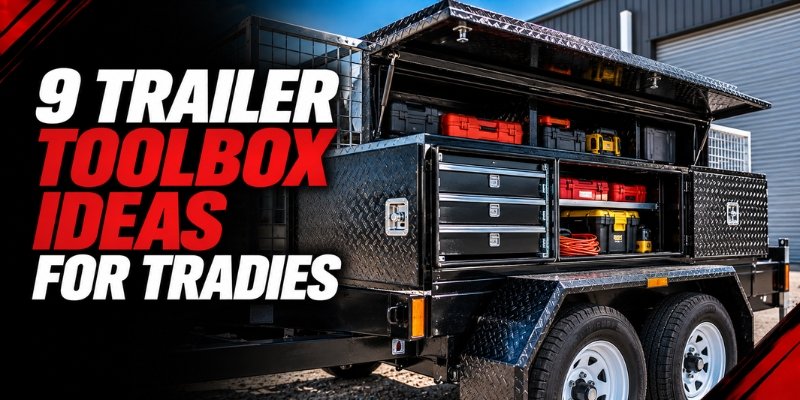
Current Australian toolbox products also show how drawer-based storage is being used in trailer and vehicle setups, with multi-drawer and shelving configurations available for trade applications.
How should you organise a trailer toolbox around daily work?
A well-organised toolbox should match the order of your workday, not the size of your tools. Put used equipment within easy reach, group related items together and keep heavy or awkward gear where it can be handled without unnecessary bending or reaching.
3. Put frequently used tools at the easiest access point
Your most-used tools should not require you to unload half the trailer.
Place daily-use equipment close to the door, lid or side-access point that you normally use. Less frequently used equipment can go deeper inside the toolbox.
Think about the first five minutes of a typical job:
- What tools do you reach for first?
- Which consumables do you use on almost every job?
- Which items are only needed occasionally?
- Which tools are too heavy to keep at shoulder height?
- Which equipment needs two hands to remove safely?
This creates a more practical layout than simply arranging tools by size.
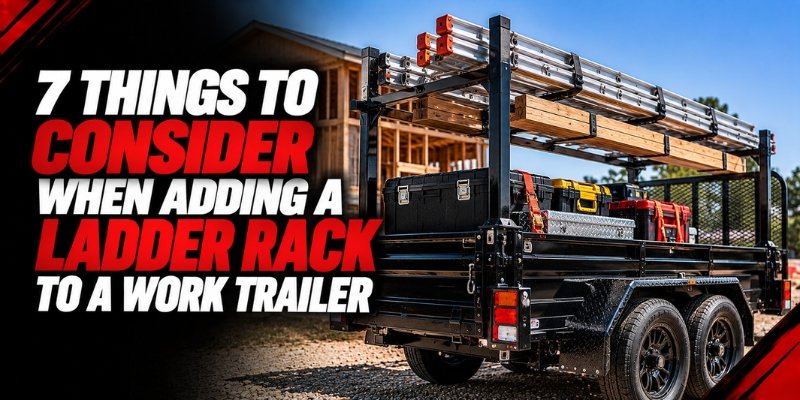
Halco’s tradesman trailers are designed around secure tool storage and practical access, with options including lockable compartments, slide-out drawers, internal shelving, compressor boxes and ladder racks.
4. Create vertical storage for long tools
Not every tool belongs inside a drawer.
Long or awkward items such as:
- Levels
- Pry bars
- Extension leads
- Long drill bits
- Brooms
- Shovels
- Measuring poles
- Long hand tools
can use vertical holders or dedicated slots.
This frees up drawer space and stops long tools from lying across smaller equipment.
A vertical storage section also makes it easier to see whether an item has been returned after a job. If a slot is empty, you know immediately that something is missing.
Which storage ideas make a work trailer faster to use?
Good work trailer storage should save time without reducing usable load space. Use the toolbox for tools and small equipment that need protection, while keeping bulky materials, machinery and other cargo in the main trailer area with suitable restraint.
5. Use labelled bins and colour-coded sections
Labels sound basic, but they become valuable when several people use the same trailer.
Create sections such as:
- HAND TOOLS
- POWER TOOLS
- FASTENERS
- ELECTRICAL
- PLUMBING
- CUTTING
- SAFETY
- SPARES
- EMERGENCY
You can also use different coloured containers for different categories.
For a small business with apprentices or multiple employees, this reduces the “Where did you put it?” problem.
The label should describe the contents rather than the person responsible for the drawer. That means the storage system remains useful when staff change.
6. Use side or underbody storage to preserve floor space
One of the smartest trailer storage ideas is to move smaller equipment away from the main floor.
Side-mounted and underbody storage can hold:
- Tie-down straps
- Chains
- Spare plugs
- Gloves
- Small hand tools
- Recovery equipment
- Cleaning equipment
- Frequently used consumables
This leaves the trailer floor available for larger items.
The important point is not to add storage simply because empty space exists. Every permanent toolbox, drawer or storage system adds weight.
According to the Australian Government’s current Vehicle Standards Bulletin 1 (Revision 6), trailers with an aggregate trailer mass of 4.5 tonnes or less are expected to comply with applicable Australian Design Rules. VSB 1 also defines tare mass with standard equipment and fitted options included.
That means storage should be planned as part of the trailer rather than treated as weight-free space.
How can you keep toolbox weight and load placement safe?
Toolbox weight matters because every permanent box, drawer, shelf and stored tool contributes to the trailer’s actual mass. Plan the storage position with the trailer’s approved ratings, load distribution, tow vehicle limits and coupling load in mind.
This is one area where a great-looking storage setup can become a poor trailer setup if weight is ignored.
According to the National Transport Commission’s Load Restraint Guide for Light Vehicles, loads must be restrained so they remain secure during normal driving and do not negatively affect vehicle stability. The guide specifically identifies tradespeople carrying tools and equipment as users of the guidance.
The NTC also advises keeping the centre of gravity low and close to the vehicle’s centreline and spreading the load across the length and width of the vehicle where appropriate.
A practical toolbox weight rule
Keep heavy equipment low and avoid concentrating unnecessary mass at one end of the trailer.
Do not assume that adding a heavy toolbox to the drawbar is automatically better because it is out of the way.
Before adding a permanent box, consider:
- Toolbox tare weight
- Weight of the tools inside
- Distance from the axle group
- Existing coupling load
- Trailer ATM and GTM
- Towing vehicle limits
- Other permanent accessories
- Typical loaded cargo
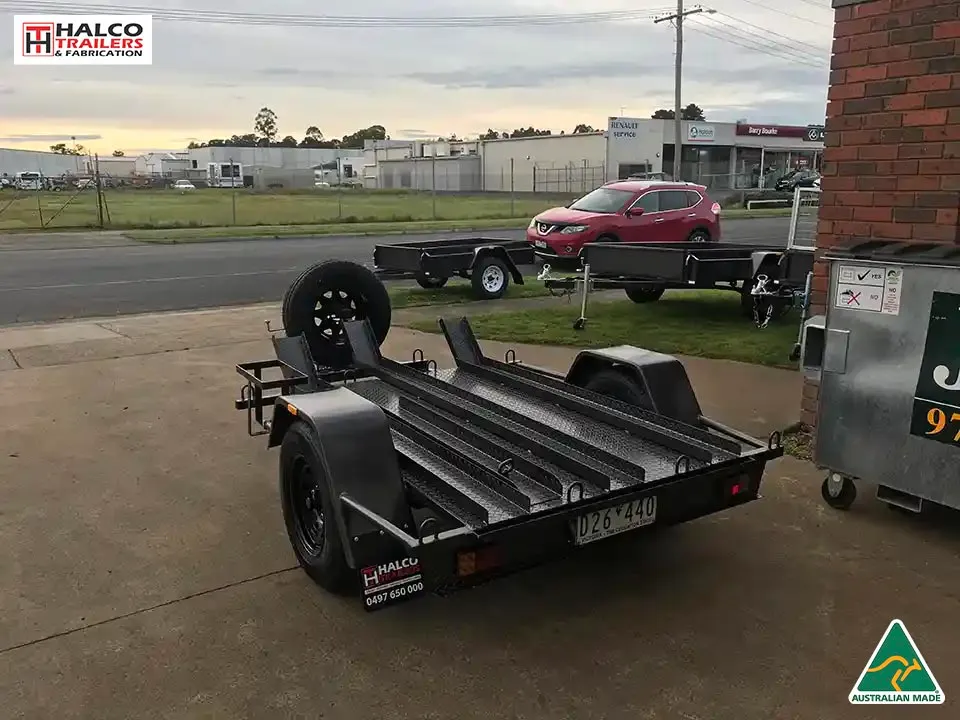
Halco’s current custom-trailer guidance specifically notes that permanent additions such as toolboxes, ramps, hydraulic equipment and storage systems contribute to tare mass and can reduce available payload.
Use the three-question weight check
Before fitting a new toolbox, ask:
- What does the empty toolbox weigh? Check the manufacturer’s specification.
- What will it weigh when fully loaded? Include batteries, compressors, tools and consumables.
- Where will that weight sit? Consider its position relative to the axle group and coupling.
If the answer to any of these is unclear, speak with the trailer manufacturer before making permanent changes.
How should different trades customise toolbox storage?
Different trades need different storage patterns, so there is no single ideal toolbox layout. Electricians, plumbers, builders, landscapers and mobile mechanics should group tools by task, frequency and size rather than copying another tradie’s setup.
7. Build trade-specific storage modules
Your trailer should reflect your work.
Trade | Useful toolbox organisation |
Electrician | Cable accessories, testers, terminals, hand tools and power tools |
Plumber | Fittings, hand tools, cutting equipment, seals and repair supplies |
Builder | Power tools, levels, fasteners, measuring equipment and site tools |
Landscaper | Battery tools, gardening equipment, hand tools and consumables |
Carpenter | Saws, drills, bits, fixings, measuring tools and finishing equipment |
Mobile mechanic | Diagnostic equipment, sockets, hand tools, fluids and recovery equipment |
Maintenance contractor | Mixed drawers, electrical parts, fasteners and emergency repair items |
For example, a landscaper may need fast access to battery-powered tools and blades, while a plumber may need more small-part storage.
Halco’s tradesman trailer range can be configured around different trades with options such as drawers, shelving, ladder racks, compressor boxes and lockable storage.
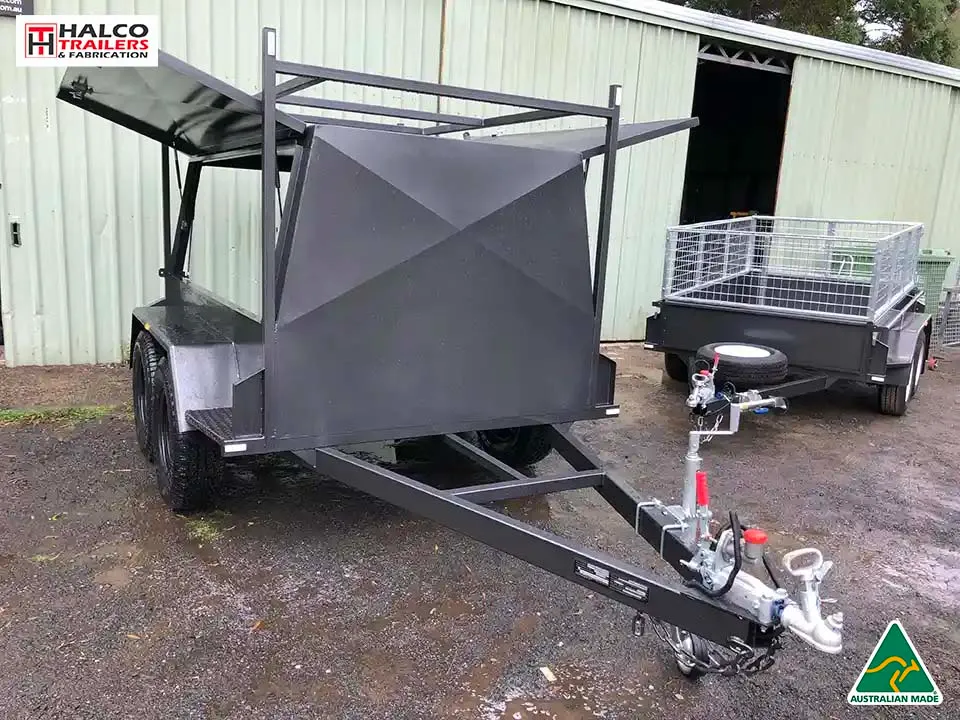
For more extensive trailer storage, you can also explore Halco’s custom trailer options, where storage, access, ramps, tie-down points and other features can be considered as part of the overall design.
A practical example
Imagine two tradies using identical 8×5 trailers.
The electrician may dedicate most toolbox space to small components and electrical testing equipment.
The landscaper may need larger open compartments for battery equipment, cutting tools and garden accessories.
The trailer dimensions are identical, but the ideal storage layout is completely different.
That is why organisation should start with the job, not the trailer.
How can you protect tools from dust, water and theft?
Security and weather protection should be designed into the toolbox, not added after your tools are already getting wet or disappearing. Choose lockable storage, suitable seals and durable materials, then check hinges, latches and mounting points regularly.
8. Choose lockable and weather-resistant storage
A toolbox that stays on the trailer needs to deal with Australian road conditions.
Depending on your location and work, that may include:
- Rain
- Dust
- Mud
- Road spray
- UV exposure
- Coastal moisture
- Construction-site debris
- Frequent vibration
Look for practical features such as:
- Lockable handles
- Rubber or suitable weather seals
- Strong hinges
- Gas struts where appropriate
- Corrosion-resistant construction
- Secure mounting brackets
- Internal dividers
- Protected electrical equipment
Tool security is particularly important for tradies because losing one toolbox can mean losing the tools required to complete several different jobs.
A secure toolbox is not a substitute for good theft-prevention practices, but it creates a controlled storage point rather than leaving expensive equipment loose in an open trailer.
Protect the inside, too
Use rubber liners, foam, dividers or fitted cases where appropriate.
This reduces:
- Tool movement
- Scratching
- Noise
- Contact between metal objects
- Damage to delicate equipment
For battery-powered tools, follow the storage instructions supplied by the battery and tool manufacturer rather than treating every battery type the same way.
How often should you reset and inspect trailer toolbox organisation?
Trailer toolbox organisation works best when it is maintained as a system. Review the layout after busy periods, remove duplicate gear, replace damaged containers, clean out debris and check mounting hardware before small storage problems become daily frustrations.
Recommended toolbox maintenance rhythm
This is a practical operating schedule, not a legal inspection interval.
Frequency | What to check |
Before each trip | Toolbox closed, locked and securely mounted |
Weekly | Return tools, remove rubbish and refill common consumables |
Monthly | Check hinges, locks, seals, drawers and mounting hardware |
Quarterly | Review the complete layout and remove unnecessary equipment |
After major work | Clean the toolbox and return tools to their assigned zones |
After modification | Recheck weight, access, mounting and load requirements |
WorkSafe Victoria recommends placing heavier and frequently used stock between mid-thigh and shoulder height where practicable and reducing long reaches or awkward handling positions. That principle can be useful when designing a trailer toolbox that workers access repeatedly throughout the day.
7-step toolbox reset
- Empty one storage zone at a time: this prevents the entire trailer from becoming disorganised during the reset.
- Group tools by task: related tools are easier to find and return when they share a defined location.
- Remove duplicates and unused equipment: unnecessary gear adds weight and takes up valuable storage.
- Label every drawer or bin: labels make the system easier for apprentices, employees and other drivers to follow.
- Inspect hinges, locks and mounting points: small hardware problems are easier to fix before a toolbox becomes loose or unusable.
- Check the toolbox against the current workload: a new service line or equipment change may require a different layout.
- Close and secure everything before towing: drawers, lids, containers and loose equipment must not become hazards during travel.
How much do trailer toolbox setups cost in Australia?
Trailer toolbox costs in Australia vary widely because a simple drawbar box is very different from a multi-section toolbox with drawers, shelves, seals and heavy-duty mounting. Compare the storage capacity and construction against your actual workflow rather than choosing purely by price.
As a current Australian market snapshot, MW Toolbox QLD’s trailer toolbox range lists a basic aluminium trailer drawbar box at about $450, while larger drawbar toolbox configurations are listed at $1,399 and $1,799. Prices are examples only and can change with specifications, freight and supplier pricing.
What changes the price?
Feature | Effect on cost |
Basic single-compartment box | Lower |
Larger aluminium toolbox | Moderate |
Multiple drawers | Higher |
Adjustable shelving | Higher |
Heavy-duty drawer slides | Higher |
Weather sealing | Moderate |
Custom fabrication | Higher |
Powder coating or special finish | Higher |
Integrated mounting | Depends on trailer |
Custom trailer integration | Quote-based |
The best trailer toolbox ideas are not necessarily the most expensive ones. A $500 box that matches your tools and workflow can be more useful than a $1,500 system full of storage you never use.
For a small business, calculate the value in terms of access time, tool protection, security and payload rather than looking only at the purchase price.
When should you build a custom tradesman trailer instead?
A custom tradesman trailer becomes worthwhile when standard boxes cannot provide the access, storage layout, security or equipment integration your work requires. Building storage into the trailer design can also reduce compromises around weight, doors, racks, drawers and loading access.
A custom setup may make sense when you need several features working together, such as:
- Lockable tool compartments
- Full-length drawers
- Internal shelving
- Ladder racks
- Compressor storage
- Dedicated battery storage
- Side-access doors
- Internal lighting
- External work lights
- Equipment mounts
- Tie-down points
- Custom ramps
- Specialised work surfaces
Halco’s custom trailer information lists toolboxes, drawers and shelving, ladder racks, equipment mounts, internal and external lighting and tie-down points among possible custom features.
You can discuss these requirements with Halco when choosing tradesman trailers or planning trailer accessories around a custom build.
When a custom layout makes more sense
Choose a custom design when:
- Your trade requires unusually sized equipment.
- You need access from several sides.
- The trailer must carry both tools and machinery.
- You need permanent compressor or generator storage.
- Standard toolboxes create poor weight distribution.
- You want storage integrated with ramps, racks or doors.
- The trailer will operate as a mobile workshop every day.
A custom trailer should be planned around the complete load, not just the toolbox. Halco advises customers to provide the intended load, maximum expected weight, towing vehicle, dimensions, loading method and required features before preparing a custom specification.
Conclusion
The right trailer toolbox ideas can turn a basic work trailer into an organised mobile workspace that saves time, protects equipment and makes everyday loading easier.
For Australian tradies, the best setup balances access, security, ergonomics and weight rather than simply maximising storage capacity. Plan the toolbox around your real workflow and review it as your business changes.
If you need a trailer with integrated storage, drawers, shelving or other trade-specific features, speak with Halco Trailers about a custom tradesman trailer configuration for your work.