

By Halco Trailers Team, Trailer Manufacturing / Safety Specialist
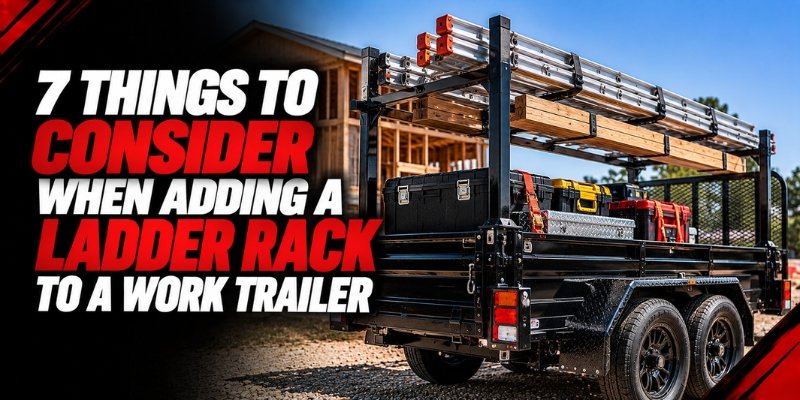
Trailer ladder rack ideas should start with the work you need the trailer to do, not the rack itself. Before adding one, consider load capacity, mounting strength, trailer dimensions, access, load restraint, storage layout and whether the modification suits your trailer’s approved configuration.
A ladder rack can free up valuable floor space and make a work trailer much easier to organise. For electricians, plumbers, builders, landscapers, maintenance contractors and mobile service businesses, getting ladders outside the main storage area can leave more room for tools, equipment and materials.
But a ladder rack also adds weight, changes the trailer’s overall dimensions and creates another structure that must handle vibration, wind and road loads. A rack that looks strong in the workshop can still be poorly suited to the trailer if its mounting, loading or position has not been planned properly.
What should your trailer ladder rack ideas prioritise first?
The best trailer ladder rack ideas start with your actual work routine: identify the ladders you carry, where they need to sit, how often you load them, what else the trailer carries and how the rack will affect access, weight distribution and towing.
1. Start with the ladder, not the rack
Measure the longest ladder you regularly carry.
Record:
- Overall ladder length
- Folded length, if applicable
- Width
- Weight
- Number of ladders
- Whether extension ladders are carried
- Whether pipes, conduit or other long materials will share the rack
A builder carrying one extension ladder may need a very different rack from an electrician carrying two ladders plus conduit.
A landscaper may also need room for long-handled equipment, while a maintenance contractor might use the rack for ladders during the week and other long items on occasional jobs.
The rack should be designed around the real load, not the maximum load you imagine carrying one day.
A simple planning table
Question | Why it matters |
What is the longest ladder? | Determines rack length and support position |
What is the heaviest ladder? | Determines required rack capacity |
How many ladders travel together? | Determines width and tie-down arrangement |
Will other long materials be carried? | May require additional supports |
How often are ladders removed? | Affects loading height and access |
Who loads them? | Ergonomics and working height matter |
What else sits in the trailer? | Determines the best rack location |
Will the trailer be enclosed or open? | Changes mounting and access options |
The goal is simple: the rack should make your work easier without creating a new loading problem.
How much weight should a ladder rack carry?
A ladder rack should have a rated capacity that comfortably covers the ladders and long materials you actually carry. You also need to account for the rack’s own weight because adding equipment changes the trailer’s available payload.
According to VSB 1 Revision 6 from the Australian Government Department of Infrastructure, trailer mass ratings and tare mass form part of the trailer’s approved configuration. The practical implication is that an added rack is not “free” weight; its mass needs to be considered alongside the trailer’s existing load and ratings.
2. Check three different weights
Do not look only at the rack rating.
You need to consider:
- Rack capacity: how much the rack itself is designed to carry.
- Ladder and accessory weight: the combined mass of everything placed on the rack.
- Trailer payload: how much additional weight the trailer can legally and safely carry after the rack is fitted.
For example, imagine a work trailer with a 2,000 kg ATM. If the trailer, tools, equipment and rack together approach that rating, fitting a stronger rack does not create additional trailer capacity.
The rack, ladders and tie-down equipment all form part of the real working setup.
Why this matters for tradies
A plumber might add a ladder rack and then gradually add pipe carriers, brackets and storage tubes.
An electrician might add two ladders plus conduit.
A builder might add an extension ladder and timber supports.
Each addition can consume payload and change how the trailer behaves.
Do not choose the rack independently from the trailer’s load rating.
Which ladder rack position works best on a work trailer?
The best rack position depends on trailer body style, ladder length, loading height, access points and the other equipment you carry. Common approaches include top-mounted, side-mounted, front-mounted and integrated rack systems.
3. Compare the main rack positions
Rack position | Best suited to | Main advantage | Potential drawback |
Top-mounted | Open or enclosed work trailers | Keeps floor space free | Increases overall height |
Side-mounted | Enclosed or box-style trailers | Convenient external access | Can affect side clearance |
Front-mounted | Some open work trailers | Keeps rear access clear | May affect drawbar area or front access |
Rear-mounted | Specific trailer configurations | Easy ladder access | Can interfere with ramps or rear doors |
Integrated cage rack | Cage or tradesman trailers | Strong, organised setup | Less flexible if layout changes |
Custom rack | Specialist work applications | Designed around exact workflow | Higher design/fabrication cost |
A top rack can be excellent when floor space is the priority, but you need to think about how high the ladder sits and whether the operator can safely load it.
A side rack can make loading easier from the kerb side, but the rack should not create an unnecessary width problem.
According to VSB 1, trailer dimensions include relevant protrusions, and overall trailer width includes items such as side-mounted racks. Total trailer height is measured to the highest point. That makes rack placement a dimensional issue as well as a storage decision.
Think about the loading position
A rack that requires two people to lift a ladder overhead every morning may look efficient on paper but become frustrating after a month.
Consider:
- Where the trailer is normally parked
- Whether loading happens from the kerb or jobsite
- Operator height
- Ladder length
- Whether the trailer is coupled when loading
- Whether other equipment blocks access
- Whether a rear ramp or tailgate needs to open fully
The best design is the one that fits the real workflow.
How should the rack work with your existing trailer storage?
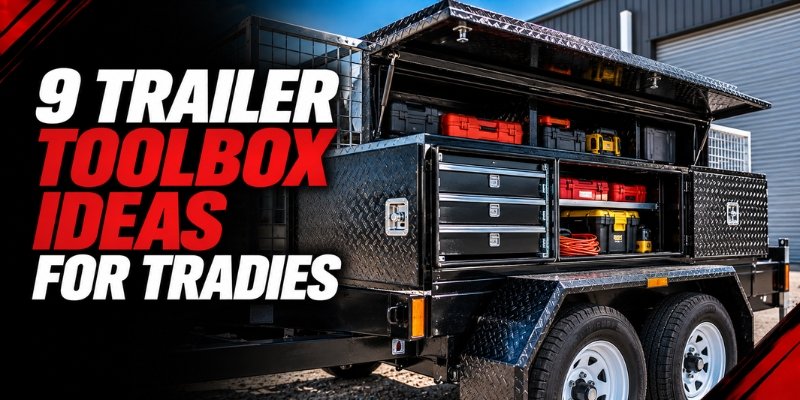
A ladder rack should complement your trailer storage rather than compete with it. Plan the rack alongside toolboxes, drawers, shelving, ramps, cages, doors and access paths so one addition does not make another feature difficult to use.
4. Treat the trailer as one storage system
This is where work trailer accessories need to be planned together.
For example:
- Ladder rack → carries long items
- Toolbox → stores hand tools
- Drawers → organise small components
- Shelving → stores boxes and equipment
- Cage → contains bulky materials
- Tie-down points → secure loads
- Ramp → loads machinery
- Spare wheel mount → protects usable floor space
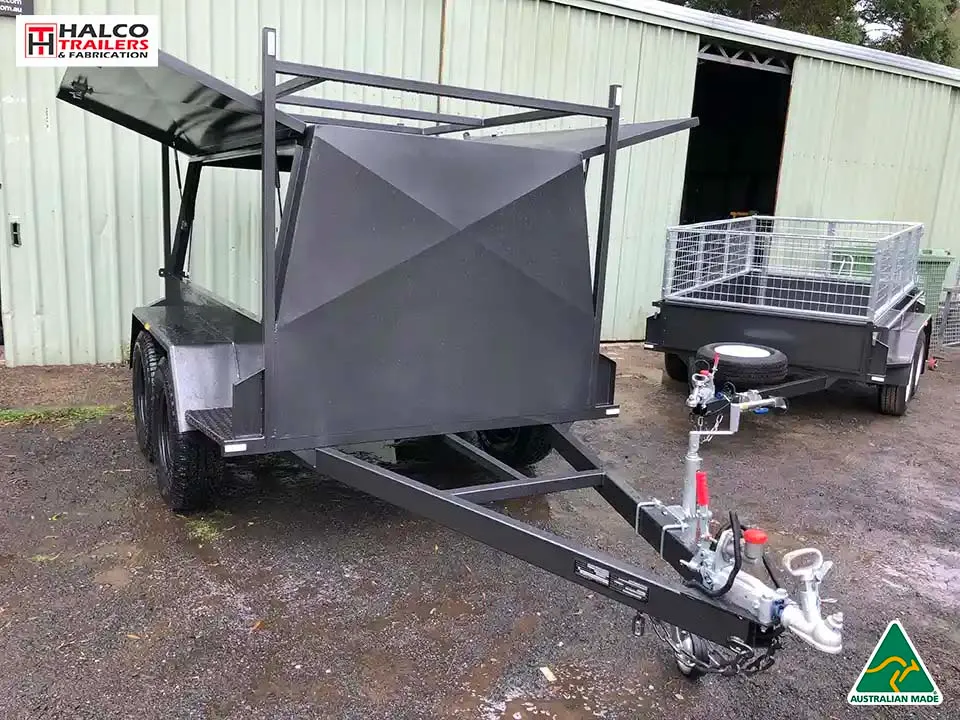
Halco’s tradesman trailer range is designed around this type of integrated approach, with options including ladder racks, lockable compartments, drawers, shelving, compressor boxes and custom layouts.
Avoid the “add everything later” problem
One of the common mistakes with trailer storage is adding accessories one at a time without considering the final layout.
A ladder rack is installed.
Then a toolbox is added.
Then a compressor box.
Then a ramp.
Then a spare-wheel holder.
Eventually, access becomes awkward and the usable space is smaller than expected.
If you already know the equipment you carry, map the trailer before installation.
A practical layout example
A plumber might use:
- External ladder rack for ladders
- Side storage for pipe and conduit
- Lockable compartments for fittings
- Drawers for hand tools
- Open rear space for larger equipment
- Tie-down points for longer materials
An electrician might prioritise:
- Ladder rack
- Cable storage
- Shelving
- Small-parts drawers
- Lockable tool compartments
- Interior lighting
A landscaper may need:
- Ladder or long-tool rack
- Mower space
- Cage sides
- Tool holders
- Tie-down points
- Open loading area
The rack should support the workflow, not simply occupy the highest available position.
What should you check about mounting and load restraint?
The rack needs secure mounting to suitable trailer structure, and the ladder still needs its own restraint system. A strong-looking rack is not enough if the mounting points, fasteners or load restraint are unsuitable for the forces experienced during braking and cornering.
5. Separate rack strength from load restraint
These are two different questions:
Can the rack support the ladder?
and
Can the ladder stay attached during transport?
You need both.
According to the National Transport Commission’s Load Restraint Guide for Light Vehicles, loads on light vehicles, including trailers, must be restrained so they remain on the vehicle during normal driving conditions, do not negatively affect vehicle stability and do not protrude in a way that could injure people or damage property.
That means the ladder should not simply sit on the rack.
Use appropriate rated restraints and secure the ladder against movement in the directions that matter during towing.
6. Check the mounting structure
Before drilling or welding:
- Identify the trailer chassis and structural members.
- Check where the rack brackets will transfer load.
- Consider vibration and repeated road impacts.
- Check whether the mounting hardware is suitable.
- Make sure bolts cannot loosen through normal use.
- Protect exposed steel against corrosion.
- Keep electrical wiring away from drilling and sharp edges.
- Confirm the rack does not interfere with lights, reflectors or the registration plate.
A community fabrication discussion about trailer ladder racks highlights a useful practical lesson: poorly secured bolted rack components can loosen and sway over time, while welded or properly engineered structures can provide greater rigidity. That is an anecdotal fabrication example rather than a regulatory standard, but it illustrates why mounting deserves as much attention as the rack itself.
What about modifying an existing trailer?
If you are modifying a registered trailer, do not assume every rack installation is automatically acceptable.
Transport Victoria states that modifications to light trailers must not affect compliance with registration standards. If you are unsure whether a proposed modification affects VSB 1 compliance, Transport Victoria recommends consulting a VASS signatory and obtaining the appropriate approval documentation.
For a simple accessory installation, the exact requirements depend on the trailer and modification. For structural welding, chassis changes or significant modifications, get the compliance position checked before starting work.
Which materials and finishes suit Australian work conditions?
Steel and aluminium are common choices for trailer ladder racks, with the right option depending on strength requirements, weight, corrosion exposure, appearance and repairability. The material should match how often the trailer works and where it operates.
7. Choose material based on the working environment
Material | Strengths | Considerations |
Steel | Strong, robust and widely repairable | Heavier and needs corrosion protection |
Galvanised steel | Good corrosion resistance | Finish can still be damaged by impacts |
Aluminium | Lightweight and corrosion-resistant | Can dent or fatigue depending on design |
Powder-coated steel | Durable finished appearance | Coating can be damaged by impacts |
Stainless steel | Strong corrosion resistance | Usually higher material cost |
For a trailer working around Melbourne construction sites, steel can make sense when robustness and repairability are priorities.
For coastal work or frequent wet exposure, corrosion resistance becomes more important.
For a trailer where reducing unnecessary tare weight is valuable, aluminium may deserve consideration.
Australian rack suppliers show that both aluminium and steel are common rack materials, with different finishes and custom sizing options available.
Think beyond the rack frame
The finish also matters.
Check:
- Weld quality
- Coating coverage
- Drainage points
- Corrosion protection
- Protective pads where ladders contact the rack
- Rubber or polymer contact surfaces
- Fastener corrosion resistance
A ladder rack is repeatedly exposed to rain, road spray, dust, vibration and handling. Good protection at the beginning can reduce maintenance later.
How can a ladder rack improve tradie trailer storage?
A well-planned ladder rack can turn wasted exterior space into useful storage while keeping long equipment out of the main cargo area. The biggest benefit is not simply carrying a ladder; it is creating a cleaner workflow for daily loading, unloading and tool access.
For tradie trailer storage, the key is to give every category of equipment a logical location.
A better storage framework
Equipment | Suggested storage location |
Ladders | External ladder rack |
Hand tools | Drawers or toolbox |
Power tools | Lockable compartments |
Pipes / conduit | Dedicated long-material holder |
Small fittings | Labelled drawers |
Compressor | Dedicated compressor box |
Machinery | Open floor/deck area |
Loose materials | Cage or contained area |
Tie-down equipment | Accessible restraint holder |
Spare wheel | Dedicated external mount |
The best trailer ladder rack ideas are therefore not isolated rack designs. They are part of a complete mobile-workspace layout.
Halco’s custom trailer engineering approach includes ladder racks, tool storage compartments, loading ramps, spare-wheel mounts and other modular features as part of the overall trailer specification rather than treating each addition as a completely separate decision.
When a ladder rack makes the biggest difference
A rack is particularly useful when:
- Ladders occupy too much floor space.
- Loading and unloading happens multiple times a day.
- The trailer carries both tools and long materials.
- You need to keep expensive equipment inside lockable storage.
- Your trade requires different ladder sizes.
- You want a more organised mobile workspace.
The improvement is often most noticeable on busy jobs where the trailer is opened and closed repeatedly. A well-planned rack can reduce unnecessary unloading and keep the main cargo area available for equipment.
When should you choose a custom-built ladder rack?
Choose a custom-built ladder rack when the trailer carries unusual equipment, has limited mounting space, needs multiple storage features or must accommodate a specific workflow. Custom design is particularly useful when the rack affects chassis structure, access, load distribution or other trailer equipment.
A standard rack can work well for straightforward applications. Custom design becomes more attractive when the trailer has to do several jobs at once.
Custom rack situations
Consider custom design when you need:
- Multiple ladder positions
- Extra-long ladders
- Pipe or conduit storage
- Integrated toolboxes
- Compressor storage
- Removable rack sections
- Special mounting locations
- Cage integration
- Custom branding panels
- Work lights
- Specific access requirements
- Tandem-axle or larger work-trailer layouts
Halco’s custom trailers are designed around the intended load, towing vehicle, dimensions, loading method, storage requirements and working conditions. Its custom trailer information specifically lists ladder racks, toolboxes, drawers, equipment mounts, tie-down points and cages among possible features.
Custom rack vs aftermarket rack
Requirement | Standard aftermarket rack | Custom-built rack |
One common ladder | Usually suitable | May be unnecessary |
Multiple ladders | Depends on capacity | Easier to optimise |
Pipes and long materials | May need extra supports | Can be integrated |
Existing cage | Compatibility must be checked | Designed around cage |
Toolboxes and drawers | May restrict access | Designed together |
Unusual trailer dimensions | Limited | Stronger fit |
New trailer build | Can be added later | Best planned from the start |
Specialist trade workflow | May compromise space | Can be built around the workflow |
For a new trailer, it is usually worth discussing the rack before fabrication is completed. Moving a mounting point during design is easier than redesigning a finished trailer.
What does a ladder rack setup cost in Australia?
Ladder rack pricing varies with material, size, load rating, mounting method and whether the rack is a standard component or custom fabrication. Current Australian product listings show examples from roughly $125 to $420, but these are individual product prices, not a market-wide average or fitted cost.
For example, Balance Trailers currently lists H-rack/ladder-rack options from $125 to $350 including GST, with different prices for bolt-on and cage-mounted options.
Another Australian supplier, Century Camper Trailer, lists a trailer ladder rack at 300–420, with a stated maximum load rating of 100 kg for that product.
These figures should be treated as examples only. A complete fitted solution can cost more once you add:
- Custom brackets
- Welding
- Powder coating
- Galvanising
- Additional crossbars
- Tie-down hardware
- Protective padding
- Structural reinforcement
- Wiring relocation
- Installation labour
For a business trailer, compare the cost against the value of usable floor space and daily loading time rather than choosing the cheapest rack.
A $200 rack that interferes with your toolbox or makes ladder loading awkward may be a poorer investment than a properly integrated system.
When should you inspect the rack after installation?
Inspect a newly fitted rack after its first few trips and regularly thereafter, especially after rough roads, heavy loading or changes to the equipment carried. Check fasteners, welds, brackets, corrosion protection, ladder contact points and restraint equipment.
Quick post-installation check
- Check every mounting point: look for movement, fresh marks or loose hardware.
- Check the rack when loaded: confirm the ladder does not contact the trailer body, lights or other equipment.
- Check the restraints: make sure straps or other restraints remain tight and correctly positioned.
- Check clearance: confirm the rack does not create an unexpected width, height or access problem.
- Check after rough travel: corrugations and worksites can loosen hardware faster than sealed-road use.
- Check for fatigue: look around welds and brackets for cracks or unusual movement.
If the rack starts moving, rattling or bending, stop using it until the cause is identified.
Conclusion
Good trailer ladder rack ideas begin with the whole trailer, not just the ladder. Match the rack to your load, payload, dimensions, storage layout, mounting structure and daily workflow, then make sure the ladder itself is properly restrained.
For Victorian tradies, contractors, builders, electricians, plumbers and landscapers, Halco can discuss ladder-rack integration as part of a new or custom trailer configuration. Explore Halco’s tradesman trailers or trailer parts and accessories and discuss your ladder, storage and towing requirements before choosing a setup.