
By Halco Trailers Team, Trailer Manufacturing / Safety Specialist
Published: 21 September 2026
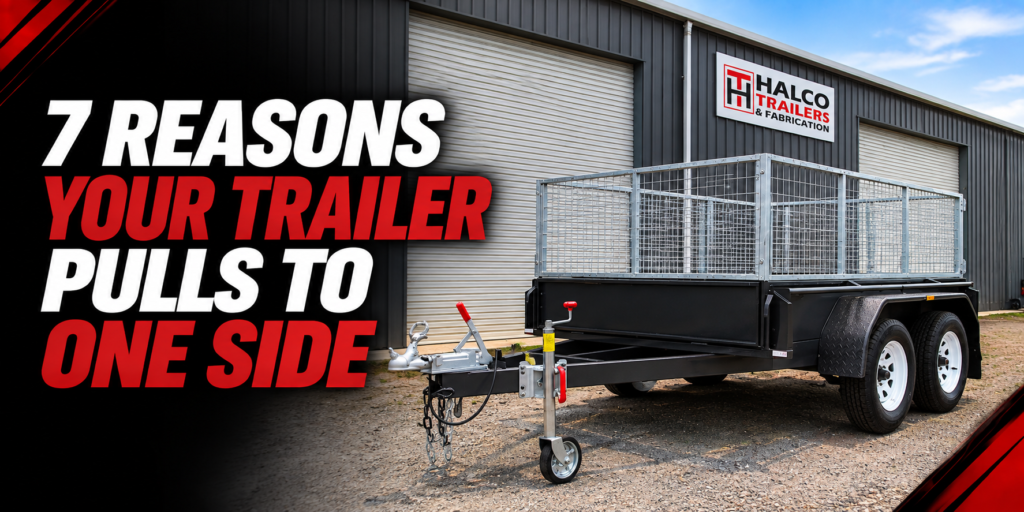
If your trailer pulls to one side while towing, check the tyres, load distribution, brakes, axle alignment, suspension, wheel bearings and coupling before continuing with a heavy load. A persistent pull can indicate a mechanical or setup problem that affects towing stability and tyre wear.
For tradies, contractors, landscapers, farmers and small business owners, this is more than an annoying steering correction. A loaded trailer that does not track properly can make braking harder, increase tyre wear and place additional stress on suspension, axles and the tow vehicle.
This trailer pulls to one side guide explains the seven most common causes, how to narrow down the problem, the mistakes to avoid and when professional trailer repair is the safer option.
Is a trailer pulling to one side the same as trailer sway?
No. A trailer pulling to one side is usually a consistent directional movement, while trailer sway is a side-to-side oscillation that can become progressively unstable. The two problems require different checks, although poor loading, tyres and suspension can contribute to either.
A trailer that always drifts right on a straight, reasonably level road is different from one that moves left and right after a gust of wind or sudden steering input.
Understanding that difference helps you start with the right checks.
What you feel | More likely area to investigate |
Constant pull to one side | Tyres, axle, suspension, brakes or coupling |
Pull only during braking | Trailer brakes or suspension |
Trailer moves left and right | Sway, loading, tyres or suspension |
Pull changes with the road | Road camber or surface |
Pull began after a pothole | Wheel, axle or suspension damage |
Pull began after loading | Load distribution or tyre pressure |
Pull becomes worse as the trailer heats up | Brake drag or bearing problem |
Australian road-safety guidance also recommends checking that a trailer’s tyres, wheel bearings, suspension and brakes work properly before each towing trip. The NSW Government towing guidance provides this type of pre-trip advice.
7 reasons your trailer pulls to one side
The seven main causes are uneven tyres, poor loading, uneven braking, axle misalignment, suspension wear, wheel or bearing problems, and coupling, drawbar or road-condition issues. The quickest diagnosis starts with simple checks before moving to mechanical inspection.
At-a-glance diagnostic table
# | Possible cause | Typical clue | First check |
1 | Tyre pressure or condition | Pull is present while cruising | Compare tyre pressures and wear |
2 | Uneven loading | Pull starts after loading | Recheck load position and restraint |
3 | Brake imbalance or drag | Pull is stronger while braking | Check brake response and hub heat |
4 | Axle misalignment | Constant pull and uneven tyre wear | Inspect axle position and alignment |
5 | Suspension wear | Leaning, clunking or bouncing | Check springs, bushes and shackles |
6 | Wheel, hub or bearing issue | Heat, noise or wheel movement | Inspect hub and wheel condition |
7 | Coupling, drawbar or road condition | Pull changes with road or coupling setup | Check coupling, drawbar and test route |
1. Uneven tyre pressure or tyre condition
Uneven tyre pressure is one of the simplest reasons a trailer can pull to one side. A softer tyre can change rolling resistance and how the trailer tracks, while uneven wear, internal tyre damage or different tyre specifications can create a similar symptom.
Check all trailer tyres when they are cold and compare them with the pressure specified for the trailer and tyre setup.
Also look for:
- Uneven tread wear
- Shoulder wear
- Cracks or bulges
- Cuts or impact damage
- Different tyre sizes or specifications
- A tyre that repeatedly loses pressure
- Evidence of the tyre rubbing on suspension or bodywork
Do not assume a new tyre fixes the problem. If one tyre is wearing differently because an axle or suspension component is misaligned, the replacement tyre can develop the same fault.
This is particularly important on work trailers that regularly carry tools, machinery, green waste, soil or construction materials.
2. Uneven loading or poor weight distribution
Uneven loading can make a trailer pull or track differently because the suspension and tyres are not carrying the load evenly. A heavy item positioned too far to one side can change the way the trailer responds, while excessive weight toward the rear can also affect towing stability.
For example, imagine a landscaping trailer carrying a mower, soil and equipment. If most of the heavier equipment is loaded on one side, the trailer may sit unevenly and place different loads on the left and right suspension.
Trailer loading checks
Check | What to look for |
Side-to-side distribution | Heavy items should not be concentrated on one side |
Front-to-rear distribution | Load position should suit the trailer and towing setup |
Trailer mass | Do not exceed applicable mass limits |
Load restraint | Equipment should remain secure during braking and cornering |
Suspension height | Trailer should not sit excessively low on one side |
Tyre pressure | Pressure should match the trailer’s required setup |
Clearance | Tyres should not rub guards or suspension |
The National Transport Commission’s Load Restraint Guide states that trailer loads must be properly restrained, must not exceed applicable mass limits and must not endanger other road users.
If the trailer only starts pulling after loading, investigate the load before assuming the axle or brakes have failed.
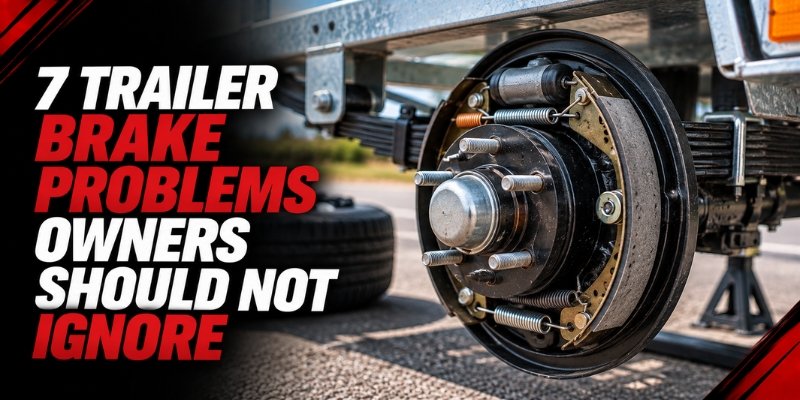
3. Uneven or dragging trailer brakes
If the trailer pulls mainly when you apply the brakes, investigate the braking system. One side may be braking harder than the other, while a dragging brake can create heat and resistance even when you are not actively braking.
Possible causes include:
- Uneven brake adjustment
- Worn brake components
- Damaged electric brake wiring
- Faulty brake magnets
- Brake drag
- Hydraulic brake problems
- Contaminated braking components
- Incorrect brake-controller settings
How braking behaviour can help
Symptom | Possible direction |
Pull only while braking | Uneven braking |
Pull gets stronger after several kilometres | Brake drag or heat |
Burning smell from one wheel | Possible brake or bearing overheating |
Trailer brakes feel weak | Adjustment, wiring or component issue |
One wheel appears to brake harder | Brake imbalance |
Controller warning appears | Electrical or brake-system fault |
Do not repeatedly adjust the brake controller to compensate for a mechanical fault. Controller settings cannot repair worn components, damaged wiring or brake drag.
If the trailer pulls hard during braking, stop using it until the braking system has been checked.
4. Axle misalignment or a bent axle
An axle that is misaligned, shifted or bent can cause a trailer to track incorrectly and may produce uneven tyre wear. This can happen after a significant pothole, kerb impact, rough worksite use, overload or suspension failure.
One useful clue is tyre wear. If one or more tyres are wearing heavily on a particular edge, do not automatically blame tyre pressure.
Possible axle-related clues
- Trailer consistently pulls in the same direction
- Tyres show unusual or uneven wear
- Wheels do not appear to sit symmetrically
- Trailer appears to “dog track”
- Pull started after an impact
- Suspension hardware has recently been replaced
- A wheel or axle appears visibly out of position
The current Vehicle Standards Bulletin 1 Revision 6 from the Australian Department of Infrastructure covers trailers with an aggregate trailer mass of 4.5 tonnes or less and provides manufacturers with applicable Australian Design Rule requirements.
Do not straighten or modify a structural axle or suspension component without proper assessment. The correct repair depends on the component, trailer design and applicable requirements.
5. Worn or damaged suspension
Worn suspension can change how a trailer tracks, particularly when it is loaded. Damaged springs, worn bushes, loose shackles, deteriorated hangers or other suspension faults can allow movement that affects axle position and tyre contact.
Look for:
- Trailer leaning to one side
- Cracked or damaged springs
- Excessive movement at shackles
- Worn bushes
- Loose suspension hardware
- Clunking over bumps
- Excessive bouncing
- Tyres rubbing the body or guard
- Uneven ride height
A trailer may feel acceptable when empty but behave very differently once loaded. This is why work trailers should be assessed under the type of conditions they actually experience.
For a trailer already showing suspension symptoms, avoid simply replacing the tyres. The underlying suspension or axle issue may still be present.
6. Wheel, hub or bearing problems
A wheel, hub or bearing problem can make a trailer feel as though it is pulling to one side. Excessive bearing play, a damaged wheel, incorrect wheel fitment or a bearing that is overheating can affect how that side rolls.
A useful warning sign is temperature difference.
After a short trip, and only when it is safe to do so, compare the general temperature of the hubs without touching components that may be extremely hot. If one side is significantly hotter than the other, investigate rather than continuing a long loaded journey.
Wheel and bearing warning signs
Sign | Possible issue |
One hub significantly hotter | Bearing problem or brake drag |
Grinding or rumbling | Bearing or hub damage |
Wheel movement | Bearing, hub or wheel-fitment issue |
Vibration | Wheel, tyre, hub or running-gear problem |
Uneven tyre wear | Alignment, suspension or wheel issue |
Grease leakage | Seal or bearing problem |
Repeated bearing failure | Incorrect adjustment, load or component issue |
A bearing problem can become a roadside failure. If there is obvious wheel movement, severe heat, grinding or damaged components, stop towing and arrange inspection.
7. Coupling, drawbar or road-condition issues
The final category covers several less obvious causes: coupling or drawbar problems, tow-vehicle alignment, road camber and changing road surfaces. These should be considered after the basic tyre, load, brake, axle and suspension checks.
Road camber can make a trailer or tow vehicle drift slightly toward the lower side of the road. That does not automatically mean there is a trailer fault.
A simple comparison
If the trailer:
- Pulls only on one particular road, consider road camber.
- Pulls consistently on different roads, investigate the trailer.
- Pulls after coupling to a different tow vehicle, check the towing setup.
- Changes behaviour after coupling hardware was replaced, inspect the coupling and drawbar.
- Pulls after a drawbar or chassis repair, have the repair assessed.
- Pulls severely or suddenly, stop towing and inspect before continuing.
The Transport Victoria roadworthiness requirements include steering and suspension, wheels and tyres, brakes, body and chassis, towing couplings and electrical wiring among the areas covered by the relevant roadworthiness inspection standards.
How can you diagnose the problem safely?
Use a simple trailer pulls to one side checklist: confirm tyre pressures, inspect tyre wear, check the load, determine whether the pull happens while braking, inspect suspension and axle components, check wheel and hub condition, and consider whether the road itself is influencing the movement.
Trailer pulls to one side checklist
Before towing
- Check all tyre pressures.
- Inspect tyres for damage and uneven wear.
- Confirm the trailer is loaded evenly.
- Check that the load is properly restrained.
- Confirm the coupling is locked.
- Check safety chains and electrical connection.
- Look for obvious suspension or axle damage.
During a cautious low-speed assessment
- Determine whether the trailer pulls constantly or only during braking.
- Listen for grinding, clunking or unusual vibration.
- Check whether the pull changes on a different road surface.
- Pay attention to any new tyre rubbing.
- Stop if braking becomes weak, uneven or unpredictable.
After a short trip
- Check for unusual hub or wheel heat.
- Look for new tyre marks or wear.
- Recheck straps and load position.
- Record anything that changed during the trip.
Do not perform testing at speed or in traffic simply to diagnose a fault. If the trailer feels unstable, brakes unevenly or pulls sharply, arrange professional inspection instead.
What are the common mistakes owners make?
The most common mistakes are replacing tyres without finding the cause, adjusting the brake controller to hide brake imbalance, ignoring uneven loading, continuing to tow after a severe pull and assuming every directional movement is caused by wheel alignment.
Common mistakes to avoid
Mistake | Why it can make things worse |
Replacing tyres immediately | The underlying axle or suspension issue may remain |
Increasing tyre pressure randomly | Incorrect pressure can affect handling and tyre wear |
Adjusting brakes repeatedly | It may hide a mechanical or electrical fault |
Ignoring one hot hub | Bearing or brake damage can escalate |
Continuing with a cracked spring | Suspension failure can affect axle position and control |
Blaming road camber every time | A constant pull across different roads needs investigation |
Loading heavier items on one side | Creates uneven suspension and tyre loading |
Towing to “see if it gets better” | A developing fault can become more serious under load |
The safest approach is to diagnose the cause rather than compensate for the symptom.
What trailer features should you consider when replacing a trailer?
If a trailer repeatedly struggles with its workload, consider the suspension, axle configuration, braking system, tyre specification, load capacity and chassis design rather than simply choosing another trailer of the same size.
This is particularly relevant when a business changes how it uses a trailer. A trailer originally carrying garden tools may later be expected to transport heavier machinery, bulk materials or equipment every day.
Trailer features to consider
Feature | Why it matters |
Correct load capacity | Prevents the trailer being routinely overloaded |
Suitable axle configuration | Supports the intended working load |
Appropriate suspension | Helps match the trailer to its real operating conditions |
Braking system | Important for heavier braked trailers |
Tyre specification | Must suit the trailer and operating load |
Chassis strength | Supports repeated work and loading |
Coupling rating | Must suit the trailer and towing setup |
Load-restraint points | Help secure equipment and materials |
Ground clearance | Important for rough worksites and farm use |
Serviceability | Easier access to common wear components can simplify maintenance |
The Department of Infrastructure’s VSB 1 should be consulted for applicable technical requirements when building or modifying a low-ATM trailer.
When should you book trailer repair?
Book trailer repair when the pull is persistent, severe, worsening or accompanied by uneven braking, unusual tyre wear, hot hubs, suspension damage, axle movement, wheel play, structural damage or coupling problems.
Do not diagnose every pull as an alignment problem. A professional inspection should consider the complete running gear.
Halco’s trailer repair and servicing team can inspect applicable brakes, bearings, axles, suspension, electrical systems, lighting, hydraulic equipment and structural components.
Halco advises owners to describe when the fault occurs, whether it happens during braking or loading, and provide photographs or relevant trailer information before travelling to the Warragul workshop.
When not to keep towing
Stop using the trailer if:
- It pulls sharply or suddenly.
- Braking is weak or uneven.
- A wheel or hub becomes unusually hot.
- You hear grinding from a wheel.
- A spring or suspension component is broken.
- A tyre is rubbing the trailer.
- The axle appears shifted.
- The coupling or drawbar is damaged.
- The trailer becomes unstable under load.
If the trailer is not safe to tow, organise suitable recovery or transport rather than driving it to the workshop.
Conclusion
When a trailer pulls to one side, start with the simple checks but do not ignore persistent symptoms. Tyres, loading, brakes, axle alignment, suspension, bearings, coupling and road conditions can all influence how a trailer tracks.
For tradies, contractors, landscapers, farmers and small businesses, early diagnosis can prevent uneven tyre wear, component damage and unexpected downtime.
If your trailer continues to pull after the basic checks, arrange a professional inspection before your next loaded trip. Halco Trailers provides trailer repairs, servicing and replacement parts from its Warragul workshop for customers across Gippsland, regional Victoria and Melbourne.
FAQ'S
Is it safe to tow if my trailer pulls to one side?
No, not if the pull is severe, persistent or accompanied by poor braking, wheel heat, unusual noise, suspension damage or instability. A mild drift caused by road camber can be different, but a consistent pull across different roads should be investigated before heavy towing.
Can low tyre pressure make a trailer pull to one side?
Yes, uneven tyre pressure can change rolling resistance and how the trailer tracks. Check all trailer tyres cold and use the pressure appropriate for the trailer and tyre setup. If one tyre repeatedly loses pressure, have the tyre, valve and wheel checked.
Why does my trailer only pull when braking?
Uneven trailer braking or brake drag can cause a directional pull during braking. Possible causes include adjustment, electric brake components, wiring, magnets or hydraulic components. If the trailer pulls strongly while braking, stop loaded towing until the braking system is inspected.
Can a bent axle make a trailer pull to one side?
Yes, a bent or displaced axle can alter wheel alignment and cause consistent pulling, unusual tyre wear or tracking problems. This can occur after impacts, overloading or suspension damage. Have the axle and related suspension components inspected rather than attempting an improvised correction.
Why does my trailer pull after I load it?
A pull that appears after loading can result from uneven side-to-side loading, incorrect load position, excessive weight or a suspension problem that becomes noticeable under load. Recheck the load and restraint first. If the trailer still pulls, inspect the suspension, tyres and axle.
Can road camber make a trailer pull?
Yes, the slope built into many roads for drainage can create a mild directional drift. If the behaviour changes with different roads, camber may be contributing. A trailer that consistently pulls the same way on different reasonably level roads should be professionally checked.