

By Halco Trailers Team, Trailer Manufacturing / Safety Specialist
Published: 17 August 2026
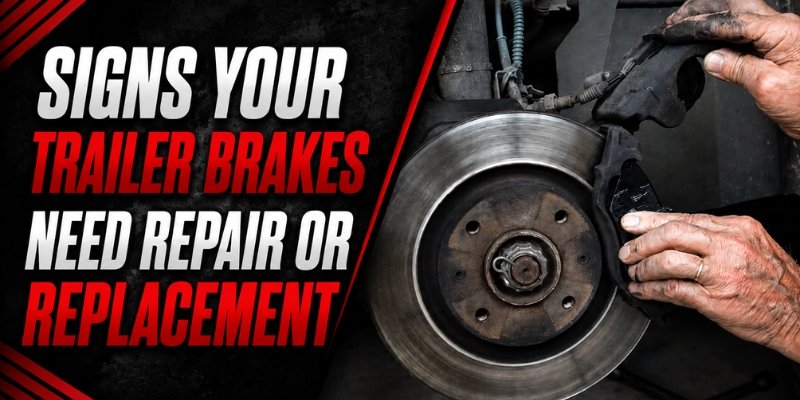
Trailer brake warning signs include weak stopping, grabbing, pulling, grinding, overheating, brake-controller warnings, delayed response, locked wheels and fluid leaks. Do not keep towing under load; inspect the braking system and book trailer brake repair quickly.
For tradies, contractors, landscapers, farmers, automotive businesses, tiny house builders and small business owners, brake faults are not just mechanical problems. They can stop a job, damage a load, put staff at risk and make a trailer unsafe on public roads.
Use these trailer brake warning signs to decide when a simple check is enough, when the trailer should stop moving and when professional trailer servicing is the safer next step.
What trailer brake warning signs mean you should stop towing?
Trailer brake warning signs that mean you should stop towing include brake drag, wheel lock-up, hot hubs, burning smell, grinding noise, strong pulling, poor stopping, leaking fluid or brake-controller warnings that appear while the trailer is connected.
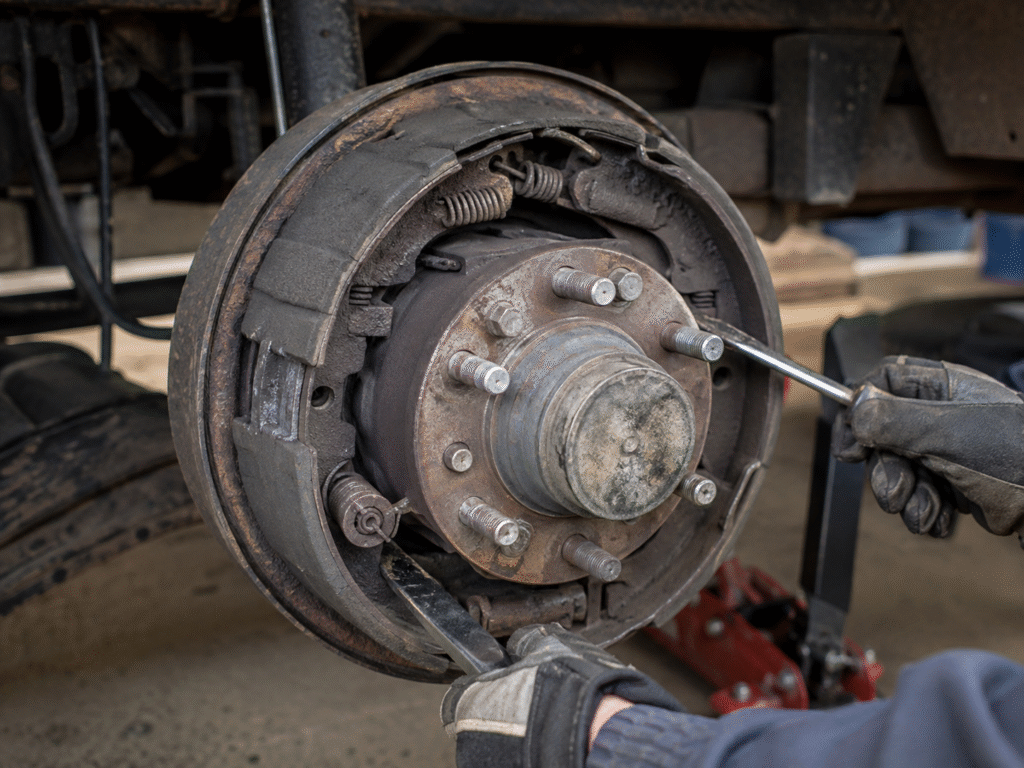
The safest rule is simple: if the trailer is loaded and the brakes feel different, stop and check. Do not assume the tow vehicle can compensate, especially with work loads, wet roads, steep streets, gravel driveways or highway speed.
Brake warning sign decision table
Warning sign | What it may mean | Safer next step |
Trailer pushes the tow vehicle | Brakes weak, disconnected or poorly adjusted | Stop loaded towing and inspect brake function |
Trailer pulls to one side | Uneven braking, tyre issue, bearing issue or load imbalance | Check load first, then book brake inspection |
Wheels lock too easily | Brake controller gain too high or brake fault | Reduce load risk and inspect before continuing |
Grinding or scraping | Worn shoes, damaged drums or hardware fault | Do not keep towing until checked |
Burning smell | Dragging brakes, overheated hubs or seized component | Stop, let it cool and arrange assessment |
Hot hub on one side | Brake drag, bearing issue or uneven adjustment | Avoid further towing under load |
Brake controller warning | Wiring, magnet, connection or controller fault | Diagnose before heavy towing |
Hydraulic fluid leak | Hose, cylinder, actuator or fitting issue | Do not tow loaded until repaired |
Delayed braking response | Wiring, controller, adjustment or hydraulic fault | Inspect before long-distance travel |
Trailer jerks when braking | Grabby brakes, coupling issue or brake imbalance | Check coupling and brakes together |
A practical example: a landscaper loads wet soil into a tipper trailer. Empty, the trailer feels normal. Loaded, it pushes through intersections and smells hot after ten minutes. That is not “just a heavy load”; it is a brake warning that needs inspection before the next run.
Why do trailer brakes fail or lose performance?
Trailer brakes lose performance because of wear, poor adjustment, contaminated linings, damaged wiring, corroded plugs, faulty magnets, hydraulic leaks, heat, overloaded towing, water exposure, long storage or mismatched brake-controller settings.
Brake problems are rarely caused by one neat issue. A dirty plug can affect electric brakes. A worn bearing can create heat that feels like brake drag. A badly balanced load can make good brakes feel weak. A trailer left outside for months can develop corrosion before it moves again.
Common causes of brake problems
Cause | Common trailer types affected | What owners may notice |
Worn brake shoes or pads | Work trailers, car trailers, plant trailers | Longer stopping, noise, reduced control |
Poor brake adjustment | Electric or mechanical brake setups | Weak braking or grabbing |
Corroded plug or wiring | Outdoor-stored trailers | Intermittent brakes or controller warnings |
Faulty brake magnets | Electric brake trailers | Weak or uneven electric braking |
Damaged drums or discs | Heavy work trailers | Vibration, grinding or uneven response |
Hydraulic fluid leak | Hydraulic brake setups | Soft response, leak marks, poor braking |
Seized or sticky components | Stored or wet-use trailers | Dragging, heat or lock-up |
Incorrect controller gain | Electric brake trailers | Too much or too little braking |
Overloading | Commercial and farm trailers | Excess stopping distance and heat |
Water or mud contamination | Boat, farm and landscaping trailers | Noise, corrosion and inconsistent braking |
For business operators, the cost of ignoring a brake issue often appears somewhere else first: tyre wear, damaged bearings, poor fuel economy, tow vehicle brake strain or a trailer that becomes unreliable during peak season.
How do Australian trailer brake requirements affect repairs?
Australian brake requirements matter because the correct repair depends on trailer weight and system type. A light trailer, braked tandem trailer and heavy hydraulic tipper may need different brake hardware, inspection depth and breakaway-system checks.
According to the Department of Infrastructure’s Vehicle Standards Bulletin 1, known as VSB 1, VSB 1 applies to trailers with an aggregate trailer mass of 4.5 tonnes or less and helps manufacturers understand ADR requirements for common trailer types.
VSB 1 states that trailers over 750 kg GTM need an efficient service braking system. It also states that trailers over 2,000 kg GTM need brakes operating on all wheels and an emergency breakaway system that applies the brakes if the trailer disconnects.
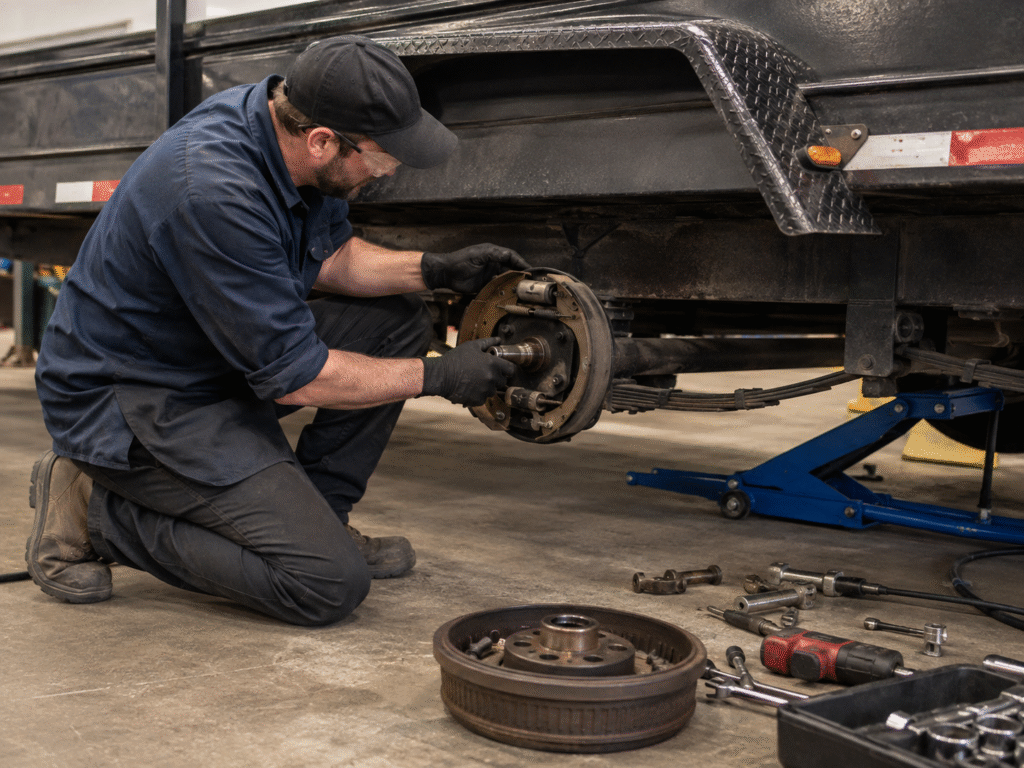
Transport Victoria’s roadworthiness requirements include brake inspection items such as general condition, brake linings, brake discs and drums, stopping performance, parking brake and warning devices. That makes brake conditions relevant for practical safety and roadworthy outcomes.
Brake requirement context table
Trailer situation | Brake-related implication |
Very light trailer | Brakes may not be required, but tyres, load and tow vehicle limits still matter |
Trailer over 750 kg GTM | Efficient service brakes are required under VSB 1 guidance |
Trailer over 2,000 kg GTM | Brakes must operate on all wheels and a breakaway system is required |
Work trailer with repeated heavy loads | Brake wear, adjustment and heat need closer inspection |
4.5 tonne trailer build | Brake system, breakaway function, coupling, load and tow vehicle suitability must be considered together |
Trailer modified or reconfigured | Brake suitability may need review after changes |
Trailer presented for roadworthy | Brake condition and performance may be inspected |
Trailer used interstate | Owners should confirm local registration and operating requirements |
The important point is not just whether the trailer has brakes. The brakes must suit the trailer’s loaded use, be maintained and work properly when the trailer is actually carrying the loads it was built for.
How can owners check trailer brakes before a trip?
Owners can check trailer brakes before a trip by testing connection, controller response, brake feel, lights, wiring, load position, hub temperature and obvious leaks. These checks do not replace workshop servicing, but they catch faults early.
A pre-trip check should be quick enough to do regularly and clear enough to stop unsafe towing. It should happen before loaded work, long travel, steep routes, towing after storage and any trip after repairs or modification.
10-minute brake check process
- Connect on level ground: uneven ground can hide coupling movement, load imbalance and poor trailer height.
- Check the plug and cable: corrosion, loose pins and crushed wiring can affect electric brake operation.
- Set the brake controller correctly: too much gain can lock wheels, while too little lets the trailer push the tow vehicle.
- Test the manual override at low speed: a gentle private-road or yard test can confirm the trailer brakes respond.
- Brake gently from walking pace: grabbing, pulling or delayed response means the system needs attention.
- Check brake lights at the same time: brake-light faults and brake-control faults can share wiring or plug issues.
- Inspect for fluid leaks where hydraulic brakes are fitted: wet backing plates, hoses or fittings need repair.
- Touch-check hubs carefully after short towing: one hot hub can indicate brake drag or bearing trouble.
- Recheck after 10 to 20 kilometres: heat, dragging and controller warnings often appear once the trailer settles.
- Stop if the trailer behaves differently under load: loaded towing exposes brake faults much faster than empty towing.
According to the National Transport Commission’s Load Restraint Guide for Light Vehicles, a vehicle or trailer must be loaded safely. Its light-vehicle guidance explains that loads must be restrained for normal driving forces such as heavy braking, cornering and acceleration. Load restraint therefore affects braking safety, not only cargo security.
What brake symptoms point to repair, adjustment or replacement?
Some brake symptoms need adjustment, while others need repair or replacement. Weak braking, grabbing, pulling, overheating, grinding, fluid leaks, repeated controller faults and uneven wear should be diagnosed before parts are replaced at random.
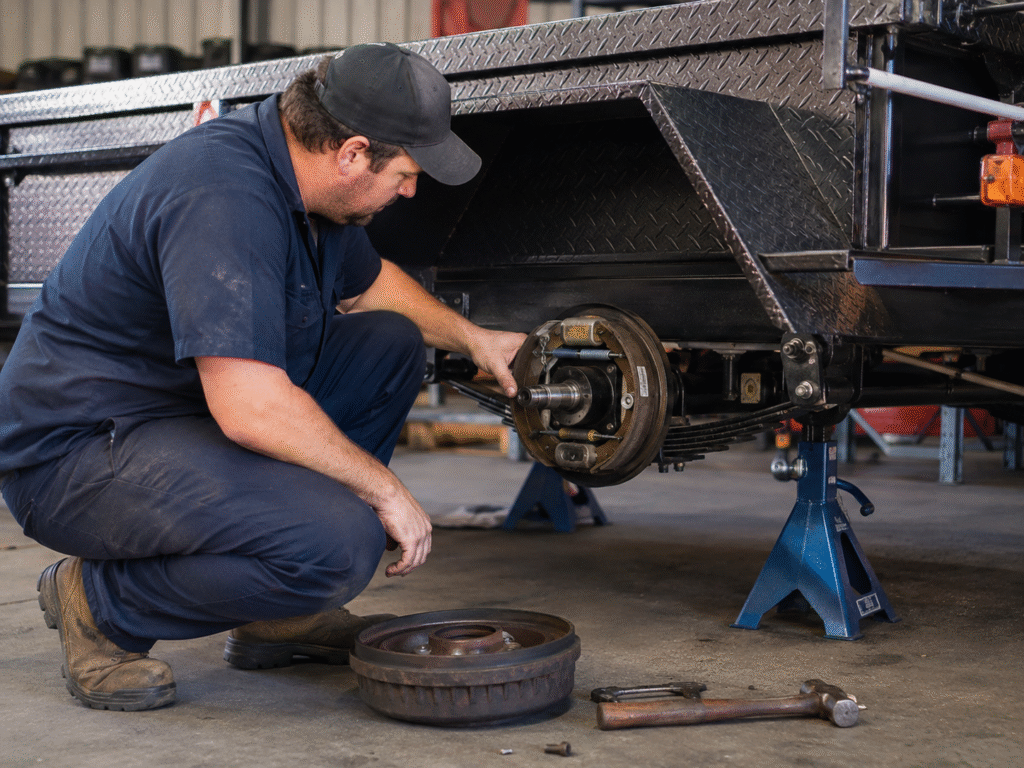
Do not start by guessing the cheapest part. Replacing a plug will not fix worn brake shoes. Adjusting controller gain will not fix a leaking hydraulic cylinder. Replacing shoes will not solve poor earth wiring on electric brakes.
Symptom-to-action table
Symptom | Likely direction | Why |
Brakes feel weak but quiet | Adjustment or controller check | Brake force may be too low or uneven |
One wheel locks first | Adjustment, contamination or mechanical fault | Brake force is not balanced |
Trailer pulls under braking | Brake balance, bearing, tyre or load issue | One side may be doing more work |
Grinding noise | Repair or replacement | Shoes, drums or internal hardware may be damaged |
Burning smell | Immediate inspection | Brake drag or hub heat can escalate quickly |
Fluid leak | Hydraulic repair | Leaks reduce hydraulic brake performance |
Controller says disconnected | Wiring or plug repair | Electric brakes may not be receiving signal |
Brakes grab at low speed | Adjustment or component inspection | Brake setup may be too aggressive or contaminated |
Brake performance fades downhill | Heat, overload or system suitability issue | The system may be working beyond its condition or rating |
Repeated faults after repair | Full diagnostic inspection | The root cause may not have been fixed |
In practice, a reliable trailer brake repair starts with diagnosis. The workshop needs to know the trailer type, brake system, load pattern, fault behaviour, recent repairs and whether the problem happens empty, loaded or only after warming up.
How do electric and hydraulic trailer brakes show faults differently?
Electric brakes often show faults through controller warnings, poor response, wiring issues, magnet faults or uneven adjustment. Hydraulic brakes often show faults through leaks, soft response, actuator problems, dragging, contamination or poor brake balance under load.
Both systems can be safe when designed, installed and maintained correctly. Both can also become unsafe if owners only check the symptoms they can see. Electrical and hydraulic brake faults need different diagnostic thinking.
Brake type | Warning signs | What to inspect |
Electric brakes | Controller warnings, lock-up, weak response, uneven braking | Controller, wiring, plug, earth, magnets, drums and adjustment |
Hydraulic override brakes | Delayed response, grabbing, fluid leaks, poor return | Coupling actuator, fluid, hoses, cylinders, calipers and drums/discs |
Electric-over-hydraulic brakes | Controller warnings, slow response, hydraulic faults | Controller compatibility, pump, fluid, wiring and hydraulic components |
Mechanical override brakes | Harsh movement, poor braking, coupling issues | Coupling slide, cables, adjustment and brake hardware |
Breakaway system | Battery warning, failed activation, loose lanyard | Battery charge, switch, wiring, lanyard and brake application |
For hydraulic tipper trailers, the brake system should be considered with the trailer’s normal workload. Soil, gravel, mulch, machinery and demolition material can change stopping behaviour quickly when the trailer is near its working limit.
Halco’s 4.5 tonne trailer page notes that integrated braking systems may be available in electric or hydraulic configurations for heavy custom builds. For owners, that means brake checks should match the actual build, load and towing setup, not a generic checklist.
How often should work trailer brakes be serviced?
Work trailer brakes should be checked before loaded towing and serviced on a schedule based on weight, distance, road surface, storage, weather exposure and business reliance. Daily work trailers need more attention than occasional household trailers.
A trailer that works around construction sites, farms, landscaping jobs or machinery transport faces vibration, dust, mud, water, heat and repeated braking. Those conditions shorten the gap between “fine last month” and “unsafe this morning.”
Trailer brake service frequency guide
Trailer use | Owner check | Workshop servicing |
Occasional household use | Before every tow | Annually or before a major trip |
Regular tradie trailer | Weekly and before heavy loads | Every 6 to 12 months depending on use |
Landscaping trailer | Before loaded runs | Before peak season and after heavy wet loads |
Farm trailer | Before road towing | After storage, rough paddock use or heavy loads |
Plant trailer | Before every machine move | Scheduled by load frequency and distance |
Car trailer | Before each transport job | Before long-distance or commercial towing |
Tandem work trailer | Before loaded towing | More often if heat, wear or braking symptoms appear |
Hydraulic tipper trailer | Before each heavy tipping job | Regularly, with hydraulic and brake checks together |
4.5 tonne trailer | Before every heavy loaded trip | Scheduled servicing based on load, GTM, braking setup and business use |
Halco’s trailer servicing support includes inspection and repair discussions around trailer brakes, bearings, axles, suspension, electrical systems, lighting, hydraulics and structural components. For business trailers, planned servicing is usually easier than emergency repair during a booked job.
When should you book trailer brake repair instead of DIY checks?
Book professional trailer brake repair when brakes pull, grab, grind, drag, overheat, leak fluid, trigger controller warnings or behave differently under load. DIY checks help identify symptoms, but brake diagnosis needs proper inspection.
The dividing line is a safety-critical function. Cleaning a plug or checking a light is basic ownership. Guessing at brake adjustment, worn drums, hydraulic leaks, electric magnets, breakaway faults or repeated overheating is not.
DIY check vs professional repair table
Issue | DIY check is enough? | Book repair when |
Dirty plug | Basic cleaning may help | Fault returns or brake controller warning remains |
Weak braking | No | Trailer pushes tow vehicle or stops poorly |
One hot hub | No | Heat appears after short towing |
Brake fluid leak | No | Any visible leak appears |
Grinding noise | No | Noise occurs while braking or rolling |
Brake lights work but brakes do not | No | Electric brake circuit may be faulty |
Brakes lock easily | Basic controller check only | Lock-up continues after proper setting |
Trailer pulls to one side | No | Load is correct but pulling remains |
Breakaway test uncertain | No | Battery, switch or lanyard function is unclear |
Repeated brake repairs | No | Full system diagnosis is needed |
Halco can inspect applicable braking systems through its trailer parts and servicing workshop in Warragul. For heavy-duty operators using tandem trailers, brake repair should be tied to axle, bearing, tyre and load checks because those systems affect each other.
How much can trailer brake repairs cost in Australia?
Trailer brake repair costs depend on brake type, trailer size, parts availability, access, fault severity and whether bearings, hubs, wiring or hydraulic components also need work. Diagnosis should come before quoting the final repair cost.
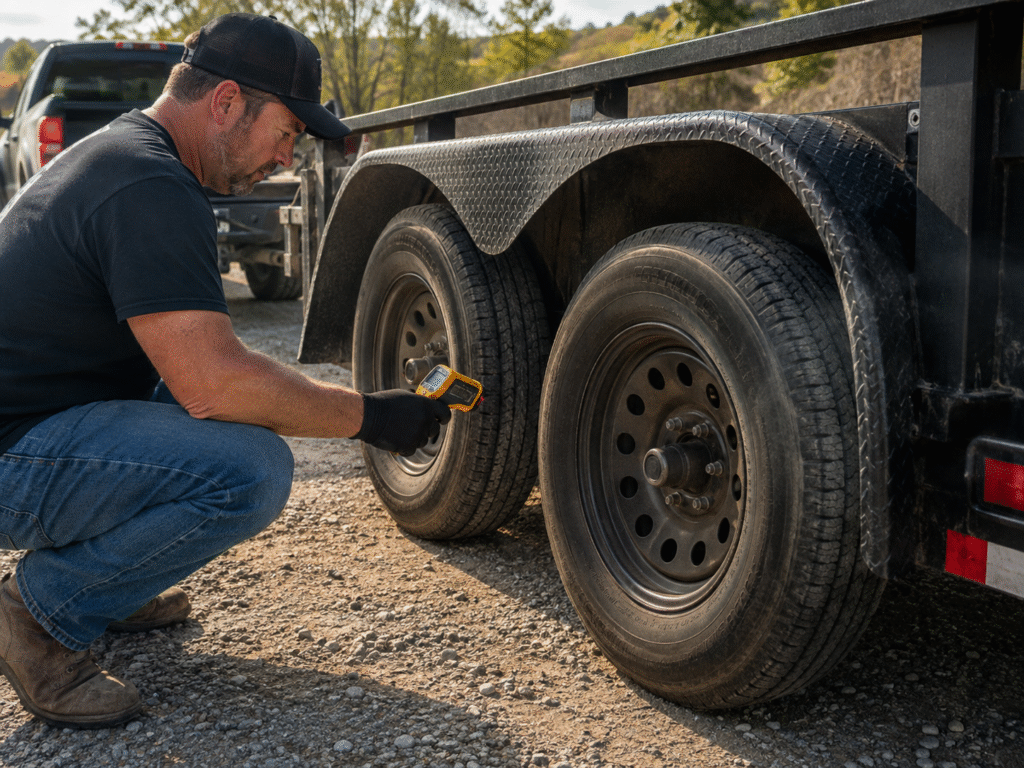
A simple adjustment or wiring repair can be very different from replacing brake assemblies, drums, magnets, hydraulic parts or damaged hubs. Work trailers also create cost through downtime, not just parts and labour.
Brake repair cost factors
Cost factor | Why it changes the job |
Electric vs hydraulic brakes | Different parts, testing methods and labour |
Single axle vs tandem axle | More wheels usually means more parts and inspection time |
Brake hardware condition | Drums, shoes, magnets, cylinders and springs may all affect repair scope |
Wiring access | Hidden wiring faults can take time to trace |
Hydraulic leaks | Hoses, cylinders, actuators or fittings may be involved |
Bearing or hub damage | Brake heat and bearing problems often overlap |
Parts availability | Standard parts are easier than unusual or older setups |
4.5 tonne trailer setup | Heavier builds need careful brake, breakaway, tyre, bearing and tow-vehicle compatibility checks |
Commercial urgency | Faster turnaround depends on workshop capacity and parts supply |
Previous repairs | Poor earlier repairs can increase diagnostic time |
For a small business, the cheapest path is usually early action. A brake adjustment or wiring repair found during servicing is easier to manage than a roadside breakdown, damaged load, missed job or overheated hub repair.
Conclusion
Do not ignore trailer brake warning signs. Weak stopping, pulling, grinding, overheating, lock-up, leaks and controller warnings are early signals that the trailer may need repair, adjustment or replacement brake parts.
For trailer owners across Warragul, Melbourne, Gippsland and regional Victoria, Halco Trailers can help with trailer brakes, trailer servicing, parts and repair support. If your trailer behaves differently under load, especially on hydraulic tipper trailers or 4.5 tonne trailer builds, book an inspection before the next work trip.