

By Halco Trailers Team, Trailer Manufacturing / Safety Specialist
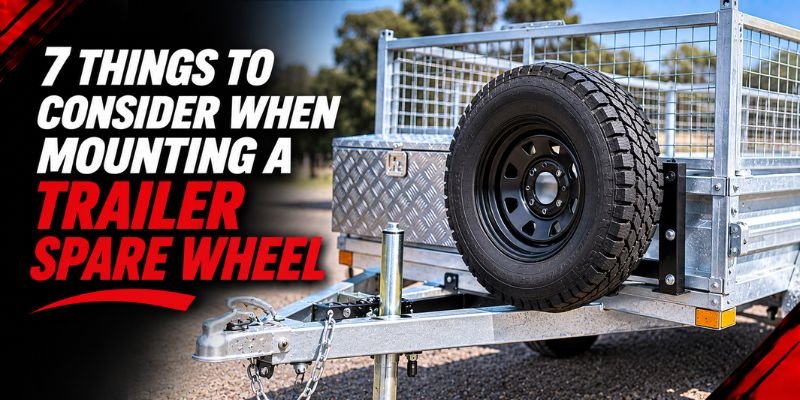
A secure trailer spare wheel mounting setup starts with choosing a suitable location, checking wheel and carrier compatibility, and considering weight distribution. Whether mounting a spare wheel on a box, tradesman or machinery trailer, the holder must be securely attached without interfering with the coupling, lighting, loading equipment or towing vehicle.
For trailer owners, mobile mechanics, tradespeople and fleet operators across Warragul, Gippsland and regional Victoria, carrying a spare wheel can be particularly useful when travelling between jobs or through areas where tyre assistance may not be immediately available.
However, simply attaching a spare wheel to the drawbar or trailer frame is not always the best solution.
An unsuitable mounting arrangement may interfere with access, alter towball download, place unnecessary loads on trailer components or create difficulties during a roadside breakdown.
This guide covers seven important considerations, common mounting locations, wheel compatibility, installation checks and mistakes to avoid when choosing a spare wheel carrier.
1. Choose a Suitable Spare Wheel Mounting Location
The first step in planning a trailer spare wheel mounting arrangement is deciding where the wheel should be positioned.
The ideal location depends on the trailer’s design, available mounting space, wheel weight and how the trailer is normally used.
Common mounting positions include:
- Trailer drawbar.
- Side of the trailer frame.
- Front section of the trailer body.
- Purpose-designed external mounting bracket.
- Suitable underbody carrier.
Each position has advantages and limitations.
Drawbar Spare Wheel Mounting
The drawbar is a common location because it may provide accessible storage without occupying the trailer deck.
However, a drawbar-mounted wheel must not interfere with the coupling, jockey wheel, electrical connections, safety chains or towing vehicle.
The mounting arrangement also needs adequate clearance during turning and reversing.
For example, a box trailer with a short drawbar may have limited space for a spare wheel carrier.
Before choosing this position, check the available clearance and structural suitability.
Side-Mounted Spare Wheel
Side mounting can be useful where the drawbar is occupied by a toolbox or other equipment.
However, the carrier may increase the trailer’s overall width or interfere with side doors, mudguards and loading arrangements.
The mounting position must also be structurally suitable.
Underbody Spare Wheel Mounting
An underbody carrier can keep the spare wheel away from the main loading area.
However, ground clearance, road debris, accessibility and mounting strength need careful consideration.
This may be particularly important for machinery trailers and work trailers travelling across uneven construction sites.
Practical tip: Select the mounting position according to your trailer’s actual layout, rather than assuming a drawbar or side-mounted carrier will suit every design.
2. Check Spare Wheel and Carrier Compatibility
Not every trailer spare wheel holder is suitable for every wheel.
Before purchasing a mounting bracket, confirm the specifications of the spare wheel and the carrier.
A carrier must be capable of securely supporting the complete wheel and tyre assembly under the intended operating conditions.
Important Wheel Compatibility Checks
Component | What to verify |
Stud pattern / PCD | Correct number and spacing of wheel mounting holes |
Centre bore | Suitable fit for the trailer hub, where applicable |
Wheel offset | Adequate clearance around brakes, hubs and guards |
Rim dimensions | Correct diameter and width |
Tyre size | Suitable replacement size for the trailer |
Tyre load rating | Appropriate for the applicable trailer load |
Carrier rating | Suitable for the complete wheel and tyre assembly |
Mounting hardware | Correct fasteners and retention method |
Carrier Compatibility vs Road-Use Compatibility
A wheel that fits onto a spare wheel carrier is not necessarily suitable for use on the trailer.
The carrier may have a compatible stud pattern while the wheel itself has an unsuitable offset, centre bore, rim dimension or tyre load rating.
For example, a wheel from another trailer might fit the carrier but not provide the necessary clearance around the trailer’s braking components.
Before selecting a spare wheel, confirm its compatibility with the trailer’s hub, axle and tyre requirements.
Why This Matters for Commercial Trailers
Mobile mechanics and fleet operators may manage several trailers with different wheel specifications.
Using the wrong spare wheel could leave the trailer unusable during a breakdown.
Keeping accurate tyre and wheel information for each trailer can help avoid compatibility problems.
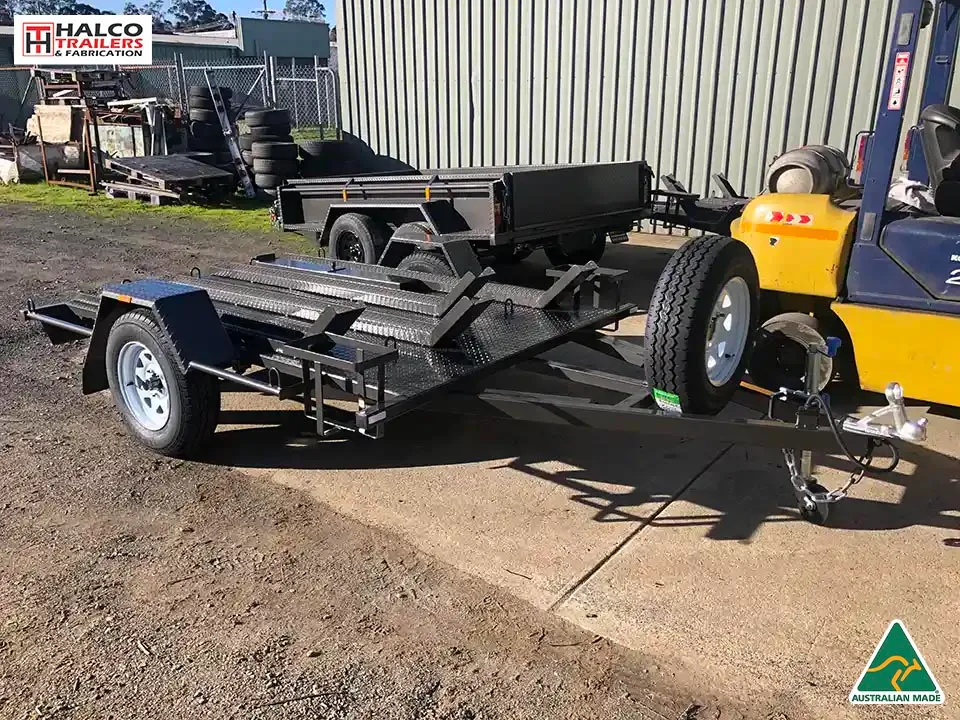
When enquiring about replacement trailer parts, provide the wheel dimensions, stud pattern and relevant trailer identification details.
Practical tip: Record the correct spare wheel and tyre specifications in your trailer maintenance documents.
3. Consider Spare Wheel Weight and Trailer Balance
Adding a spare wheel and carrier increases the trailer’s weight.
Its mounting location can also change how the trailer’s mass is distributed between the axle group and towing vehicle.
This is particularly important for work trailers carrying heavy equipment, toolboxes or machinery.
How Mounting Position Affects Towball Download
A spare wheel positioned ahead of the trailer’s axle group will generally increase towball download.
A spare wheel positioned behind the axle group may reduce towball download.
The actual change depends on the wheel’s weight, its distance from the axle group and the trailer’s existing load distribution.
Example: Spare Wheel and Carrier Weight
Consider the following hypothetical arrangement:
Component | Weight |
Spare wheel and tyre | 25 kg |
Mounting carrier and hardware | 5 kg |
Total additional mass | 30 kg |
In this example, the spare wheel arrangement adds 30 kg to the trailer’s mass.
However, this does not automatically mean towball download increases by 30 kg.
The effect depends on where the carrier is mounted relative to the trailer’s axle group.
For example, placing the assembly near the front of the drawbar may have a different effect from mounting it closer to the axle.
The remaining payload must also be checked, along with axle, towbar, coupling and towing vehicle limits.
Why Weight Distribution Matters
Incorrect trailer loading can affect towing stability and handling.
A spare wheel carrier should therefore be considered part of the trailer’s overall loading arrangement rather than an accessory with no effect on towing.
This is especially relevant for tradesman trailers fitted with front toolboxes or machinery trailers carrying concentrated loads.
Practical tip: If the trailer regularly operates near its approved mass limits, have the proposed mounting arrangement assessed and check the actual loaded axle and towball loads where necessary.
4. Choose Secure Mounting Brackets and Suitable Fasteners
The mounting bracket must keep the spare wheel securely attached during transport.
Road vibration, braking, cornering and uneven surfaces can place repeated loads on the carrier and its mounting points.
A suitable bracket should be designed for the wheel and approved mounting arrangement.
Important considerations include:
- Appropriate carrier load rating.
- Suitable bracket construction.
- Correct mounting fasteners.
- Secure attachment to the trailer.
- Resistance to vibration and loosening.
- Corrosion protection.
- Accessibility for inspection.
Should You Bolt or Weld a Spare Wheel Carrier?
The correct installation method depends on the carrier and trailer structure.
Some spare wheel holders are designed for bolted or clamped installation using specified hardware.
Other installations may involve fabrication or structural modifications.
However, drilling or welding into a trailer’s chassis or drawbar without proper assessment may affect its structural integrity.
A mounting bracket should not be installed simply because there is enough physical space.
The proposed attachment area must be capable of supporting the wheel and carrier under the relevant operating conditions.
Why Professional Assessment May Be Necessary
Structural trailer components are designed to carry particular loads.
Poorly positioned holes, unsuitable welds or incorrect attachment hardware can affect their performance.
Where the mounting method requires structural changes, consult a suitably qualified trailer specialist before proceeding.
Do not use universal bolt sizes, tightening values or drilling locations unless they are specified for the actual carrier and trailer.
Practical tip: Follow the carrier manufacturer’s installation requirements and seek technical advice if structural suitability is uncertain.
5. Make Sure the Spare Wheel Is Easy and Safe to Access
A spare wheel is most useful when it can be removed safely when required.
An installation may look practical when the trailer is empty but become difficult to access once equipment is loaded.
For example, a wheel mounted behind a large toolbox or beneath heavy machinery may require unnecessary unloading before it can be removed.
Check Accessibility Before Installation
Consider:
- Can the wheel be reached when the trailer is loaded?
- Can the mounting fasteners be accessed?
- Is there enough room to lift and remove the wheel?
- Does the carrier interfere with toolboxes or loading ramps?
- Can the wheel be removed without unsafe body positioning?
- Is the necessary removal tool available?
For mobile mechanics and tradespeople, these checks are particularly important because trailers may carry extensive storage systems.
Can You Access the Spare Wheel During a Breakdown?
Imagine a contractor travelling between Warragul and a regional Gippsland worksite when a trailer tyre develops a puncture.
If the spare wheel is mounted behind equipment or beneath an inaccessible part of the chassis, retrieving it may be difficult.
The mounting position should allow practical access without requiring unsafe lifting or unnecessary unloading.
What About Roadside Wheel Changes?
Carrying a spare wheel does not mean every roadside location is suitable for changing a tyre.
If a breakdown occurs near moving traffic, on uneven ground or in another hazardous location, arrange professional roadside assistance rather than attempting an unsafe wheel change.
Trailer owners should also know the manufacturer’s approved lifting points and carry suitable wheel-changing equipment where appropriate.
The correct equipment depends on the trailer design and wheel specifications.
Planning a Trailer Spare Wheel Mounting Upgrade?
If you are unsure where a spare wheel should be positioned, contact Halco Trailers in Warragul.
Share your trailer type, spare wheel dimensions and photographs of the proposed mounting area so the team can discuss relevant parts or workshop options.
6. Check Trailer Dimensions, Clearances and Australian Requirements
A spare wheel mounting arrangement must not make a trailer unsafe or non-compliant.
Depending on its location, the wheel may affect trailer width, ground clearance, access or the operation of essential equipment.
Before installing a carrier, review:
- Overall trailer width.
- Clearance around the towing vehicle.
- Coupling and jockey wheel operation.
- Safety chain movement.
- Ground clearance.
- Door and ramp access.
- Visibility of lights and reflectors.
- Number plate visibility.
- Structural mounting requirements.
Side-Mounted Spare Wheel Clearance
A spare wheel fitted to the side of a trailer may increase its overall width.
The completed trailer must remain within the applicable vehicle dimension requirements.
The carrier must also avoid unsafe projections and interference with other trailer components.
Drawbar Spare Wheel Clearance
A drawbar-mounted carrier must provide enough clearance during turning and reversing.
It should not interfere with the trailer coupling, jockey wheel, safety chains, electrical wiring or towing vehicle.
Underbody Ground Clearance
An underbody spare wheel must be positioned so it does not create unsuitable ground clearance or interfere with the trailer’s operation.
For trailers used on uneven construction sites, the likelihood of the wheel or carrier contacting obstacles should also be considered.
Trailer Spare Wheel Mounting Requirements in Victoria
Transport Victoria advises that modifications to light trailers must not affect compliance with applicable registration and vehicle standards.
Light trailers with an Aggregate Trailer Mass of 4.5 tonnes or less are covered by relevant light-trailer requirements, including applicable provisions of Vehicle Standards Bulletin 1.
Where there is uncertainty about whether a proposed structural modification affects compliance, a Vehicle Assessment Signatory Scheme (VASS) signatory may need to assess it.
For more information, review Transport Victoria’s guidance on modifying a light trailer.
Important: No single mounting location or installation method can be assumed suitable for every trailer.
7. Consider Security, Corrosion Protection and Maintenance
Spare wheel carriers are regularly exposed to rain, road dust, moisture and vibration.
For work trailers travelling around Warragul, Gippsland and regional Victoria, inspection and maintenance should form part of normal trailer care.
Check the Carrier and Mounting Hardware
Inspect for:
- Loose or damaged fasteners.
- Corrosion on brackets.
- Cracks or deformation.
- Damage around attachment points.
- Deterioration of protective finishes.
- Secure retention of the wheel.
Any damage that could affect wheel retention should be assessed before further use.
Check Spare Tyre Condition
A spare tyre can lose pressure or deteriorate even when it is not used.
Check the tyre’s pressure, visible condition and suitability according to the relevant manufacturer recommendations.
Also inspect the wheel for damage and corrosion.
Should You Choose a Lockable Carrier?
A lockable carrier may help discourage opportunistic theft.
However, it should still allow practical access when the wheel is required.
Make sure the key or removal tool is available and stored securely.
For commercial trailer owners and fleet operators, it may be useful to include carrier inspections in regular maintenance records.
Halco Trailers provides parts and servicing support from its Warragul workshop and can discuss relevant trailer accessories and repair requirements, subject to availability and compatibility.
Practical tip: Inspect the spare wheel carrier when checking tyres, couplings, lights and other trailer components before longer journeys.
Which Spare Wheel Mounting Position Suits Different Trailer Types?
The most practical mounting location depends on how the trailer is used and which equipment must remain accessible.
Trailer type | Mounting position to assess | Main consideration |
Box trailer | Drawbar or suitable side mounting | Coupling clearance and accessibility |
Tradesman trailer | Drawbar or compatible exterior carrier | Toolbox doors, storage access and load distribution |
Enclosed trailer | Suitable front or exterior mounting | Door clearance, body structure and trailer dimensions |
Plant trailer | Position away from machinery loading areas | Ramp access, machinery clearance and restraint points |
Flat-top trailer | Suitable frame or drawbar arrangement | Loading access and deck usability |
These are mounting options to evaluate rather than approved solutions for every trailer.
Spare Wheel Mounting on a Box Trailer
A drawbar-mounted carrier may be convenient where sufficient structural support and clearance are available.
However, compact trailers may have limited drawbar space.
Spare Wheel Mounting on a Tradesman Trailer
Tradesman trailers often include toolboxes, storage compartments and exterior access doors.
The spare wheel should not prevent these features from opening or increase towball download beyond the applicable limits.
Spare Wheel Mounting on an Enclosed Trailer
An enclosed trailer may require a mounting arrangement that keeps access doors unobstructed.
The supporting structure must also be suitable for the carrier.
Spare Wheel Mounting on a Plant Trailer
Machinery trailers often have loading ramps, restraint systems and heavy equipment.
A spare wheel carrier must not interfere with machinery positioning, loading access or required restraints.
The best arrangement is one that provides suitable structural support, practical access and safe trailer operation.
How to Mount a Spare Wheel on a Trailer Safely
The following guide outlines the main planning and installation checks.
It is not a universal DIY installation procedure, as carrier designs and trailer structures differ.
Step 1: Confirm Spare Wheel Compatibility
Identify the correct wheel and tyre specifications.
Check stud pattern, rim dimensions, offset, centre bore and relevant tyre load ratings.
Step 2: Select a Suitable Spare Wheel Carrier
Choose a carrier that is rated for the complete wheel assembly and compatible with the intended mounting arrangement.
Follow the carrier manufacturer’s requirements.
Step 3: Compare Mounting Locations
Review the drawbar, side frame, front body or underbody positions where suitable.
Consider accessibility, load distribution and normal trailer use.
Step 4: Confirm Structural Suitability
Check whether the proposed location can safely support the carrier and wheel.
Do not drill, weld or modify structural components without confirming that the method is suitable.
Step 5: Check Required Clearances
Confirm that the mounted wheel will not interfere with coupling operation, turning clearance, lights, doors, ramps or other essential components.
Step 6: Install Using an Approved Method
Use the manufacturer’s specified mounting hardware and installation procedure.
If the installation involves structural modifications or uncertain compliance, arrange professional assessment.
Step 7: Complete Final Safety Checks
After installation, confirm:
- The wheel is securely retained.
- Fasteners and carrier components are correctly installed.
- Required clearances remain available.
- The trailer remains within applicable dimensions.
- The additional mass has been accounted for.
- The loaded trailer and towing vehicle remain within their approved limits.
Check the carrier again after initial use and follow the manufacturer’s inspection requirements.
Trailer Spare Wheel Mounting Checklist
Before buying a carrier or arranging installation, use this checklist.
Requirement | What to check |
Spare wheel | Compatible with the trailer hub, tyre and axle requirements |
Carrier rating | Suitable for complete wheel and tyre weight |
Stud pattern | Correct PCD and mounting arrangement |
Mounting position | Accessible and practical for the trailer |
Structural support | Suitable for the intended attachment |
Weight distribution | Effect on loaded trailer balance |
Towball download | Remains within applicable limits |
Trailer dimensions | Overall width and other relevant limits |
Turning clearance | No interference with the towing vehicle |
Ground clearance | Suitable for expected road and site conditions |
Doors and ramps | Remain fully functional |
Mounting hardware | Correct type and secure installation |
Security | Wheel retained and locking system accessible |
Maintenance | Carrier and tyre can be inspected regularly |
This checklist can also help when discussing a proposed mounting arrangement with a trailer workshop.
7 Common Trailer Spare Wheel Mounting Mistakes to Avoid
1. Buying a Carrier Without Checking Compatibility
A carrier may have the wrong stud pattern, mounting arrangement or load rating.
Check the complete wheel and carrier specifications before purchasing.
2. Mounting Too Close to the Coupling
A drawbar-mounted wheel may interfere with turning, reversing or jockey wheel operation.
Verify clearance before installation.
3. Ignoring Weight Distribution
A spare wheel adds weight and can change towball download.
Consider the mounting position and existing trailer load.
4. Using Unsuitable Fasteners
Incorrect bolts, clamps or other hardware may not provide adequate retention.
Follow the specific carrier manufacturer’s requirements.
5. Blocking Storage or Loading Access
A carrier may prevent toolboxes, doors or ramps from operating correctly.
Test accessibility with the trailer in its normal working arrangement.
6. Overlooking Vehicle Dimensions
Side-mounted spare wheels may increase the trailer’s width.
Confirm that the completed arrangement meets applicable requirements.
7. Forgetting Routine Maintenance
Spare wheels and carriers can deteriorate over time.
Inspect tyre pressure, corrosion, fasteners and wheel retention regularly.
How to Choose a Trailer Spare Wheel Mounting Setup in Australia
Selecting the right setup starts with understanding your trailer and the spare wheel it requires.
First, identify the trailer’s specifications and confirm that the spare wheel is compatible.
Next, compare mounting locations based on available space, structural suitability and accessibility.
Consider how the wheel and carrier will affect the trailer’s weight distribution and normal operation.
Then confirm that the proposed carrier and installation method are suitable.
If structural changes are required, obtain appropriate technical advice before making modifications.
Finally, review the relevant Australian trailer standards and Victorian requirements.
For commercial trailers, document the mounting arrangement and include it in routine inspections.
A carefully selected carrier can provide useful spare wheel storage without unnecessarily interfering with towing, loading or access.
Why Consider Halco Trailers for Trailer Spare Wheel Mounting Advice?
Halco Trailers and Fabrication manufactures, repairs and services trailers at its workshop in Warragul, Victoria.
The company supports trailer owners, tradespeople, contractors and businesses across Gippsland, Melbourne and surrounding areas.
If you are considering a spare wheel carrier or mounting modification, providing accurate trailer information can help the team discuss relevant components and workshop options.
What Information Should You Provide?
Before contacting Halco, prepare:
- Trailer make and model.
- Trailer identification or registration details.
- Aggregate Trailer Mass, where known.
- Spare wheel and tyre dimensions.
- Wheel stud pattern.
- Weight of the wheel assembly, if available.
- Preferred mounting location.
- Photographs of the proposed mounting area.
- Details of nearby toolboxes, ramps or other accessories.
- Information about how the trailer is normally loaded.
These details can help identify compatibility questions and determine whether further inspection is necessary.
Any proposed mounting solution should be assessed against the trailer’s actual structure and intended use.
Discuss Trailer Spare Wheel Mounting with Halco Trailers
A practical trailer spare wheel mounting arrangement should keep the wheel secure, accessible and compatible with the trailer’s design.
From selecting a suitable holder to checking weight distribution, structural support and operating clearances, the right approach depends on the trailer and how it is used.
Halco Trailers provides trailer manufacturing, repairs, servicing and parts support from its workshop in Warragul, Victoria.
Whether you own a box trailer, tradesman trailer, enclosed trailer or machinery trailer, contact the Halco team to discuss relevant parts and workshop requirements.
Enquire About Spare Wheel Mounting and Trailer Parts
Share your trailer specifications, spare wheel dimensions, preferred mounting location and photographs of the mounting area so the team can discuss suitable options and available support.