

By Halco Trailers Team, Trailer Manufacturing / Safety Specialist
Plumber trailer storage ideas work best when the trailer is organised around daily workflow, not simply filled with shelves. A practical setup separates hand tools, fittings, pipes, power tools and consumables while keeping heavy equipment secure, accessible and safely distributed.
For a plumber, the trailer often becomes a mobile storeroom, workshop and parts department in one. A typical day might involve carrying copper or PVC fittings, pipe sections, hand tools, cordless tools, inspection equipment, hoses, ladders, sealants and replacement parts sometimes all for completely different jobs.
That makes plumber trailer setup more complicated than simply adding more boxes. The best layout helps you find the right fitting quickly, keeps expensive equipment protected and leaves enough open space for larger materials.
This guide covers nine practical storage ideas for Australian plumbers, including options for plumber tool storage, pipe handling, wet equipment, gas cylinders, security and daily restocking.
What should a plumber trailer setup include?
A plumber trailer setup should provide separate areas for everyday tools, fittings, long materials, power equipment, wet gear and job-specific stock. It should also provide secure storage, sensible weight distribution, easy access and suitable restraint for anything carried during transport.
The first step is to stop thinking of the trailer as one large storage compartment.
Think in zones.
A useful plumbing trailer might have:
|
Zone |
Typical contents |
Access priority |
|
Daily tools |
Spanners, pliers, cutters, screwdrivers, drills |
Very high |
|
Small fittings |
Elbows, tees, couplings, valves, adapters |
Very high |
|
Consumables |
Tape, sealants, washers, clips, screws |
High |
|
Power tools |
Drills, impact drivers, saws |
High |
|
Pipe and long materials |
PVC, copper, conduit, longer components |
Medium |
|
Wet/dirty equipment |
Hoses, drain gear, wet tools |
Medium |
|
Safety gear |
PPE, first aid, extinguisher |
High |
|
Job-specific stock |
Special fittings, replacement components |
Medium |
|
Large equipment |
Compressors, jetting equipment or specialist tools |
Based on job |
The objective isn’t maximum storage. It’s the minimum wasted movement.
If you need to move three boxes just to reach a $5 fitting, the trailer has storage capacity but poor workflow.
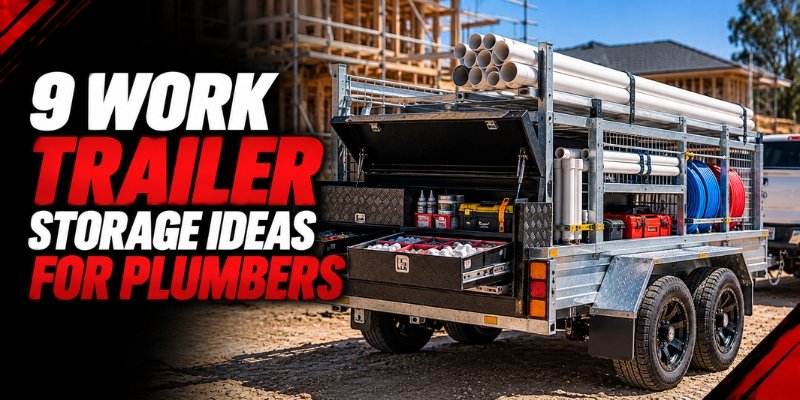
Halco’s current tradesman trailer information specifically identifies plumbers as a key application and describes features such as lockable compartments, ladder racks, slide-out drawers, internal shelving, lighting and custom storage areas.
What are the 9 best work trailer storage ideas for plumbers?
The best plumber trailer storage ideas divide equipment by frequency, size and job function. Start with the tools you use every day, then create dedicated storage for fittings, pipes, power tools, wet equipment, hazardous goods and less frequently used specialist gear.
1. Create three main storage zones
Action (daily workflow): divide the trailer into daily tools, plumbing stock and bulky equipment zones: this prevents frequently used gear from getting buried behind materials used only occasionally.
Put your everyday hand tools where you can reach them immediately after opening the trailer.
Fittings and consumables should have their own area, preferably using shallow drawers or labelled bins.
Larger equipment should occupy the remaining floor or lower storage area.
For example:
- Zone A: hand tools and daily service equipment
- Zone B: fittings and consumables
- Zone C: larger tools, pipes and specialist equipment
This simple structure is one of the most useful forms of plumbing trailer organisation because every item has a logical home.
2. Use shallow drawers for fittings and small parts
Action (small-part storage): use shallow, labelled drawers for fittings that are easy to lose in deep boxes: smaller compartments let you see stock without emptying an entire container.
Plumbers deal with dozens of small components that look almost identical until you need one particular size.
Create dedicated sections for categories such as:
- Elbows
- Tees
- Couplings
- Reducers
- Adaptors
- Valves
- Washers
- Clips
- Fasteners
- Taps and repair components
Don’t create a separate drawer for every possible fitting immediately. Start with the categories you actually use.
Use labels that make sense at a glance. For example, “20 mm PVC elbows” is more useful than simply “PVC”.
Clear-front bins can also work well because you can see stock levels before leaving for a job.
3. Build upwards with shelving and labelled bins
Action (vertical space): use the trailer walls for shelves, hooks and bins while keeping the floor available for larger equipment: vertical storage increases usable capacity without forcing tools into unstable piles.
This is particularly useful in enclosed trailers.
Instead of stacking boxes three or four levels high on the floor, use vertical shelving so each category remains visible.
A good shelf arrangement might place:
- Daily hand tools around waist height
- Small fittings at eye or chest level
- Power tools in secure middle shelves
- Lightweight backup stock higher up
- Heavy boxes and equipment lower down
Avoid putting heavy items on high shelves. A box that is manageable at floor level becomes awkward and potentially dangerous when lifted overhead.
EZ Tool Box’s current tool-trailer organisation guide also recommends zoning by tool category, keeping frequently used items accessible and placing heavier tools closer to the trailer’s axle.
4. Give pipes and long materials their own storage area
Action (long-material storage): keep pipes, conduit and other long materials in dedicated racks or carriers rather than placing them across shelves: this protects smaller equipment from being buried and keeps the main work area usable.
Plumbing materials can be awkward because their length doesn’t match the dimensions of normal storage boxes.
A dedicated pipe rack can separate long materials from your tool storage.
Depending on the trailer design and material being carried, you may use:
- Side-mounted pipe racks
- Vertical carriers
- Long internal compartments
- Roof-mounted systems where suitable
- Dedicated external racks
- Floor channels for selected materials
The rack itself must be appropriate for the trailer and the material being transported.
Never assume that because a pipe fits physically, the arrangement is automatically suitable for road transport. Long materials still need appropriate restraint and must not create dangerous protrusions.
5. Create a dedicated power-tool and battery station
Action (power-tool storage): keep drills, impact drivers, saws and batteries together in one secure zone: grouping power equipment prevents chargers, batteries and tools from being scattered throughout the trailer.
A plumber’s power-tool collection can grow quickly.
Instead of storing every tool in a separate case, create a dedicated power-tool section.
Consider:
- Drill storage
- Impact-driver storage
- Battery shelves
- Charger location
- Spare battery compartment
- Saw storage
- Tool-case parking area
If you charge batteries inside the trailer, the electrical installation and ventilation should be designed appropriately rather than relying on loose extension leads.
The storage area should also protect batteries and tools from water, excessive heat and physical impact.
This creates a cleaner plumber tool storage system and makes the end-of-day pack-up much faster.
6. Separate wet and dirty plumbing equipment
Action (wet-equipment storage): keep hoses, drain equipment and wet tools in a dedicated washable area: separating dirty equipment prevents moisture and contamination from spreading through your clean tool storage.
Plumbers regularly deal with water, wastewater, dirt and wet equipment.
If wet hoses are placed directly beside cordless tools or boxed fittings, moisture can become a much bigger problem.
Create a “dirty zone” using:
- Washable floor sections
- Removable trays
- Heavy-duty tubs
- Hose hooks
- Drain-friendly storage
- Separate wet-equipment bins
Allow equipment to dry when appropriate rather than sealing wet gear inside an airtight container for days.
This is also where an enclosed trailer needs sensible ventilation and maintenance. Halco notes that enclosed trailers can provide protection for tools and equipment, but ventilation, seals, storage layout and ongoing maintenance still affect how well the trailer protects its contents.
7. Store gas cylinders and chemicals separately and safely
Action (dangerous-goods storage): use storage designed for the specific gas cylinder or chemical being transported, with appropriate restraint and ventilation: plumbing work can involve dangerous goods that cannot simply be placed beside ordinary tools.
This is one area where storage convenience should never override safety.
WorkSafe Victoria specifically identifies plumbers as workers who may transport dangerous goods such as oxygen, acetylene, propane, propylene, butane, fuels, corrosive sealants and drain-cleaning products. The guidance requires dangerous goods to be appropriately packaged, marked, secured, separated from incompatible goods and ignition sources, and adequately ventilated during transport.
For flammable gas cylinders, WorkSafe Victoria’s vehicle guidance says cylinders should be secured upright and protected from impact. Closed vehicle arrangements can require a separate gas storage cabinet that is sealed from the vehicle interior and vented to outside air.
So don’t simply place a gas bottle in an enclosed toolbox because there is spare space.
If your plumbing business regularly transports cylinders or hazardous products, design the storage system around the applicable dangerous-goods requirements and obtain professional advice where necessary.
8. Use side access for your most frequently needed equipment
Action (fast-access storage): place frequently used tools and service parts behind side-access doors or near the easiest entry point: fast access reduces the need to climb into the trailer or unload other equipment.
Imagine arriving at a residential service call.
You need:
- A drill
- Adjustable spanners
- Pliers
- Tape
- Sealant
- A small fitting
You shouldn’t have to move a compressor, pipe bundle and three storage boxes to reach them.
Side access is especially useful on larger tradesman trailers because it allows you to retrieve smaller equipment without disturbing the main cargo area.
Use the easiest access point for the items you reach for repeatedly.
The least accessible areas should be reserved for backup stock and specialist equipment.
9. Create a restock and end-of-day station
Action (daily reset): leave one small area for returned tools, empty bins and stock that needs replenishing: a reset station prevents the trailer from becoming disorganised after several consecutive jobs.
This idea is easy to overlook.
A plumber might finish a job late, throw used tools into the nearest box and leave. After several days, the storage system starts breaking down.
Create a small “return” area.
At the end of the day:
- Return tools to their assigned locations.
- Refill commonly used fittings.
- Remove rubbish and empty packaging.
- Recharge batteries.
- Dry wet equipment.
- Check missing items.
- Prepare the next day’s common service kit.
This turns organisation into a routine rather than a once-a-month cleanup.
How should you balance storage with trailer payload and load restraint?
Storage should never be planned independently from trailer capacity. Shelving, drawers, toolboxes and equipment add tare mass, while tools and plumbing materials add payload, so the finished setup must remain suitable for the trailer and towing combination.
The National Transport Commission says loads on light vehicles, including trailers, must be properly restrained, must not dangerously overhang, must not exceed mass limits and must not obstruct lights, indicators, reflectors or the number plate.
The current NTC guide also sets performance standards for restraint forces, including 80% of load weight forwards, 50% sideways and rearwards, and 20% upwards where the load is not fully contained.
Storage layout decision table
|
Storage choice |
Best use |
Main benefit |
Main caution |
|
Shallow drawers |
Fittings and consumables |
Fast identification |
Don’t overload |
|
Deep shelves |
Tool cases and larger equipment |
Flexible capacity |
Items can disappear at the back |
|
Side compartments |
Daily tools |
Very fast access |
Limited capacity |
|
Pipe racks |
Long materials |
Keeps floor clear |
Must suit load and restraint requirements |
|
Floor boxes |
Heavy equipment |
Low centre of storage |
Can consume valuable floor space |
|
Overhead shelves |
Lightweight backup stock |
Uses unused height |
Avoid heavy items overhead |
|
Enclosed cabinets |
Valuable tools |
Security and weather protection |
Adds tare mass |
|
Open racks |
Frequently handled materials |
Easy access |
Less weather/security protection |
A useful rule is to position heavy items low and close to the trailer’s appropriate load-distribution area rather than building a top-heavy storage system.
Before adding permanent storage, calculate what the completed trailer weighs with your normal tools and materials.
How should gas cylinders and chemicals be stored in a plumbing trailer?
Gas cylinders and hazardous plumbing chemicals need dedicated storage and transport controls, not ordinary shelving. Cylinders must be secured against movement and protected from impact, while dangerous goods must be appropriately packaged, separated and ventilated.
WorkSafe Victoria lists gas cylinders, fuels, corrosive sealants and drain-cleaning products among dangerous goods that plumbers may transport as tools of trade. Its guidance says these materials must be secured, separated from incompatible goods and ignition sources, appropriately marked and well ventilated during transport.
For flammable gas cylinders, don’t place loose cylinders beside drills, fittings or metal tools.
The storage plan should consider:
- Upright cylinder restraint
- Valve protection
- Separation from loose tools
- Ventilation
- Protection from impact
- Separation from incompatible products
- Appropriate labelling
- Fire-safety equipment
- State-specific dangerous-goods requirements
If your work involves gas welding or cutting equipment, LPG, acetylene or other regulated materials, treat that storage design as a safety issue rather than a simple organisation project.
Are tradesman trailers or enclosed trailers better for plumbers?
The better trailer depends on the plumber’s workflow. Tradesman trailers prioritise organised access and dedicated storage, while enclosed trailers provide a larger protected interior that can accommodate tools, stock, equipment and flexible mobile-workshop layouts.
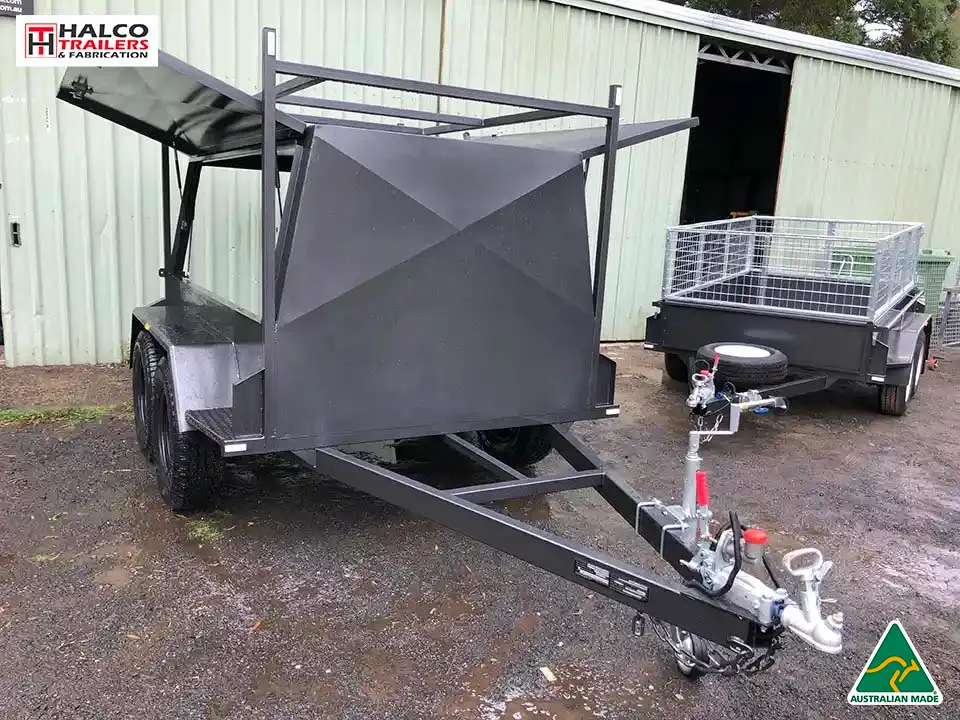
Halco currently offers tradesman trailers designed for plumbers and other mobile trade professionals, with storage and access options that can be customised around the daily workload.
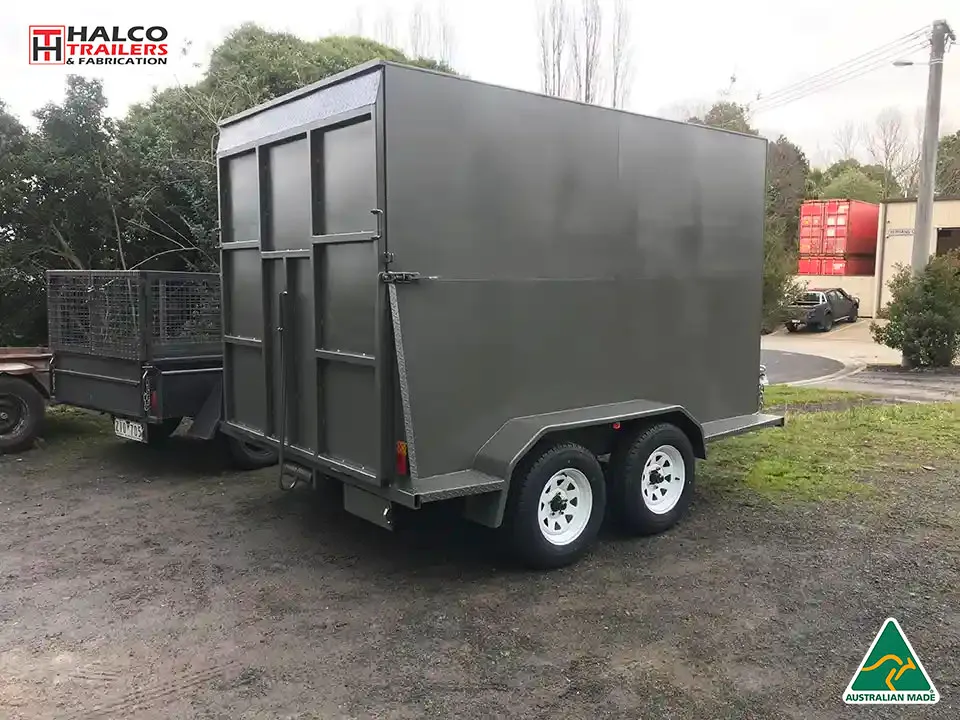
Halco’s enclosed trailers provide a fixed roof, full-height body and access doors, with configurations that can include shelving, tie-downs, toolboxes and other storage features.
|
Your plumbing work |
Better starting point |
|
Daily service calls |
Tradesman trailer |
|
Lots of fittings and small parts |
Tradesman or enclosed |
|
Large mixed equipment |
Enclosed |
|
Regular pipe transport |
Custom or hybrid setup |
|
Drainage and jetting work |
Enclosed or specialist custom setup |
|
Valuable tools left between jobs |
Enclosed |
|
Large materials plus tools |
Hybrid/open configuration |
|
Growing business with changing needs |
Custom trailer |
Don’t choose solely on trailer size.
Ask:
- What do I carry every day?
- What needs to stay dry?
- What needs to remain locked?
- What needs immediate access?
- What is too long or bulky for internal storage?
- What will I add to the business next year?
Halco’s trailer range includes tradesman, enclosed, tandem, plant, box, flat-top and custom configurations, allowing the trailer category to be matched to the actual application.
How much does plumber trailer storage cost in Australia?
Storage costs range from inexpensive organisers and bins to substantial drawer systems or custom trailer fit-outs. The final budget depends on whether you are adding removable boxes, permanent shelving, drawers, racks, electrical systems or a purpose-built trailer interior.
Current Australian retail examples show small compartment organisers can cost under A20,whilemodulartoolboxesandorganiserscommonlysitaroundA50–A300.LargerprofessionalstoragesystemscanexceedA1,000 before trailer fabrication or installation. These are examples, not a fixed plumber trailer budget.
Practical storage budget framework
|
Budget level |
Typical approach |
Best for |
|
A50–A250 |
Bins, organisers and removable boxes |
Existing basic trailer |
|
A250–A750 |
Better modular boxes, drawers and shelving |
Regular service plumber |
|
A750–A1,500+ |
Professional drawer/shelving combinations |
High-use commercial trailer |
|
Custom quote |
Permanent racks, compartments, electrical, specialist storage |
Established plumbing business |
Don’t spend the whole budget on storage hardware.
A custom shelf that blocks a door or reduces useful payload can make the trailer worse, even if the storage itself is high quality.
How do you keep plumbing trailer organisation under control?
Good plumbing trailer organisation needs a reset routine, not just an attractive initial layout. Review the trailer weekly, remove unused equipment, replenish fast-moving fittings and check that drawers, shelves, racks and restraints remain secure.
Use a simple maintenance cycle:
|
Frequency |
What to check |
|
Every workday |
Return tools, remove rubbish, recharge batteries |
|
Weekly |
Restock fittings and inspect storage |
|
Monthly |
Remove unused equipment and review layout |
|
Quarterly |
Check brackets, shelves, drawers and mounting hardware |
|
After major jobs |
Rebuild the common service kit |
|
After trailer modifications |
Recheck payload and weight distribution |
|
Before long trips |
Check all storage and load restraints |
The layout should change when your work changes.
If you have started doing more drainage work, create more space for drainage equipment. If service calls now dominate the business, move everyday fittings closer to the access doors.
A good trailer organisation system should evolve with the business.
When should you customise your trailer storage layout?
Custom storage becomes worthwhile when standard boxes no longer match your tools, daily workload or trailer dimensions. If you repeatedly move equipment, cannot reach key tools quickly or carry specialised plumbing gear, a custom layout can improve access and reduce wasted space.
Halco’s current custom-trailer service allows storage, access, dimensions, tie-down points, ramps and other features to be considered as part of one trailer specification. Its custom tradesman trailer information specifically describes secure compartments, shelving, drawers, side-access doors, ladder racks and dedicated equipment storage for trade applications.
A custom layout makes sense when you need:
- Dedicated pipe storage
- Specialist drainage equipment storage
- Compressor or generator space
- Custom drawer dimensions
- Side-access compartments
- Lockable tool storage
- Battery charging areas
- Job-specific equipment mounts
- Branding and business presentation
- A combination of open and enclosed storage
Before designing it, make a list of everything you carry for a normal week not everything you have ever owned.
That list is a much better starting point than copying someone else’s trailer.
Conclusion
The best plumber trailer storage ideas are the ones that make your daily work faster without compromising safe loading. Organise tools by frequency, fittings by type, pipes separately and specialist equipment according to the jobs you actually perform.
A good plumber trailer setup should grow with your business. If your current trailer has become difficult to access, overcrowded or poorly suited to your plumbing workflow, it may be time to redesign the storage or consider a purpose-built tradesman or enclosed trailer.
Halco Trailers builds and supports trailer configurations for plumbers and other Australian tradies from its Warragul workshop, with custom storage and access options available for different work requirements.