

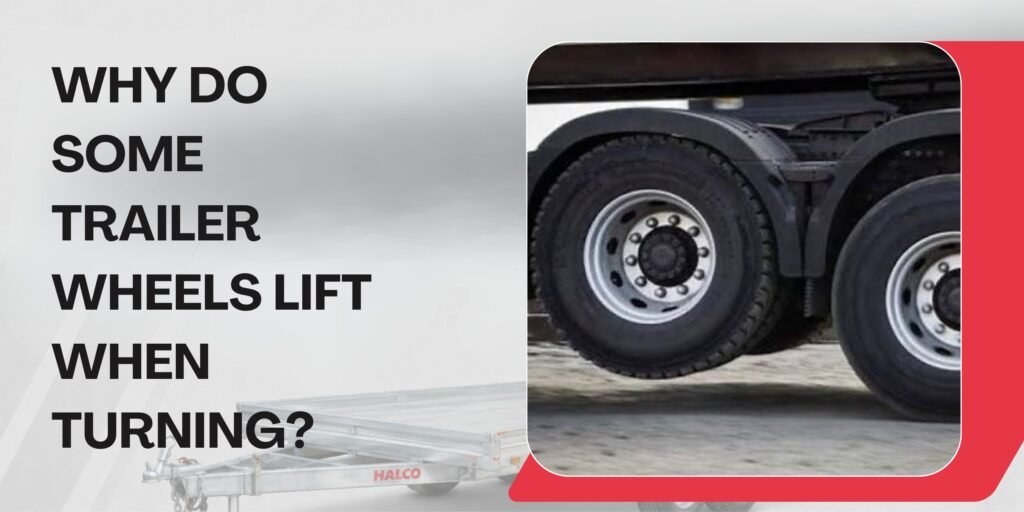
You are turning a trailer around in a tight driveway, worksite, farm gate, or depot yard. The trailer starts to twist through the turn, one tyre scrubs sideways, and for a moment it looks like one wheel is lifting off the ground.
It can be worrying, especially if you are towing a loaded trailer for work.
The good news is that trailer wheel lifting is not always a sign of a serious fault. On some trailers, especially tandem trailers for heavy-duty work, a small amount of tyre scrub, skipping, or wheel unloading can happen during sharp low-speed turns.
The important part is knowing the difference between normal trailer movement and a problem that needs inspection.
Quick answer: Trailer wheel lifting during tight turns is often caused by tyre scrub, suspension movement, load transfer, or axle geometry. It is common on tandem trailers because the tyres cannot all follow the same turning path. However, severe wheel lift, loud banging, uneven tyre wear, or poor towing behaviour may point to suspension, axle, tyre, or load-balance problems that need professional attention.
What Does Trailer Wheel Lifting Mean?
The question of why trailers lift some wheels during turns is one of the most common things trailer owners notice, and it has several explanations depending on the trailer type, load, and conditions.
People use the term trailer wheel lifting to describe a few different things. Sometimes the wheel is not fully lifting off the ground. It may be:
- Scrubbing sideways across concrete
- Skipping or hopping during a tight turn
- Unloading slightly as weight shifts
- Twisting against the surface
- Dragging instead of rolling smoothly
- Bouncing because the trailer is empty
- Lifting briefly as the suspension moves
A landscaper might notice it while reversing a loaded green-waste trailer into a client’s driveway. A builder might see it while turning a tandem trailer in a tight site access. A farmer might notice it when backing through a narrow gate on uneven ground.
Here is a simple way to read what you are seeing:
What You Notice | What It May Mean |
Tyre scuffs sideways during a tight turn | Often normal tyre scrub |
One wheel briefly looks lighter | Load transfer or suspension movement |
Trailer hops or shudders on concrete | Tyres resisting the turn |
Loud clunking or banging | Possible suspension or axle issue |
One tyre wears faster than the others | Possible alignment, tyre, bearing, or suspension problem |
Trailer leans heavily to one side | Possible load balance or suspension issue |
Small movement during a tight manoeuvre can be normal. Repeated, severe, noisy, or uneven behaviour should not be ignored.
Why Do Trailers Lift Some Wheels When Turning? Tandem Trailers Explained
This issue is most noticeable on tandem trailers. Understanding why trailers lift some wheels when turning starts with understanding how fixed axles work in tight turns.
A tandem trailer has two axles. That usually gives better load distribution and stability for heavier work. It is one reason tandem trailers are popular with tradies, landscapers, farmers, construction crews, machinery operators, and small businesses.
But there is a trade-off during tight turns.
Unlike the front wheels of a car, trailer wheels do not steer. They are fixed in line. When you make a sharp turn, each wheel wants to follow a slightly different path, but the axles keep them straight. The tyres then have to scrub, flex, or skip sideways to get through the turn.
That is why a tandem trailer can look like it is fighting the ground when you turn sharply on concrete or asphalt.
You may notice this more when:
- Reversing into a tight driveway
- Turning around in a small depot yard
- Manoeuvring on concrete
- Backing into a shed
- Turning around a jobsite
- Reversing with a heavy load
On gravel, dirt, or loose ground, the tyres may slide more easily, so the movement may look less dramatic. On concrete, the tyres grip harder, so the scrub can look and sound worse.
This does not automatically mean the trailer is faulty. It means the tyres are resisting a tight turn.
Is Trailer Wheel Lifting Normal?
Sometimes, yes.
A small amount of wheel unloading, tyre scrub, or skipping can be normal during a tight, slow turn. This is especially true for tandem trailers and heavy-duty trailers with fixed axles.
It Is Usually Less Concerning When:
- It only happens at low speed
- It happens during sharp turns or reversing
- The trailer settles once straight
- There are no loud noises
- The tyres are wearing evenly
- The trailer tracks straight on the road
- The trailer does not lean heavily to one side
- The issue has always happened in tight manoeuvres and has not suddenly become worse
For example, a builder reversing a loaded tandem trailer into a narrow driveway may see the inside tyre scrub across the surface. If the trailer straightens up cleanly, tows normally, and tyres are wearing evenly, that may simply be tight-turn scrub.
It Needs Attention When:
- One wheel lifts significantly
- The trailer bangs, clunks, or jerks
- Tyres show uneven wear
- The trailer pulls to one side
- One wheel looks angled
- One hub runs hotter than the others
- The trailer feels unstable on the road
- The wheel lift happens during normal road turns
- The problem started after hitting a kerb, pothole, rut, or worksite obstacle
A good rule: small scrub in tight turns can be normal; severe lift or repeated symptoms need inspection.
The Main Causes of Trailer Wheel Lifting
Trailer wheel lifting is usually caused by one of several things. Sometimes it is just trailer geometry. Other times, it is a sign that maintenance is overdue.
1. Tyre Scrub During Tight Turns
This is the most common cause of tandem trailers.
When the trailer turns sharply, the tyres cannot all roll through the exact same arc. Some tyres drag or scrub sideways.
You may see black marks on concrete or hear a squeaking sound. That is common during tight, low-speed turns, especially with a loaded trailer.
The fix is usually better manoeuvring: take wider turns, move slowly, and pull forward to reset instead of forcing the trailer around.
2. Suspension Load Transfer
When a trailer turns, weight shifts across the suspension. One wheel may carry more load while another wheel unloads.
This is more noticeable when the trailer is loaded unevenly, turning sharply, on uneven ground, travelling over a kerb or driveway lip, or fitted with worn suspension parts.
If the suspension is healthy, the trailer should settle back down smoothly. If it bangs, twists, or leans heavily, get it checked.
3. Uneven Load Distribution and the 60/40 Rule
A poorly balanced load can make trailer wheel lifting worse.
What Is the 60/40 Rule for Trailers?
The 60/40 rule is a load distribution guideline used for trailers. It recommends placing approximately 60 percent of the total load weight over the front half of the trailer and 40 percent over the rear half.
This helps keep appropriate downward pressure on the drawbar, which improves towing stability and reduces the risk of trailer sway, rear wheel unloading, and wheel lifting during turns.
Loading too much weight toward the rear can cause the front of the trailer to lift at the hitch, which unloads the tow vehicle’s rear wheels and increases the risk of instability. Loading too far forward can overload the hitch and reduce tow vehicle steering feel.
Applying the 60/40 guideline when loading soil, machinery, timber, gravel, or trade equipment reduces wheel lifting risk and improves towing safety for all trailer types.
Common load distribution problems that cause wheel lifting:
- A landscaper loads wet soil mostly on one side
- A contractor parks machinery slightly off-centre on a plant trailer for heavy machinery transport
- A builder stacks timber hard against one side rail
- A farmer loads fencing gear unevenly across the deck
- A vehicle transport trailer carries a car that is not centred correctly
Weight should be balanced side to side and follow the 60/40 front-to-rear guideline. Too much weight on one side can overload one set of tyres and unload the opposite side during turning.
4. Axle or Suspension Misalignment
If a trailer has a bent axle, worn shackle bushes, loose U-bolts, cracked springs, or damaged suspension mounts, the wheels may not track correctly.
Signs include tyre wear on one edge, trailer pulling to one side, a wheel sitting at a strange angle, clunking from the suspension, uneven ride height, or tyres scrubbing even during gentle turns.
This is not something to guess your way through. A trailer suspension inspection can save tyres, bearings, suspension parts, and downtime.
5. Incorrect Tyre Pressure
Tyre pressure affects how the trailer behaves.
Underinflated tyres can flex too much, heat up, scrub harder, and wear quickly. Overinflated tyres may have less contact area and can skip more easily on rough or uneven ground.
Mismatched tyres can also cause problems. If one tyre is a different size, has a different load rating, or is worn more than the others, the trailer may not sit or turn evenly.
6. Trailer Design and Wheelbase
Trailer length, axle spacing, drawbar length, suspension type, and load height all affect turning behaviour.
A short heavy trailer can scrub aggressively because the turn angle changes quickly. A longer trailer may respond more gradually but needs more room. Tandem and tri-axle trailers usually need wider turning space than single axle trailers.
This is why choosing the right trailer matters. A trailer that suits your load, worksite access, and towing conditions will usually be easier to manage.
7. Turning Too Sharply Under Load
A loaded trailer puts more force through the tyres. If you turn sharply with a heavy load, the tyres, suspension, axles, bearings, and chassis all work harder.
This is common on worksites where space is limited. The better approach is to take a wider line, use a spotter, reverse slowly, and reset early.
Trailer Wheel Lifting on a Plant Trailer
A plant trailer for heavy machinery transport has a tougher job than a basic box trailer. It may carry excavators, skid steers, scissor lifts, compact loaders, trenchers, rollers, or other heavy equipment.
That weight changes everything.
If the machine is slightly off-centre not following the 60/40 rule for load distribution one side of the trailer may carry more load. During a tight turn, the loaded side can compress while the opposite side unloads. This can make one wheel appear to lift, skip, or scrub more than expected.
A real example: a contractor reverses a plant trailer loaded with a mini excavator into a tight residential jobsite. The driveway is concrete, the turn is sharp, and the machine is sitting slightly toward one side. As the trailer turns, the inside tyre scrubs hard and one wheel looks like it unloads. A small amount of scrub may be expected, but if the trailer bangs, twists heavily, or one tyre is wearing faster than the others, the trailer should be inspected.
Plant trailers also deal with rougher conditions:
- Muddy worksites
- Gravel access tracks
- Ramps
- Kerbs
- Uneven ground
- Heavy point loads
- Repeated loading and unloading
If you use a plant trailer for work, treat unusual wheel lifting as an early warning. It may be load position, but it may also be suspension, axle, tyre, brake, or bearing related.
Loaded vs Empty Trailers: Why Weight Changes Everything
The same trailer can behave differently depending on whether it is empty or loaded.
A useful guide when loading any trailer is the 60/40 rule placing 60 percent of the load weight over the front half of the trailer and 40 percent over the rear which helps maintain drawbar pressure and reduces the risk of rear wheel unloading during turns.
Empty Trailers
An empty trailer may bounce more, skip over rough ground, react quickly in turns, look more dramatic when one wheel unloads, and be harder to see when reversing.
A small empty trailer may hop slightly during a tight turn simply because there is not much weight holding the tyre down.
Loaded Trailers
A loaded trailer may scrub tyres harder, put more force through suspension parts, need more turning space, be harder to recover from a bad angle, place more stress on tyres and bearings, and exaggerate any load-balance problem.
Think about a landscaper carrying wet green waste, a farmer hauling feed, a builder towing timber and tools, or an automotive business moving a vehicle. The trailer is not just heavier, the load changes how the trailer reacts.
If trailer wheel lifting only happens when the trailer is loaded, check load balance first and apply the 60/40 guideline. If the load is centred and secured but the issue continues, inspect the trailer.
When Trailer Wheel Lifting Could Signal a Problem
Some signs point beyond normal tyre scrub.
Book a trailer suspension inspection if you notice:
- Uneven tyre wear
- One tyre wearing faster than the others
- Cracked or sagging leaf springs
- Worn shackle bushes
- Loose U-bolts
- Bent axle
- Damaged chassis or cross members
- Different tyre sizes or load ratings
- Incorrect tyre pressures
- Wheel bearing play
- Brake drag on one wheel
- One hub running hotter
- Trailer leaning to one side
- Trailer pulling or wandering
- Clunking, grinding, or banging sounds
Do not ignore tyre wear. Tyres often tell the story before a trailer fails. If one tyre is wearing on the inside edge, outside edge, or in a strange pattern, something is likely out of line, loose, overloaded, or underinflated.
Seeing uneven tyre wear, a hot hub, or suspension damage? Don’t wait for a roadside failure. Halco Trailers inspects trailer suspension, axles, bearings, and brakes from our Warragul workshop across Gippsland and Victoria.
How to Check Your Trailer After Wheel Lifting Happens
You do not need to be a mechanic to do a basic check. You are looking for obvious signs that something is wrong.
Start on Level Ground
Park the trailer on flat ground. Step back and look at it from behind.
Check whether the trailer sits level, whether one side is lower, whether the tyres are sitting straight, whether one wheel is tucked in or leaning, and whether the tyre gaps look similar from side to side.
If the trailer looks uneven while parked, the issue is not just turning behaviour.
Check the Tyres
Look at all tyres, not just the one that lifted. Check tyre pressure, tread depth, edge wear, cracks, bulges, cuts, flat spots, and whether all tyres match in size and load rating.
For tandem trailers, compare all four tyres. One tyre wearing differently from the others is a useful clue.
Check the Suspension
Look around the springs, shackles, hangers, bolts, and U-bolts.
Warning signs include cracks, fresh rust marks around bolts, loose-looking hardware, bent brackets, sagging springs, rubber bushes falling apart, and metal-on-metal contact.
If anything looks loose, bent, or cracked, do not keep towing heavy loads until it has been checked.
Check Hubs and Bearings
After towing, carefully compare hub temperatures. Do not grab a hot hub with bare hands. Move close carefully and check whether one hub feels much hotter than the others.
A hot hub may point to a bearing issue, brake drag, poor adjustment, lack of grease, or internal wear. If one hub is significantly hotter than the rest, book a service.
Check the Load
Make sure the load is centred, secured, and within the trailer’s rated capacity. Apply the 60/40 rule 60 percent of the load weight over the front half and 40 percent over the rear.
For machinery, check that the machine is centred on the trailer and tied down correctly. For loose materials like soil, gravel, mulch, or green waste, make sure the load is not piled heavily to one side.
A well-built trailer can still behave poorly if the load is badly placed.
How to Lift a Trailer Wheel for Inspection
If you need to physically lift a trailer wheel to inspect the bearing, tyre, suspension, or brake, follow these steps carefully.
- Park on firm, level ground
- Chock the wheels that will remain on the ground
- Place the jack under an approved chassis or axle lifting point
- Raise the wheel clear of the ground
- Support the trailer on appropriately rated axle stands before working near the wheel
- Never rely on a jack alone as the only support
For tandem trailers, note which wheels remain on the ground and ensure the trailer cannot roll or shift before removing the raised wheel.
Once the wheel is safely raised, you can:
- Check for bearing play by holding the tyre at 12 and 6 o’clock and rocking it gently
- Inspect the tyre sidewall, tread, and edges
- Check the hub temperature if you have been towing recently
- Inspect suspension components, springs, and U-bolts with the wheel removed
- Check for brake drag by spinning the wheel by hand
If the wheel is difficult to raise because of a jacking-point issue, seized component, or damaged chassis, do not improvise. Contact a trailer repairer rather than working under an unsupported trailer.
How to Raise Trailer Axle Height Is That the Fix?
If trailer wheel lifting is linked to a sagging axle, incorrect ride height, or worn springs, some owners ask whether raising the axle height is the solution.
Axle height on a trailer can be affected by:
- Worn or collapsed leaf springs
- Incorrectly fitted spring packs
- Loose or under-torqued U-bolts
- The axle’s original mounting position
- Damaged spring hangers or mounts
Raising axle height by replacing worn springs, fitting the correct spring pack, or having the axle repositioned by a trailer workshop can restore correct geometry and reduce abnormal tyre wear or wheel lifting.
However, this is not a DIY adjustment for most owners. Incorrect axle height or U-bolt torque can cause axle twist, brake misalignment, and abnormal tyre scrub that is worse than the original problem.
If you suspect the axle height is contributing to trailer wheel lifting, book a professional inspection rather than adjusting it yourself. A qualified repairer can measure the axle position, assess spring condition, check U-bolt torque, and confirm whether repositioning is needed.
How to Reduce Trailer Wheel Lifting and Tyre Scrub
You cannot remove all tyre scrub from tandem trailers, but you can reduce the stress.
Use these habits:
- Take wider turns where possible
- Avoid full-lock turns with a loaded trailer
- Reverse slowly
- Pull forward and reset instead of forcing the angle
- Apply the 60/40 load distribution rule
- Keep tyres inflated correctly
- Use matching tyres with correct load ratings
- Balance loads side to side
- Keep heavy items low and secure
- Service suspension and bearings regularly
- Avoid twisting the trailer over steep kerbs
- Do not turn sharply on high-grip surfaces unless needed
- Check tyre wear before it becomes severe
Real-world examples: a landscaper turning around in a tight driveway with a full green-waste load should avoid forcing the tandem trailer through a sharp angle. A farmer backing through a narrow gate should straighten the trailer before the wheels start climbing ruts. A construction company moving a plant trailer through tight site access should use a spotter and avoid aggressive steering on concrete.
Small changes in driving habits can reduce tyre wear and protect suspension components.
Tandem Trailers vs Single Axle Trailers: Which Is More Likely to Scrub?
Both trailer types can have issues, but tandem trailers are more likely to scrub tyres in tight turns.
Trailer Type | Turning Behaviour | Wheel Lift or Scrub Risk |
Pivots more easily | Usually lower scrub, but may bounce more when empty | |
More stable under load but resists tight turns | Higher scrub in tight manoeuvres | |
More tyres resisting the turn | Higher scrub risk in sharp turns | |
Heavy load increases stress | Depends on load balance, surface, and suspension condition |
This does not mean tandem trailers are a bad choice. For many businesses, they are the right choice because they provide better load support and stability for heavier work.
The key is to give them enough turning space and keep them maintained.
If you are choosing a trailer for commercial use, think beyond payload. Consider where you will use it every day. A trailer that suits open farm tracks may not be ideal for tight inner-suburban driveways. A trailer used on construction sites needs to handle rough surfaces, turning pressure, and repeated loading.
Halco builds custom tandem trailers in Victoria for trade, farm, transport, and commercial use, with configurations to suit your load, worksite, and towing requirements.
Should You Keep Driving If a Trailer Wheel Lifts?
It depends on what happened.
You Can Usually Continue Slowly If:
- It happened during a tight, low-speed turn
- The trailer settled once straight
- There were no strange noises
- The tyres look normal
- The trailer tracks straight
- No hub is unusually hot
- There is no visible suspension damage
In that case, drive carefully and keep an eye on it. Check the tyres again after the next trip.
Stop and Inspect If:
- The wheel lifted significantly
- It happened during normal road driving
- The trailer felt unstable
- You heard banging, cracking, grinding, or metal-on-metal noise
- A tyre looks damaged
- A wheel looks angled
- The trailer hit a kerb, rut, pothole, or worksite obstacle
- A load shifted
- One hub is much hotter than the others
Get Professional Help If:
- The trailer carries machinery or commercial loads
- It is a heavy tandem setup
- It is a plant trailer for heavy machinery transport
- You can see damaged suspension parts
- The issue is getting worse
- You are not sure whether it is safe to tow
With work trailers, the cost of checking early is usually much lower than the cost of a breakdown, tyre failure, damaged load, or missed job.
Not sure whether it is safe to keep towing? Halco Trailers can inspect tandem trailers, plant trailers, machinery trailers, and custom builds for suspension, axle, bearing, and structural issues from our Warragul workshop.
When to Book a Trailer Inspection
Book an inspection if trailer wheel lifting is repeated, severe, noisy, or linked with other symptoms.
You should also get the trailer checked if:
- Tyres are wearing unevenly
- The trailer pulls to one side
- One hub gets hotter
- Suspension looks loose or damaged
- Brakes grab on one side
- The trailer was recently overloaded
- You regularly carry machinery, tools, soil, gravel, vehicles, livestock, or building materials
- The trailer is used commercially
- The trailer is a tandem trailer, plant trailer, machinery trailer, or custom-built trailer
For small business owners, contractors, landscapers, farmers, and automotive businesses, trailer downtime costs money. A trailer axle and brake servicing check can prevent bigger problems later.
Halco Trailers can inspect and service trailer suspension, axles, brakes, bearings, tyres, electrical systems, structural components, and custom trailer setups from its Warragul workshop.
Final Takeaway
Trailer wheel lifting can look alarming, but it is not always a fault. On tandem trailers, some tyre scrub or wheel unloading during tight turns can be normal because the wheels cannot all follow the same turning path.
What matters is the pattern. Apply the 60/40 load distribution rule, check your tyre pressures, maintain your suspension, and give your trailer enough turning room. If the movement is severe, noisy, sudden, or linked with uneven tyre wear, hot hubs, poor tracking, or suspension damage, get it checked before it becomes a roadside problem.
Noticing wheel lift, tyre scrub, uneven tyre wear, or strange suspension movement?
Halco Trailers services tandem trailers, plant trailers, box trailers, and custom builds covering bearings, brakes, axles, suspension, and structural repairs from our Warragul workshop across Gippsland, Melbourne, and Victoria.
Faq's
Trailer wheels lift or scrub when turning because the wheels are fixed to the axle and cannot steer. During a tight turn, each tyre wants to follow a different arc, but the axles keep them straight. The tyres then scrub, skip, or unload to get through the turn. This is most noticeable on tandem trailers, on concrete or asphalt, and when the trailer is loaded.
The 60/40 rule recommends placing approximately 60 percent of the total load weight over the front half of the trailer and 40 percent over the rear. This maintains downward pressure on the drawbar, improves towing stability, and reduces the risk of rear wheel unloading and trailer sway. Loading too far toward the rear can cause the front of the trailer to lift at the hitch, which makes the tow vehicle less stable and increases wheel lifting risk during turns.
Park on firm, level ground and chock the remaining wheels. Place a rated jack under an approved chassis or axle lifting point, raise the wheel clear of the ground, and support the trailer on axle stands before working near the wheel. Never rely on a jack alone. Once raised, you can check for bearing play by rocking the tyre at 12 and 6 o'clock, inspect the tyre and hub, and check suspension components.
Trailers lift some wheels when turning because of fixed axle geometry, load transfer across the suspension, and the grip between the tyres and the road surface. On tandem trailers, the two fixed axles mean the tyres cannot all follow the same turning arc, so some wheels scrub, skip, or unload during sharp manoeuvres. Load imbalance and worn suspension can make this worse.
In some cases, yes if the axle has dropped due to worn springs or incorrect positioning, restoring the correct axle height can improve tyre scrub and wheel behaviour. However, axle height adjustment is not a DIY task. Incorrect spring packs, U-bolt torque, or axle positioning can cause brake misalignment and worse tyre wear. Book a professional inspection rather than adjusting it yourself.
A small amount of tyre scrub or wheel unloading can be normal during tight, low-speed turns, especially on tandem trailers. Severe lifting, loud noise, poor tracking, or uneven tyre wear should be inspected.
Tandem trailers have fixed axles, so the wheels cannot all follow the same turning arc. During sharp turns, the tyres may scrub or skip sideways. This is more noticeable on concrete and asphalt where the tyres grip harder.
Yes. Concrete and asphalt provide more grip than gravel or dirt, so tyres resist sliding and the scrub can look and sound more dramatic.
Yes. A heavy load placed too far to one side, too far toward the rear, or not following the 60/40 guideline can change how the suspension loads each wheel and increase wheel lifting during turns.