

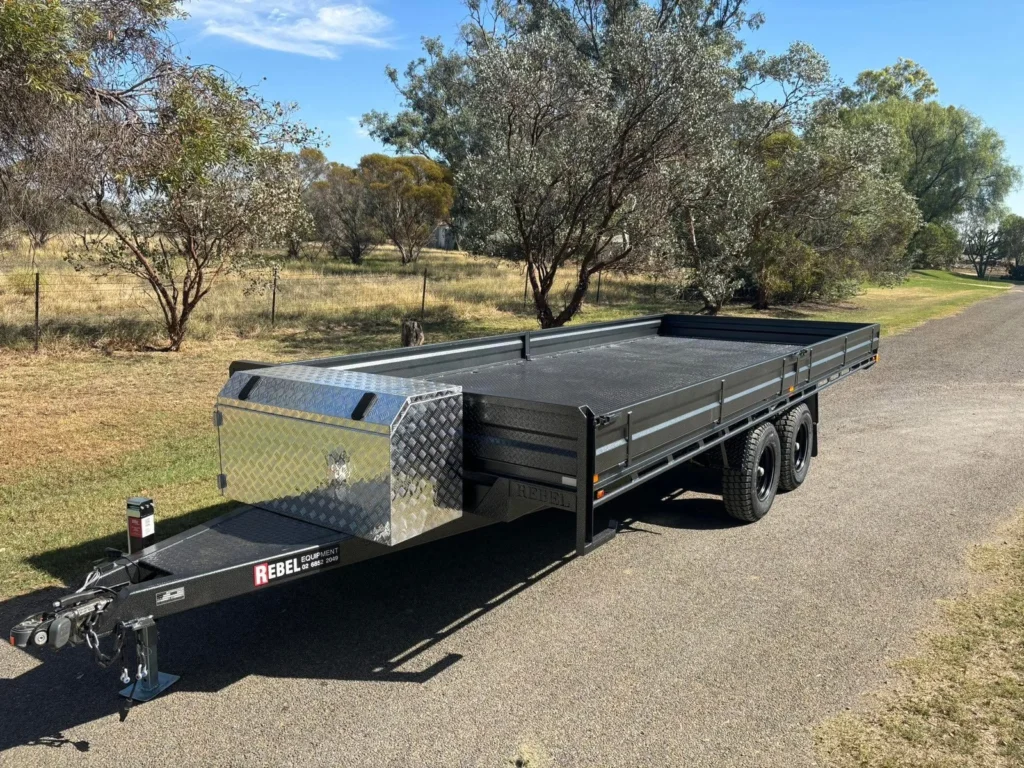
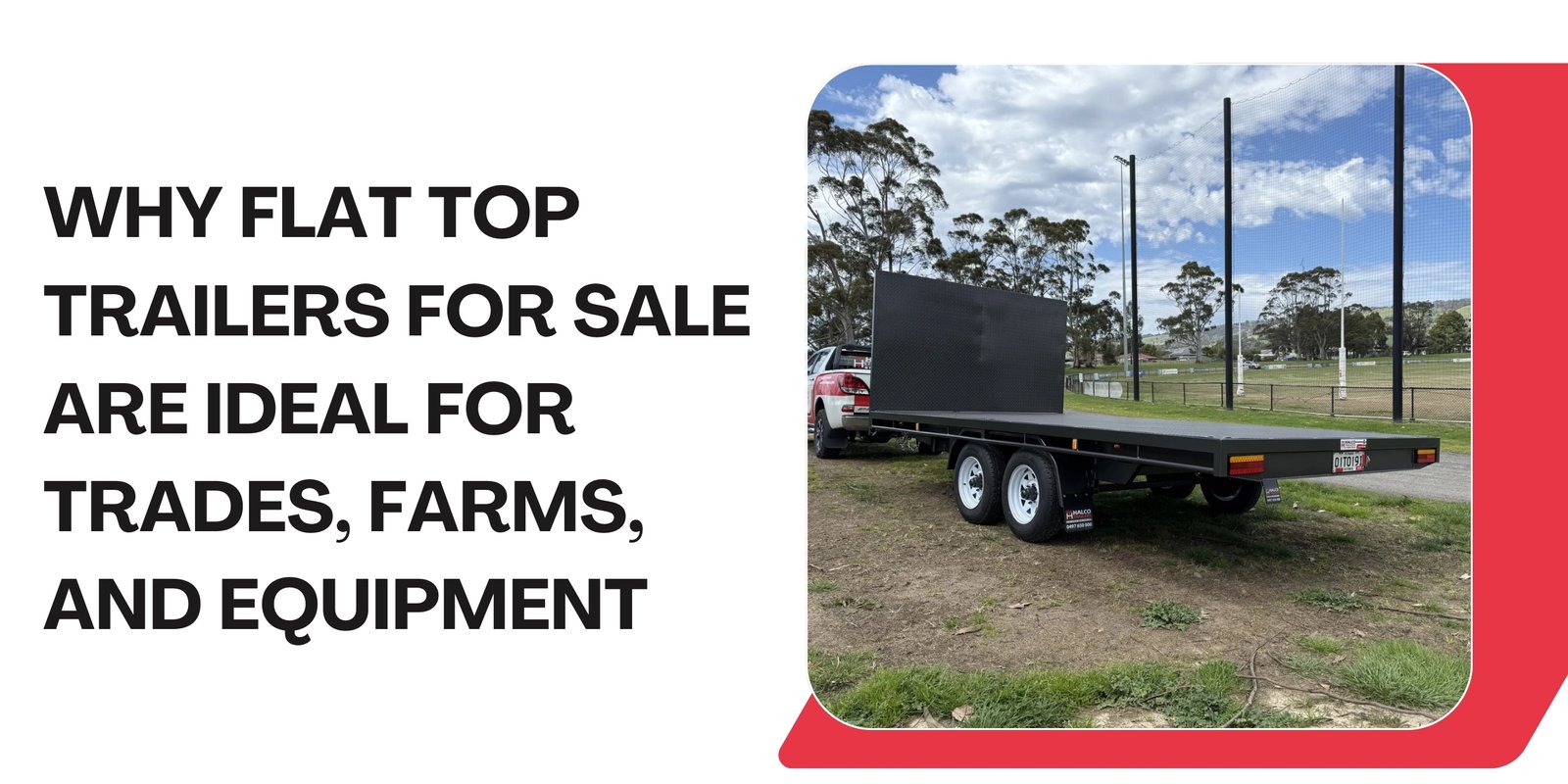
Flat top trailers provide an open deck that can allow rear, side or overhead loading, depending on the trailer configuration and the space available around it.
Tradespeople may use them for timber, scaffolding, pallets and construction equipment. Farms may use them for fencing supplies, feed, machinery and seasonal materials. Equipment operators may choose an open deck when loading requires ramps, a forklift, tractor or lifting machinery.
However, an open deck is not suitable for every transport task. Cargo remains exposed to weather and must be correctly positioned and restrained. The trailer’s approved capacity, completed tare mass and towing setup must also suit the intended load.
This guide explains common flat top trailer uses, the benefits and limitations of an open-deck design, and the information operators should consider before choosing a configuration.
For available configurations and quotation information, view Halco’s flat top trailers for sale in Melbourne.
A flat top trailer can be useful when cargo requires open side access, overhead loading or a clear deck without fixed body walls. Suitability still depends on the cargo dimensions, weight, loading method, restraint requirements and towing vehicle.
What Is a Flat Top Trailer?
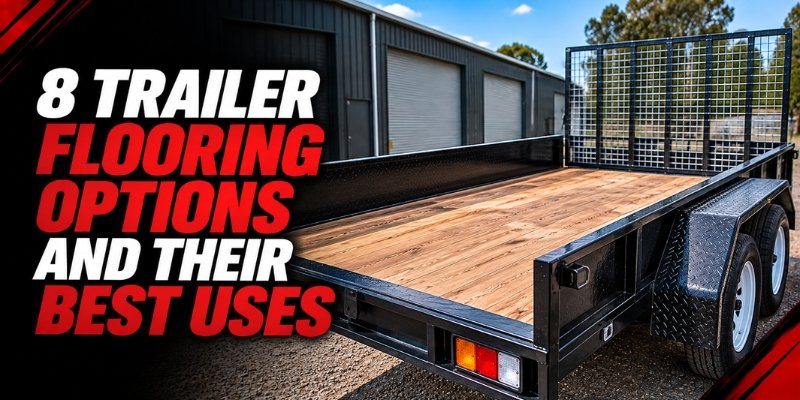
A flat top trailer uses a level, open deck rather than a fixed-sided box or fully enclosed body.
The open design can provide access from several directions, depending on the trailer configuration and the space available around it. This can simplify loading when cargo is:
- Wider than a conventional box body
- Irregularly shaped
- Loaded by forklift
- Lifted by crane or tractor
- Driven or rolled onto the deck
- Difficult to position through a rear opening
A flat deck can also make it easier to inspect restraint points and arrange straps or chains around suitable loads.
The absence of fixed sides does not mean the trailer can carry any load. Cargo must remain within the applicable limits and be restrained so it cannot move, fall or affect safe towing.
When Is an Open Deck Useful?
An open deck is useful when loading access is more important than enclosed storage or built-in weather protection.
For example, a pallet may be easier to position from the side with a forklift than to move through the rear of a fixed-sided body. Long materials may also be easier to arrange when walls would restrict their placement.
An open deck may suit a task when:
- Cargo needs to be loaded from the side
- Overhead lifting equipment will be used
- The load has an irregular shape
- Ramps are required for machinery
- Frequent visual access to the load is useful
- Fixed sides would interfere with restraint equipment
Before choosing an open design, consider how the load will be protected from rain, wind, dust and road debris.
Flat Top Trailer Uses for Trades
Tradespeople often carry materials and equipment that vary between jobs. A flat deck can provide useful flexibility where the load changes frequently or side access makes loading more efficient.
Building and construction materials
Timber, pipes, frames, scaffolding components and packaged building products may be suitable for an open deck when they can be properly supported and restrained.
Long materials require careful positioning. They must not create unsafe overhang, interfere with the towing vehicle or place excessive weight at one end of the trailer.
Sharp edges can also damage webbing straps. Suitable edge protection or another restraint method may be required.
Pallets and packaged supplies
Forklift access is one reason a business may consider a flat top trailer.
Pallets can potentially be positioned from the side or rear, depending on the deck layout and loading area. This can reduce the need to move heavy packaged goods manually across the trailer.
Pallet dimensions alone do not confirm suitability. The combined cargo weight, position and available payload must also be checked.
Trade tools and equipment
Large tools, compressors, generators and site equipment may be carried on an open deck when they have suitable support and restraint points.
Smaller tools and loose items should not be left unsecured. They may need to be stored in an appropriate toolbox, container or enclosed compartment.
Landscaping and property maintenance
Landscapers may use flat top trailers for mowers, compact machinery, timber, plants, irrigation materials and other property-maintenance supplies.
The preferred configuration depends on whether equipment will be driven, rolled, lifted or loaded by forklift. Ramp angle, deck height and available restraint positions can all affect day-to-day use.
Flat Top Trailer Uses on Farms
Farms often move different loads between paddocks, sheds, suppliers and worksites. Open deck access can be practical where materials are loaded by tractor, forklift or lifting equipment.
Fencing materials
Posts, wire, gates and fencing supplies can have awkward dimensions that do not fit easily within a fixed-sided trailer.
A flat deck may provide more placement flexibility, but long materials must be supported and restrained so they cannot slide, bounce or move sideways.
Feed and farm supplies
Palletised feed, packaged products and other agricultural supplies may be loaded from the side when suitable equipment is available.
Operators should consider whether the load needs protection from rain or contamination. Weather-sensitive supplies may require a secured cover or another trailer body.
Machinery and attachments
Compact machinery, implements and equipment attachments may suit an open deck when their dimensions, weight and loading method match the trailer configuration.
Before transport, identify:
- The equipment’s actual weight
- Overall length and width
- Ground clearance
- Loading direction
- Suitable restraint points
- Areas that must not be used for restraint
- Likely weight distribution
Manufacturer specifications are more reliable than visual estimates.
Seasonal and irregular loads
Farm transport needs can change throughout the year. An open deck may offer useful flexibility for seasonal materials or equipment that would be difficult to load into a fixed body.
However, a versatile trailer still has defined limits. Each load must be assessed separately rather than assuming that a trailer suited to one machine will suit another.
Equipment and Machinery Transport
Flat top trailers are often considered for machinery because the deck may be accessed from several directions.
Loading can involve:
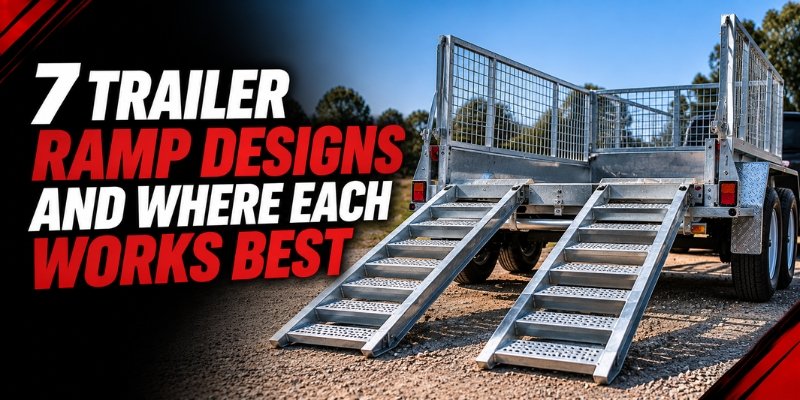
- Fixed or removable ramps
- A forklift
- A crane
- A tractor or loader
- A winch
- Equipment driven onto the deck
The loading method should be considered before the trailer configuration is selected.
For trailer designs developed specifically around machinery dimensions, loading angles and restraint requirements, explore Halco’s plant trailers.
Ramp requirements
Ramp length and angle affect whether machinery can be loaded without grounding, slipping or losing traction.
Equipment with low ground clearance may require a shallower loading angle. Heavy machinery requires ramps and mounting points suited to its actual weight.
Do not assume that a ramp is appropriate simply because the equipment fits on it. The ramp system, deck and complete trailer must all suit the load.
Equipment restraint
Machinery should be secured at suitable structural restraint points.
Hydraulic components, handles, guards or lightweight brackets may not be appropriate securing locations. Attachments may also require separate restraint if they can move during transport.
Centre of mass and load position
The position of heavy machinery affects trailer balance and towing behaviour.
A machine positioned too far forward or rearward can produce an unsuitable coupling load or reduce stability. The correct position depends on the machinery, trailer design and towing setup.
Flat Top Trailers Versus Box and Enclosed Trailers
Each trailer body style serves a different purpose.
Flat top versus box trailer
A flat top trailer provides an open deck, while a box trailer generally uses fixed sides to help contain cargo.
A flat deck may be more practical for pallets, machinery and irregular loads requiring side access. A box trailer may suit loose or general-purpose cargo that benefits from contained sides.
Compare Halco’s box trailers when fixed sides would be useful for the intended load.
Flat top versus enclosed trailer
An enclosed trailer uses a fixed roof and full-height walls.
It can help reduce exposure to weather, road debris and public visibility. A flat top trailer provides broader loading access but leaves the cargo exposed.
Explore Halco’s enclosed trailers when covered transport or controlled access is more important than open loading.
The basic distinction is:
- Flat top: open access and flexible loading
- Box: fixed sides for cargo containment
- Enclosed: covered transport and controlled access
Some operators may require different trailer types for separate transport tasks.
How Deck Dimensions Affect Trailer Use
Deck dimensions influence which loads can be positioned on a trailer, but size alone does not determine capacity.
Deck length
Additional length may accommodate long materials or larger equipment. It can also increase the trailer’s tare mass and affect manoeuvrability.
The load must be positioned so its weight is distributed appropriately rather than merely fitting within the deck outline.
Deck width
A wider deck may provide more usable space for machinery, materials or pallets.
Operators must still consider legal width requirements, towing conditions and the space available for loading and storage.
Deck height
Deck height influences ramp angle and loading effort.
A lower deck may assist with some equipment, while other applications may prioritise ground clearance or a different chassis arrangement.
Open loading access
Unlike a fixed-sided body, a flat deck does not impose the same side or overhead loading restrictions. This can be valuable when cargo is lifted into place or extends close to the usable deck width.
For verified design and option details, review Halco’s custom flat top trailer configurations.
ATM, Tare Mass and Payload
Three weight terms are important when assessing a trailer.
Tare mass
Tare mass is the mass of the completed trailer when it is not carrying cargo.
Permanent components and accessories contribute to tare mass, including ramps, toolboxes, headboards, hydraulic equipment and storage systems.
Aggregate Trailer Mass
Aggregate Trailer Mass, or ATM, is the total permitted mass of the trailer carrying its maximum manufacturer-specified load. It includes the mass acting through the trailer wheels and the mass imposed on the towing vehicle through the coupling.
The Australian Government defines ATM as the total mass of a laden trailer carrying the maximum load recommended by its manufacturer, including the mass imposed on the towing vehicle while the connected combination rests on a horizontal surface.
Payload
Payload is the remaining mass available for cargo after the completed trailer’s tare mass is deducted from its ATM.
Payload = ATM − tare mass
The Australian Government’s VSB 1 guidance confirms that ATM minus tare mass determines the maximum load a trailer can carry.
A larger deck does not automatically provide a larger payload. The completed tare mass and approved ATM determine the available cargo capacity.
The towing vehicle, towbar and coupling must also suit the actual loaded trailer.
Loading and Load-Restraint Considerations
An open deck gives broad access to the cargo, but it does not contain the load.
Every item must be restrained so it cannot move during acceleration, braking, cornering or travel over uneven roads.
Transport Victoria load-restraint guidance advises using restraint equipment and methods suited to the load. It recommends rated equipment where possible and checking the load and restraints regularly during travel.
The National Transport Commission also advises that a trailer load must be properly restrained, remain within mass limits, avoid dangerous overhang and not obscure lights, reflectors or the number plate.
Use suitable restraint equipment
The appropriate restraint method depends on the load’s:
- Weight
- Shape
- Surface
- Centre of mass
- Structural securing points
- Likely direction of movement
Rated webbing, chains, wheel supports, blocking or other equipment may be needed depending on the cargo.
Protect straps from sharp edges
Metal, timber and machinery edges can cut or damage webbing.
Use appropriate edge protection where required and inspect restraint equipment before use.
Check the load during travel
Restraints can settle after the trailer begins moving.
Stop in a safe place and inspect the load after the initial part of the journey and at suitable intervals, particularly on long trips or rough roads.
Restrain loose accessories
Ramps, attachments, tools, chains and packaging also need to be secured.
A small loose object can still leave the trailer, damage another road user or strike the transported equipment.
Limitations of Flat Top Trailers
A flat top trailer is not the right choice for every task.
Limited weather protection
Cargo remains exposed to rain, dust, sunlight and road spray unless additional protection is used.
A cover may help in some situations, but it must be secured so it cannot loosen, obstruct visibility or affect towing.
No fixed cargo containment
The open deck does not stop unsecured material or equipment from moving.
Loads that cannot be properly restrained may require a box body, cage or enclosed trailer.
Security considerations
Visible tools and equipment may attract unwanted attention when the trailer is parked.
Portable items should be removed where practical. Locks, secure storage and other theft-deterrence measures may also be needed.
Loading-space requirements
Side or overhead access is useful only when there is enough room around the trailer.
A forklift or crane may require more working space than is available at a narrow worksite or residential property.
Specialised cargo requirements
Some cargo requires ventilation, weather protection, temperature management or containment that an open deck cannot provide.
Choose the trailer according to the cargo rather than assuming that an open design is universally more flexible.
Pre-Use Flat Top Trailer Checklist
Before travelling, confirm that:
- The trailer is suitable for the intended load
- The actual cargo weight is known
- The towing vehicle and towbar are suitable
- Tyres appear serviceable
- Wheels and hubs show no obvious faults
- Lights and electrical connections operate correctly
- The coupling and safety connections are secure
- Ramps are secured for travel
- Cargo is positioned appropriately
- Restraints are rated and undamaged
- Loose tools and equipment are secured
- The load does not create unsafe overhang or obstruction
If a fault affects the brakes, bearings, tyres, coupling, chassis or drawbar, do not continue towing until the trailer has been assessed.
Is a Flat Top Trailer Right for Your Load?
A flat top trailer can provide practical loading flexibility for trades, farms and equipment operators. Its open deck may simplify side loading, overhead lifting and the transport of cargo that would be difficult to position within fixed walls.
The design also requires careful planning. Cargo remains exposed, every load needs suitable restraint, and deck size alone does not determine capacity.
Before selecting a configuration, confirm the cargo dimensions, weight, loading method, approved payload and towing setup.
To discuss verified dimensions, ramps, axle arrangements and available options, request a flat top trailer quote.