

By: Halco Trailers Team, Trailer Manufacturing / Safety Specialist
Published: 08/09/2026
Last updated: 08/09/2026
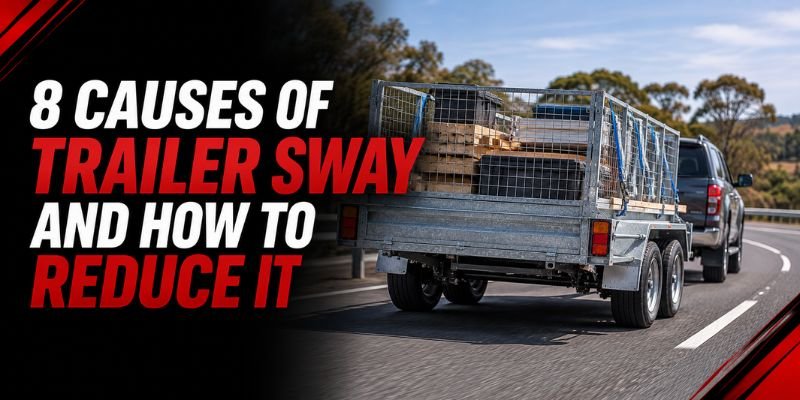
If you are wondering why does my trailer sway, the most common causes are poor load distribution, excessive speed, incorrect tyre pressure, crosswinds, unsuitable towing setup, worn suspension or coupling components, and sudden steering or braking. Correct loading and controlled driving can significantly reduce the risk.
Trailer sway, sometimes called fishtailing or snaking, happens when the trailer begins moving from side to side behind the tow vehicle. A small movement can sometimes settle quickly. A larger oscillation can become difficult to control, particularly at highway speeds or when towing a high-sided or heavily loaded trailer.
For tradies, landscapers, farmers, contractors and small businesses, sway is more than an uncomfortable towing experience. It can affect vehicle stability, load security, tyre wear and braking control.
This guide explains what causes trailer sway, how to recognise the warning signs and practical ways to reduce the risk.
What causes trailer sway?
Trailer sway is usually caused by an imbalance between the trailer, its load, the towing vehicle and road conditions. Common triggers include rear-heavy loading, excessive speed, incorrect tyre pressure, crosswinds, worn suspension, coupling problems, sudden manoeuvres and unsuitable towing limits.
The important point is that sway is rarely caused by one factor alone. A trailer with poor load distribution may feel stable at low speed but become unstable when a crosswind or passing truck adds another disturbance.
Ford Australia explains that trailer sway or snaking is usually associated with a poorly balanced trailer, although wind gusts and turbulence from large vehicles can also trigger it.
The 8 main causes
# | Cause | Why it can increase sway |
1 | Poor load distribution | Too much rear weight can reduce stability |
2 | Excessive speed | Higher speed can make oscillations harder to control |
3 | Incorrect tyre pressure | Uneven or unsuitable pressure can affect handling |
4 | Crosswinds | Side forces can push the trailer sideways |
5 | Passing heavy vehicles | Turbulence can temporarily disturb the trailer |
6 | Worn suspension or coupling components | Excess movement can affect tracking |
7 | Sudden steering or braking | Abrupt inputs can amplify trailer movement |
8 | Unsuitable towing setup | Incorrect capacity, balance or component selection can compromise stability |
Understanding the cause matters because the correct solution depends on what is actually creating the instability.
Does weight distribution cause trailer sway?
Yes, weight distribution can cause trailer sway when heavy items are positioned too far towards the rear or when the load is unevenly distributed. Keeping the load stable, appropriately positioned and within the trailer’s approved limits is fundamental to safer towing.
The National Transport Commission’s Load Restraint Guide states that the loaded centre of mass of a drawbar trailer should be in front of the centre of the axle group to minimise trailer sway. It also notes that the trailer coupling should place downward load on the towbar without exceeding the applicable ratings.
Transport Victoria similarly advises that loads should be positioned so they are stable and evenly distributed across the width and length of the trailer.
Loading mistakes that can increase sway
Loading mistake | Potential effect |
Heavy equipment placed at the rear | Can reduce stable coupling load |
Load concentrated on one side | Can affect balance |
Loose equipment | Can shift during braking or cornering |
Heavy items stacked high | Can raise the centre of gravity |
Load positioned beyond suitable limits | Can affect handling and axle loading |
Trailer overloaded | Can compromise braking, tyres and stability |
Poorly restrained machinery | Movement can change the trailer’s balance |
For a tradie carrying tools and equipment, keep heavy items low and appropriately positioned rather than allowing them to collect at the rear doors.
For a landscaper carrying soil, mulch or green waste, the load can change considerably during the trip. The trailer should still remain within its approved mass and be loaded so that the combination remains stable.
Can tyre pressure cause trailer sway?
Yes, incorrect tyre pressure can contribute to poor trailer handling and may make instability more difficult to control. Underinflation, overinflation, mismatched pressures, damaged tyres or tyres unsuitable for the trailer’s load can all affect tracking and stability.
Tyres are part of the trailer’s suspension and road-contact system. A tyre with insufficient pressure can flex excessively, generate heat and change how the trailer responds to steering and road movement.
Tyre checks before towing
Check | What to look for |
Pressure | Set according to the tyre, trailer and manufacturer’s requirements |
Sidewalls | No bulges, cuts or significant cracking |
Tread | Adequate tread and even wear |
Matching | Suitable tyres across the axle |
Load rating | Appropriate for the trailer’s expected load |
Temperature | Investigate unusual heat after towing |
Wear pattern | Uneven wear may indicate alignment or suspension problems |
Do not automatically increase or decrease pressure to solve sway. Use the pressure recommended for the particular tyre and trailer setup.
If one tyre repeatedly wears differently from the others, the problem may be suspension, axle alignment, braking or load distribution rather than pressure alone.
Does speed contribute to trailer sway at highway speeds?
Yes, speed can make trailer sway more difficult to control, particularly once an oscillation has started. Higher speed gives the trailer less time to settle and can make wind, road movement and steering inputs more significant.
This is why trailer sway at highway speeds deserves particular attention. A trailer that feels stable around town may behave differently at 90 or 100 km/h because aerodynamic forces and small steering movements become more influential.
Ford Australia recommends maintaining safe towing speeds, slowing in poor conditions and using smooth steering and braking techniques.
Conditions where speed deserves extra attention
- Open highways with strong crosswinds
- Bridges and exposed roads
- Long downhill sections
- Roads with uneven surfaces
- When being overtaken by trucks or buses
- When towing a high-sided trailer
- When the trailer is heavily loaded
- When towing an unfamiliar trailer
Never use increased speed to “push through” sway. If instability appears, the safer response is to reduce the conditions contributing to it without making abrupt steering or braking movements.
Can wind and passing trucks cause trailer sway?
Yes, crosswinds and turbulence from large vehicles can trigger trailer movement even when the trailer has been loaded correctly. High-sided trailers can be particularly exposed because their larger side area gives wind more opportunity to push against the trailer.
A strong gust on an open road can move the trailer sideways. When a truck approaches or passes, the pressure change can create another temporary disturbance.
Basic Trailers also identifies wind gusts, bridges, passing large vehicles, rough roads and downhill sections as potential trailer-sway triggers.
Common wind-related situations
Situation | Potential effect |
Strong side wind | Pushes trailer laterally |
Passing truck | Creates turbulence |
Open bridge | Exposes combination to crosswinds |
High-sided trailer | Larger surface area catches wind |
Empty cage trailer | Lightweight body can respond quickly to gusts |
Long downhill | Speed can increase while stability decreases |
Uneven road surface | Can initiate lateral movement |
Wind cannot always be avoided, but speed, load condition and smooth driving can be managed.
Can suspension, tyres or coupling problems cause sway?
Yes, worn or damaged trailer components can contribute to poor tracking and unstable towing. Suspension wear, uneven tyres, axle alignment problems, loose coupling components, damaged wheels or excessive movement should be inspected rather than treated as normal trailer behaviour.
A trailer should follow the tow vehicle predictably. If the trailer begins wandering, bouncing excessively or changing direction under load, the cause may be mechanical rather than simply the way it was loaded.
Mechanical components worth checking
Component | Potential problem |
Suspension springs | Sagging, cracking or fatigue |
Shackles and bushes | Excess movement or wear |
Axles | Misalignment or damage |
Wheel bearings | Excess play or overheating |
Tyres | Uneven wear, pressure or damage |
Wheels | Damage or loose wheel hardware |
Coupling | Wear, incorrect fit or poor locking |
Drawbar | Structural damage or fatigue |
Brakes | Uneven braking or poor adjustment |
This is where regular trailer servicing becomes important. Halco’s current servicing information covers running-gear inspections, brakes, bearings, electrical systems, structural faults and related trailer components.
If sway has appeared recently on a trailer that previously towed normally, do not assume the problem is simply your driving. A mechanical inspection may reveal a worn or damaged component.
Can sudden braking or steering cause a trailer to sway?
Yes, sudden braking, steering or lane changes can increase trailer movement. Abrupt inputs can transfer forces through the tow vehicle and trailer quickly, making an existing oscillation worse and reducing the driver’s time to respond.
Smooth driving is particularly important when towing heavy equipment, machinery, building materials or other loads with a high centre of gravity.
Driving habits that reduce instability
- Brake progressively where conditions allow.
- Avoid unnecessary sharp steering movements.
- Allow additional following distance.
- Enter corners at an appropriate speed.
- Reduce speed before steep downhill sections.
- Leave room for wider turning paths.
- Avoid aggressive lane changes.
- Be especially cautious around trucks and buses.
- Slow down in strong crosswinds.
- Do not make rapid steering corrections if sway begins.
Basic Trailers notes that sudden braking and unexpected changes of direction can increase the difficulty of controlling a swaying trailer.
Can an unsuitable trailer or towing setup increase sway?
Yes, an unsuitable trailer and towing combination can increase stability risks. The trailer, load, tow vehicle, coupling, towbar, tyres, brakes and suspension all need to be appropriate for the intended application and within their approved ratings.
A trailer should not be selected based only on deck size. A larger trailer may have more capacity, but the complete combination still needs to work with the tow vehicle and the actual load.
Ford Australia recommends staying within towing, GVM and GCM limits and notes that weight distribution affects braking, handling and stability.
Check the complete towing combination
Area | What to confirm |
Trailer rating | Actual load remains within approved limits |
Tow vehicle | Rated for the intended trailer and load |
Towbar | Correct rating for the application |
Coupling | Suitable rating and secure connection |
Brakes | Appropriate system and functioning correctly |
Tyres | Correct size, rating and condition |
Suspension | Suitable for the working load |
Load | Properly positioned and restrained |
Nose/tow-ball load | Within relevant manufacturer limits |
Dimensions | Suitable for the towing vehicle and road requirements |
Halco’s current trailer range includes tandem, flat-top, tradesman, plant, hydraulic tipper and other configurations, with the complete chassis, suspension, tyres, brakes and coupling needing to suit the intended application.
How to stop trailer sway when it starts
If sway begins, the priority is to avoid making abrupt steering or braking inputs. Ease off the accelerator, keep steering controlled and allow the combination to settle while reducing speed safely. If the problem continues, stop in a safe location and investigate before continuing.
The exact response depends on the vehicle and trailer combination, including whether the tow vehicle has a manufacturer-provided trailer-sway-control system.
What to do
- Stay calm: panic steering can make oscillation worse.
- Keep the steering controlled: avoid rapid left-right corrections.
- Ease off the accelerator: allow speed to reduce progressively.
- Avoid sudden braking: unless required to prevent an immediate collision.
- Keep a safe road position: maintain control and avoid unnecessary lane changes.
- Reduce speed safely: let the combination settle.
- Stop when practical: choose a safe location away from traffic.
- Inspect the cause: check load distribution, tyres, coupling and obvious damage.
- Do not continue with a serious fault: arrange inspection or recovery if necessary.
Ford Australia’s towing guidance similarly recommends easing off the throttle if sway starts rather than making abrupt inputs.
If the trailer repeatedly sways despite correct loading and careful driving, treat that as a reason for mechanical inspection.
8 trailer sway prevention tips
The most effective trailer sway prevention tips combine correct loading, suitable towing equipment, tyre maintenance, appropriate speed, smooth driving and regular inspection. No single accessory or driving technique can compensate for an incorrectly loaded or mechanically defective trailer.
1. Load heavy items appropriately
Keep heavy equipment low and positioned according to the trailer’s design and approved loading requirements. Avoid placing unnecessary weight at the extreme rear.
2. Restrain the load properly
A load that moves can change the trailer’s balance during acceleration, braking and cornering. Use suitable restraints for the load.
Transport Victoria specifically advises that loads should be stable and evenly distributed across the trailer.
3. Check tyre pressure
Check tyres before towing rather than relying on how they look. Inspect for damage, unusual wear and incorrect pressure.
4. Keep within approved mass limits
Do not exceed trailer, axle, towbar or vehicle ratings. Overloading can affect handling, braking, suspension and tyres.
5. Reduce speed when conditions change
Strong winds, wet roads, downhill sections and passing heavy vehicles all justify greater caution.
6. Service the running gear
Regularly inspect brakes, bearings, suspension, coupling, tyres, wheels and other safety-critical components.
7. Avoid sudden manoeuvres
Smooth acceleration, braking and steering give the combination a better chance of remaining stable.
8. Choose the right trailer
Match the trailer to the actual job. A tradesman trailer carrying organised tools is a different application from a plant trailer carrying machinery or a flat-top trailer carrying pallets and equipment.
When should you inspect or repair a trailer that sways?
A trailer should be inspected if sway is new, repeated, severe or occurs despite correct loading and appropriate driving. Trailer repair may be required when inspection identifies worn suspension, damaged tyres, coupling wear, axle problems, brake faults, loose wheel hardware or structural damage.
Do not simply add more weight to the front of the trailer to make it feel stable. That may create a different loading problem and could exceed the coupling, towbar or axle limits.
Stop and inspect if you notice
Symptom | Why it matters |
Sway starts at a lower speed than usual | Trailer behaviour may have changed |
Trailer pulls sideways | Could indicate tyres, brakes, suspension or alignment |
One tyre wears quickly | Possible alignment or suspension issue |
Coupling feels loose | Connection requires inspection |
Suspension clunks | Bushes, shackles or springs may be worn |
Trailer bounces excessively | Suspension may not be controlling movement correctly |
Wheels feel unusually hot | Brake or bearing problem may exist |
Visible cracks or damage | Structural inspection required |
Sway continues after correcting loading | Mechanical or setup issue may remain |
Halco advises customers not to tow trailers when the condition of brakes, wheels, bearings, coupling, tyres, chassis or drawbar may make transport unsafe, and provides repair and servicing support from its Warragul workshop.
For businesses, early inspection can also prevent a sway-related fault from becoming a larger trailer repair problem during a busy work period.
How do different trailer types respond to sway risk?
Different trailer types can experience sway for different practical reasons because their loads, dimensions and applications vary. A tandem trailer, tradesman trailer and flat-top trailer should each be loaded and operated according to their intended use rather than treated as interchangeable.
Trailer type comparison
Trailer type | Common sway consideration |
Tandem trailers | Heavier loads, axle load sharing and tyre condition need attention |
Tradesman trailers | Tool storage can create uneven side-to-side or front-to-rear loading |
Flat-top trailers | Machinery and pallets require careful positioning and restraint |
Plant trailers | Concentrated machinery loads can strongly affect balance |
Hydraulic tipper trailers | Loose materials can shift as loading conditions change |
Enclosed trailers | Larger side area can be affected by crosswinds |
Box trailers | General cargo must remain evenly distributed |
Tiny-home chassis | Large, high or changing loads require careful engineering and loading |
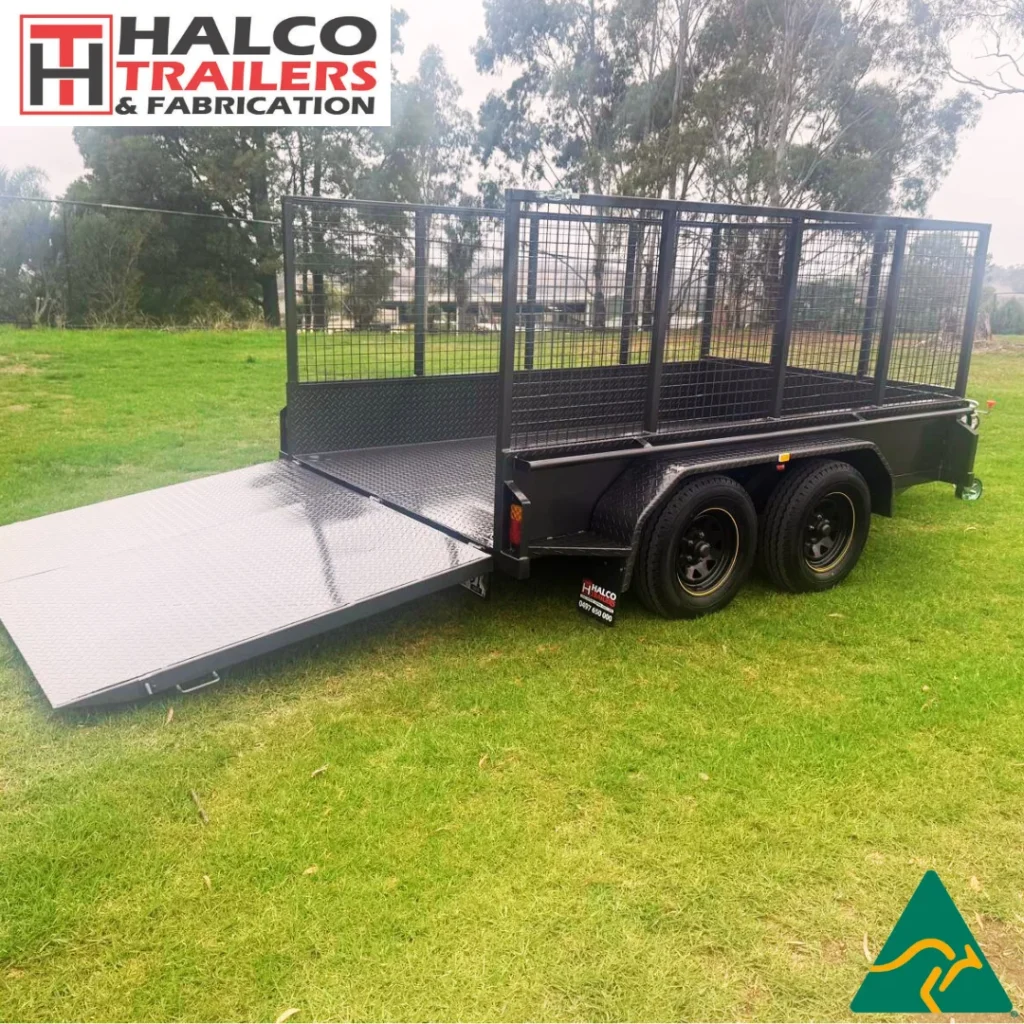
Halco’s tandem trailers are available for commercial transport, construction, landscaping, machinery, farming and other heavy-duty applications. Its tradesman trailers are designed around organised tool storage and worksite access, while its flat-top trailers provide open loading access for machinery, pallets and building materials.
The correct configuration depends on the complete combination, not simply the number of axles or trailer body style.
Conclusion
If you are asking why does my trailer sway, start with the basics: check the load, tyre pressure, speed, coupling, suspension, brakes and towing limits. Wind, passing trucks and sudden driving inputs can then add to an already unstable combination.
Knowing how to stop trailer sway is useful, but preventing it is better. Load correctly, restrain equipment, keep tyres and running gear maintained, stay within approved limits and adjust your driving for road and weather conditions.
If your trailer has started swaying when it previously towed normally, do not ignore the change. Arrange an inspection before the next loaded trip.