

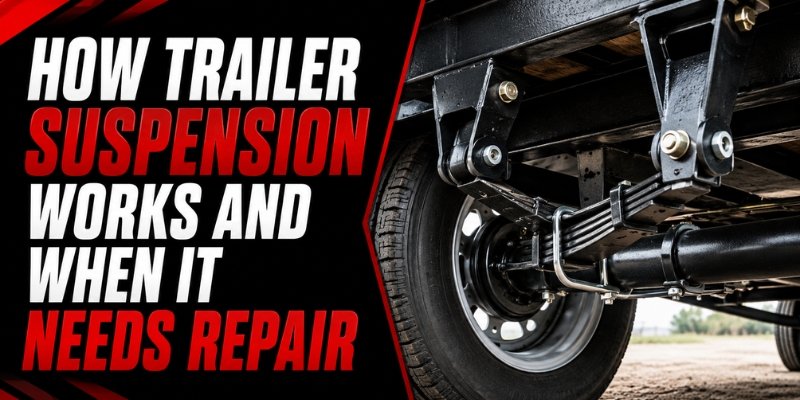
Trailer suspension problems usually show as leaning, bouncing, clunking, uneven tyre wear, poor tracking, sagging springs or axle movement. Stop loaded towing if the trailer feels unstable, then inspect springs, shackles, bushes, hangers, axles and tyres.
A trailer suspension fault can start quietly. One tyre wears on the inside edge. A loaded trailer sits slightly lower on one side. A tandem trailer clunks over site entrances. A plant trailer starts scrubbing tyres after carrying the same machine for months.
This guide focuses on practical trailer suspension problems, how the system works, which symptoms matter, when trailer suspension repair is needed and when a workshop should inspect the complete running gear.
What trailer suspension problems should owners notice first?
The earliest suspension issues are often uneven tyre wear, a trailer sitting low on one side, clunks over bumps, poor tracking, extra bounce, cracked springs, worn bushes, loose hangers or visible axle movement after heavy towing.
Suspension faults are easy to miss because the trailer may still tow. That does not mean it is safe under load. A trailer can move from “slightly noisy” to “unsafe” quickly once a spring cracks, a hanger loosens or a bush wears through.
Early symptom table
Warning sign | What it may suggest | Safer next step |
Trailer leans to one side | Sagging spring, broken leaf, bent axle or uneven load | Check load first, then inspect suspension |
Uneven tyre wear | Axle alignment, bush wear, bent component or overload | Do not replace tyres only; find the cause |
Clunking over bumps | Worn shackles, bushes, hangers or loose bolts | Book inspection before loaded towing |
Excessive bounce | Weak springs, failed shocks or poor load control | Inspect suspension and load balance |
Trailer tracks sideways | Bent axle, worn suspension or chassis issue | Stop heavy towing and check running gear |
Tyre rubbing guard | Sagging spring, overload or clearance issue | Stop before tyre damage worsens |
Visible cracked spring | Metal fatigue or overload | Do not tow loaded |
Loose U-bolts | Axle movement risk | Tightening may not be enough; inspect hardware |
Rust around mounts | Corrosion and possible fatigue | Check brackets, hangers and chassis section |
Load shifts more than usual | Weak suspension or poor restraint | Check suspension and load restraint together |
A realistic example is a landscaper towing mulch, soil and tools every week. The trailer begins to sit lower on the driver’s side. The tyre then starts wearing on the inside edge. Replacing the tyre alone may hide the symptom, but the spring, bush or axle issue remains.
How does trailer suspension work under load?
Trailer suspension supports the trailer’s weight, keeps tyres in contact with the road and absorbs movement from bumps, braking and cornering. It also helps distribute load through springs, axles, hangers, shackles, bushes and wheels safely.
The suspension is part of the running gear. It works with the axle, hubs, bearings, wheels, tyres, brakes, chassis and load position. If one part wears, the rest of the system can start carrying stress it was not meant to carry.
According to the Department of Infrastructure’s Vehicle Standards Bulletin 1, known as VSB 1, an axle group can include single, tandem or tri-axle arrangements, and load-sharing suspension must be designed so each axle in the group carries the same load regardless of relative wheel movement.
What each suspension part does
Part | Role | Common problem |
Leaf spring | Supports load and flexes over bumps | Cracking, flattening, rust, sagging |
Slipper spring | Supports load with one sliding end | Wear at slipper end, noise, poor tracking |
Rocker / equalizer | Helps share load between tandem axles | Worn pivots, poor weight distribution |
Shackle | Connects spring movement points | Elongated holes, loose fit, clunks |
Bush | Absorbs movement between metal parts | Wear, cracking, metal-on-metal noise |
Hanger | Mounts spring hardware to chassis | Cracks, rust, bending, loose welds |
U-bolts | Clamp axle to spring assembly | Stretching, looseness, axle movement |
Axle | Carries wheels and load through suspension | Bending, misalignment, tyre scrub |
Shock absorber | Controls bounce where fitted | Leaks, poor rebound, continued bouncing |
Chassis mount | Transfers suspension loads into frame | Cracks, fatigue, corrosion |
A trailer that carries the same weight every week can still develop suspension wear because every pothole, driveway lip, farm track and hard stop pushes load through these parts.
What causes suspension faults on work trailers?
Work trailers develop suspension faults from overloading, poor weight balance, potholes, corrugations, farm tracks, construction sites, corrosion, worn bushes, loose hardware and repeated heavy braking. These conditions stress springs, axles, hangers and chassis mounting points.
Tradies and contractors often think in terms of payload only. Suspension wear is more practical than that. The same load can affect the trailer differently depending on where it sits, how often it moves, whether the trailer is braked correctly and what roads it travels.
According to the National Transport Commission’s Load Restraint Guide for Light Vehicles, loads must be properly restrained, not exceed mass limits, not overhang dangerously and not cover lights, indicators, reflectors or number plates. Poor load control can make suspension problems worse because the trailer is being stressed unevenly.
Common cause and effect table
Cause | Suspension effect | Example |
Overloading | Sagging springs, heat, tyre wear | Soil loaded above practical working limit |
Rear-heavy loading | Poor tracking and unstable tow-ball weight | Machinery positioned too far back |
Side-heavy loading | Leaning, uneven tyre wear | Tools or equipment stored on one side |
Rough worksites | Loose shackles, hanger fatigue | Building sites, driveways, gravel yards |
Farm and paddock use | Shock loading and corrosion | Fencing gear, feed, rural tracks |
Corrosion | Weak springs, hangers and bolts | Outdoor storage, coastal air, mud |
Worn bushes | Clunks, axle shift and tyre scrub | Tandem trailer used daily |
Loose U-bolts | Axle movement and poor tracking | After heavy impact or repeated vibration |
Poor previous repair | Repeat failure | Incorrect spring rating or poor fitment |
Wrong trailer for the job | Chronic suspension stress | Light trailer used for machinery loads |
A farmer carrying fencing posts over paddock tracks, or a builder moving pallets and equipment between sites, may wear suspension faster than a homeowner towing garden waste on sealed roads.
How do leaf springs, slipper springs, rocker suspension and torsion axles differ?
Common trailer suspension types behave differently under load. Leaf and slipper spring systems are simple and tough, rocker systems help tandem load sharing, and torsion axles use rubber inside the axle beam for independent wheel movement.
Choosing suspension is not only about ride comfort. It affects load sharing, repair cost, tyre wear, ramp height, ground clearance, long-term maintenance and how the trailer handles regular work conditions.
Suspension type | How it works | Best suited to | Watch-outs |
Eye-to-eye leaf spring | Spring fixed through eyes at both ends | General box and work trailers | Bush and shackle wear |
Slipper spring | One end fixed, one end slides | Heavy-duty simple trailer setups | Noise and slipper-end wear |
Rocker roller / equalized tandem | Connects tandem springs through a rocker system | Tandem trailers and heavier work loads | Equalizer and bush wear |
Torsion axle | Rubber inside axle tube provides suspension movement | Some light, boat or custom trailers | Harder to repair in parts |
Drop axle setup | Axle layout helps lower deck or loading height | Plant trailer and machinery access | Ground clearance and impact risk |
Independent suspension | Each wheel moves more independently | Some caravan or specialty builds | Higher complexity and cost |
For tandem trailers, the key issue is load sharing. VSB 1 says load-sharing suspension must be designed so each axle in a group carries the same load irrespective of vertical axle movement. That is why worn equalizers, bushes and spring hardware can affect more than ride comfort.
When do suspension symptoms mean stop towing?
Stop towing when suspension symptoms affect control, wheel position, ride height or tyre contact. A cracked spring, shifted axle, dragging tyre, broken hanger, severe lean or loud metal-on-metal noise should be inspected before road use.
Do not keep towing because the destination is close. A suspension failure can quickly become a tyre failure, brake issue, axle movement problem or loss of control, especially with tools, machinery, soil, stock equipment or vehicle transport loads.
Stop-towing decision table
Symptom | Why it is serious | What to do |
Broken spring leaf | Load support is compromised | Stop loaded towing |
Trailer leaning heavily | Load may not be supported evenly | Inspect before road use |
Tyre rubbing guard or chassis | Tyre damage can escalate fast | Stop and correct clearance |
Loud metal-on-metal clunk | Bush, shackle or hanger may have failed | Arrange workshop inspection |
Axle appears shifted | Wheels may not track correctly | Do not tow loaded |
U-bolts loose or missing | Axle can move on the spring | Stop and repair |
Cracked hanger or chassis mount | Structural attachment is compromised | Do not continue road towing |
Severe tyre scrub | Alignment or axle geometry is wrong | Inspect before replacing tyres |
Trailer sways despite correct loading | Suspension or axle issue may exist | Stop heavy towing |
Suspension bottoms out | Springs may be overloaded or worn | Reduce load and inspect |
For structural faults, Halco’s trailer repair support is a safer pathway than tightening visible bolts and hoping the rest of the system is fine.
How can owners inspect trailer suspension before a trip?
Owners can inspect suspension before towing by checking ride height, spring shape, shackles, bushes, U-bolts, hangers, tyres, wheel clearance and visible cracks. This takes minutes and can prevent unsafe loaded towing or roadside failure later.
A pre-trip check does not replace workshop servicing, but it does catch obvious danger signs before road speed and load expose them.
10-minute trailer suspension inspection
- Park on level ground: uneven ground can hide leaning, sagging or poor ride height.
- Stand back and compare both sides: one side sitting lower can point to spring, axle or load-balance trouble.
- Check spring shape and condition: cracked, flattened, separated or heavily rusted springs need inspection.
- Look at shackles and bushes: worn holes, movement and missing rubber can create clunks and tyre scrub.
- Inspect U-bolts and axle seats: loose or shifted hardware can let the axle move under the trailer.
- Check hangers and chassis mounts: rust trails, cracks or bent brackets are warning signs.
- Look at tyre wear patterns: inner-edge wear, feathering or cupping often points beyond the tyre itself.
- Check clearance around tyres and guards: rubbing marks show the trailer may be sagging or overloaded.
- Listen during a low-speed test: clunks, squeaks and harsh bangs should not be ignored.
- Recheck after rough worksites: corrugations, paddock travel and building sites loosen hardware quickly.
Transport Victoria’s roadworthiness requirements include steering and suspension, wheels and tyres, brakes, body and chassis, towing couplings and electrical wiring within the general inspection standards for roadworthiness. That supports the practical approach of checking the trailer as a connected system, not only one visible part.
How does trailer suspension repair differ from replacement or upgrade?
Trailer suspension repair fixes worn or damaged parts when the design still suits the job. Replacement restores failed components, while an upgrade is needed when regular loads, machinery or road conditions exceed the current setup.
Repair is right when the trailer’s original configuration still matches its real workload. Upgrade becomes smarter when the same fault keeps returning or the trailer is being pushed beyond its practical design.
Situation | Best action | Example |
Loose shackle bolt | Repair and inspect related wear | Clunking after rough jobsite use |
Worn bushes | Replace bushes and check hardware | Metal-on-metal movement |
Cracked spring | Replace spring and inspect axle alignment | Trailer leaning under load |
Bent axle | Replace or specialist repair after diagnosis | Severe tyre scrub |
Rusted hanger | Repair mount and inspect chassis | Corrosion around spring bracket |
Repeated spring failure | Review load, rating and setup | Same side fails every season |
Trailer used for heavier loads than planned | Upgrade or choose a more suitable trailer | Machinery now heavier than original use |
Old trailer with multiple running-gear issues | Repair-vs-replacement review | Springs, tyres, bearings and brakes all worn |
When trailer suspension problems keep returning after basic repairs, the real issue may be load rating, axle position, trailer type or business use rather than one failed component.
Halco’s trailer suspension inspection support includes applicable axles, springs, mounting points, hubs, suspension hardware and related running-gear components from its Warragul workshop. The full running gear should be assessed before any axle or suspension repair is confirmed.
How often should work trailer suspension be serviced?
Work trailer suspension should be checked before loaded towing and professionally inspected on a use-based schedule. Daily trade, landscaping, farm, plant and tandem trailers need shorter intervals than occasional domestic trailers used a few times yearly.
A time-only schedule is not enough. Usage, terrain, load weight, wet conditions, storage and business reliance should determine how often you inspect and service the suspension.
Suspension service frequency guide
Trailer use | Owner check | Workshop inspection |
Occasional household trailer | Before every tow | Annually or before major trips |
Regular tradie trailer | Weekly and before heavy loads | Every 6 to 12 months depending on use |
Landscaping trailer | Before loaded runs | Before peak season and after heavy wet loads |
Farm trailer | Before road towing | After paddock use, storage or heavy loads |
Tandem work trailer | Before loaded towing | More often if tyres, bushes or springs show wear |
Plant trailer | Before every machine move | Scheduled by machine mass, distance and site conditions |
Car trailer | Before each transport job | Before long-distance towing or commercial use |
Stored trailer | Before reuse | Before road towing after months unused |
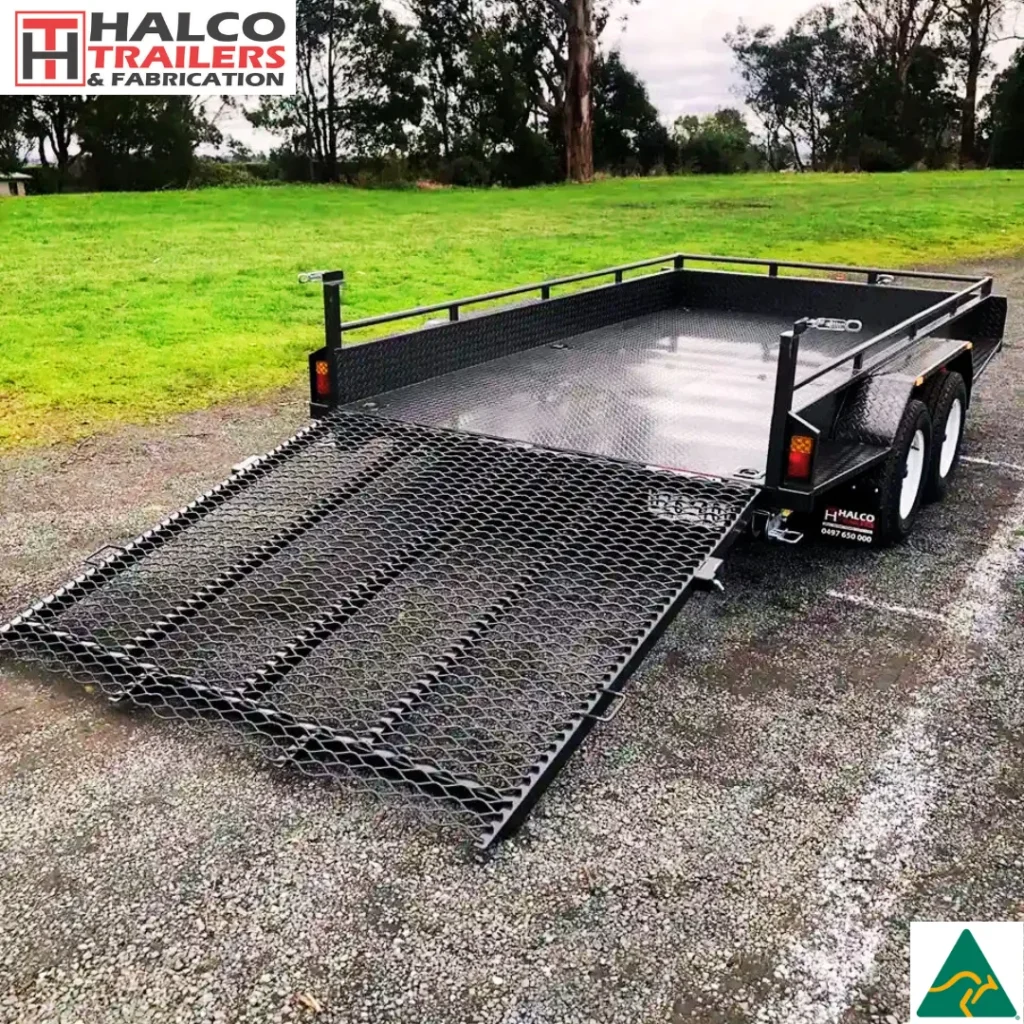
Halco’s plant trailer page notes that plant trailers can be configured around machinery dimensions, mass, ramp style, axle, suspension and braking requirements. That is important because machinery transport places concentrated loads through suspension and axle components.
What should buyers check before buying a used trailer?
Used trailer buyers should inspect suspension before checking cosmetics. Uneven ride height, tyre scrub, bent axles, rusty springs, cracked hangers or loose bushes can turn a cheap trailer into an expensive repair project very quickly.
A used trailer can look freshly painted while the running gear is tired. Paint hides rust for a while; it does not fix spring fatigue, worn bushes, bent axles or poor load rating.
Used trailer suspension checklist
Check | What to look for |
Ride height | Trailer sits level on flat ground |
Spring condition | No cracks, broken leaves, severe flattening or rust-through |
Shackles and bushes | No excessive movement, elongation or metal-on-metal contact |
Hangers | No cracking, poor welding, bending or rust trails |
U-bolts | Tight, even and not heavily corroded |
Axle position | Wheels sit square and track straight |
Tyres | Even wear across both sides and all wheels |
Chassis mounts | No cracks around spring attachment areas |
Brake and bearing overlap | Heat, wobble or rumble may mimic suspension issues |
Load rating | Suspension suits the buyer’s real load, not just the seller’s claim |
Repair history | Invoices show what was replaced and when |
Test tow | No clunking, swaying, tracking sideways or harsh bouncing |
For customers comparing heavier trailers, Halco’s tandem trailers page explains that tandem axle trailers support the load across four wheels and are commonly selected for heavier transport requirements, improved stability and better load distribution.
How much can trailer suspension repair cost in Australia?
Trailer suspension costs depend on trailer size, axle count, spring type, hardware condition, rust, labour access and whether tyres, bearings, brakes or chassis mounts also need attention. Accurate pricing should follow inspection, not guesswork first.
Suspension repair is difficult to price without seeing the trailer because the visible symptom may not be the root cause. A worn tyre may come from alignment. A clunk may come from bushes. A leaning trailer may come from spring fatigue, bent hardware or incorrect loading.
Cost factor table
Cost factor | Why it changes the repair |
Single axle vs tandem axle | Tandem setups have more springs, bushes and load-sharing parts |
Spring type | Slipper, rocker and torsion setups require different parts |
Rust and corrosion | Seized hardware increases labour and replacement scope |
Axle condition | Bent or shifted axles add diagnosis and repair complexity |
Tyre damage | Uneven wear may require tyre replacement after repair |
Bearing and hub condition | Running-gear faults often overlap |
Brake system proximity | Brake lines, wiring or drums may need protection or removal |
Chassis mount condition | Cracked mounts can become structural work |
Parts availability | Standard parts are easier than unusual or older setups |
Commercial urgency | Faster turnaround depends on workshop capacity and parts supply |
For businesses, the cheapest repair is usually the one booked early. A suspension issue found during trailer servicing is easier to manage than a broken spring on a loaded weekday job.
Conclusion
Fix trailer suspension problems early because leaning, clunking, bouncing and tyre scrub can quickly become tyre, axle, brake or chassis damage.
For trailer owners across Warragul, Melbourne, Gippsland and regional Victoria, Halco Trailers can inspect suspension, axles, springs, hubs, tyres, brakes and related running gear. If your trailer sits unevenly, tracks poorly or makes noise under load, book an inspection before the next work trip.